


Experience using liver transplantation for the treatment of severe bile duct injuries over 20 years in Argentina: results from a National Survey
- PMID: 21762297
- PMCID: PMC3163276
- DOI: 10.1111/j.1477-2574.2011.00322.x
Experience using liver transplantation for the treatment of severe bile duct injuries over 20 years in Argentina: results from a National Survey
Abstract
Background: Bile duct injury (BDI) is a severe complication that may arise during the surgical treatment of benign disease and a few patients will develop end-stage liver disease (ESLD) requiring a liver transplant (LT).
Objective: Analyse the experience using LT as a definitive treatment of BDI in Argentina.
Patients and methods: A national survey regarding the experience of LT for BDI.
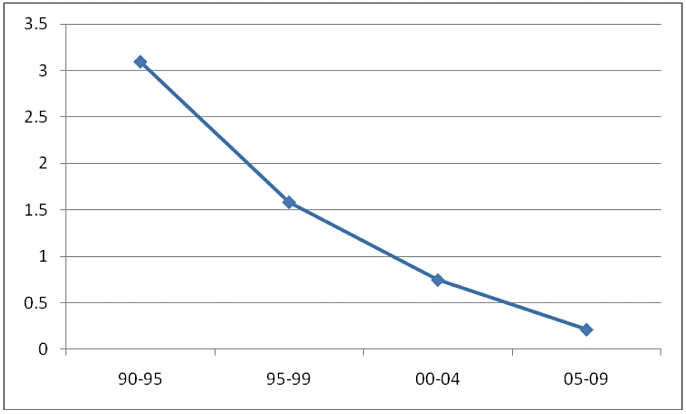
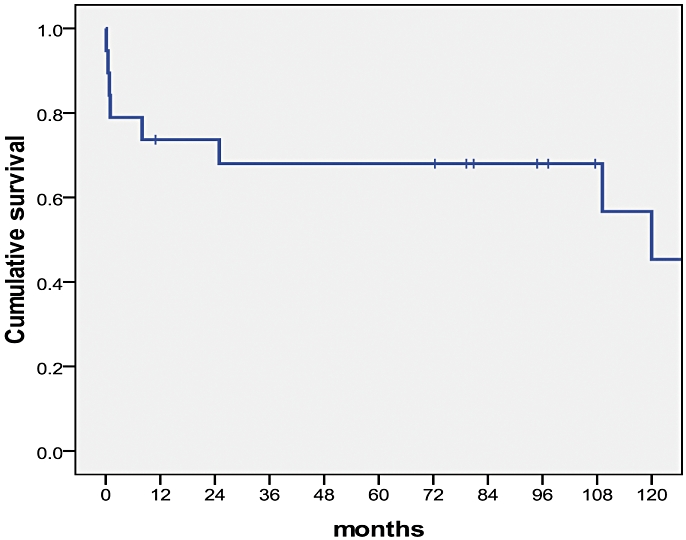
Results: Sixteen out 18 centres reported a total of 19 patients. The percentage of LT for BDI from the total number of LT per period was: 1990-94 = 3.1%, 1995-99 = 1.6%, 2000-04 = 0.7% and 2005-09 = 0.2% (P < 0.001). The mean age was 45.7 ± 10.3 years (range 26-62) and 10 patients were female. The BDI occurred during cholecystectomy in 16 and 7 had vascular injuries. One patient presented with acute liver failure and the others with chronic ESLD. The median time between BDI and LT was 71 months (range 0.2-157). The mean follow-up was 8.3 years (10 months to 16.4 years). Survival at 1, 3, 5 and 10 years was 73%, 68%, 68% and 45%, respectively.
Conclusions: The use of LT for the treatment of BDI declined over the review period. LT plays a role in selected cases in patients with acute liver failure and ESLD.
© 2011 International Hepato-Pancreato-Biliary Association.
Figures
References
-
- de Santibañes E, Ardiles V, Gadano A, Palavecino M, Pekolj J, Ciardullo M. Liver transplantation: the last measure in the treatment of bile duct injuries. World J Surg. 2008;32:1714–1721. - PubMed
-
- Zaydfudim V, Wright JK, Pinson CW. Liver transplantation for iatrogenic porta hepatis transection. Am Surg. 2009;75:313–316. - PubMed
-
- Loinaz C, González EM, Jiménez C, García I, Gómez R, González-Pinto I, et al. Long-term biliary complications after liver surgery leading to liver transplantation. World J Surg. 2001;25:1260–1263. - PubMed
-
- Vicente E, Meneu JC, Hervás PL, Nuño J, Quijano Y, Devesa M, et al. Management of biliary duct confluence injuries produced by hepatic hydatidosis. World J Surg. 2001;25:1264–1269. - PubMed
Publication types
MeSH terms
LinkOut - more resources
Full Text Sources
Medical
