


Chronic neuropathic pain in mice reduces μ-opioid receptor-mediated G-protein activity in the thalamus
- PMID: 21762883
- PMCID: PMC3159154
- DOI: 10.1016/j.brainres.2011.06.023
Chronic neuropathic pain in mice reduces μ-opioid receptor-mediated G-protein activity in the thalamus
Abstract
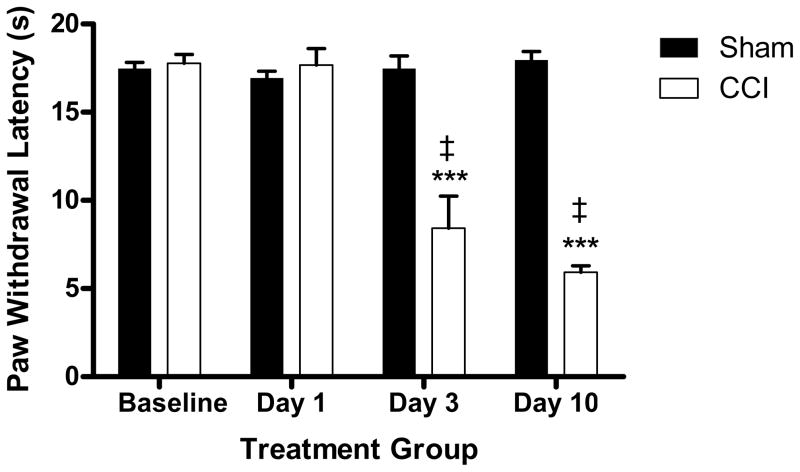
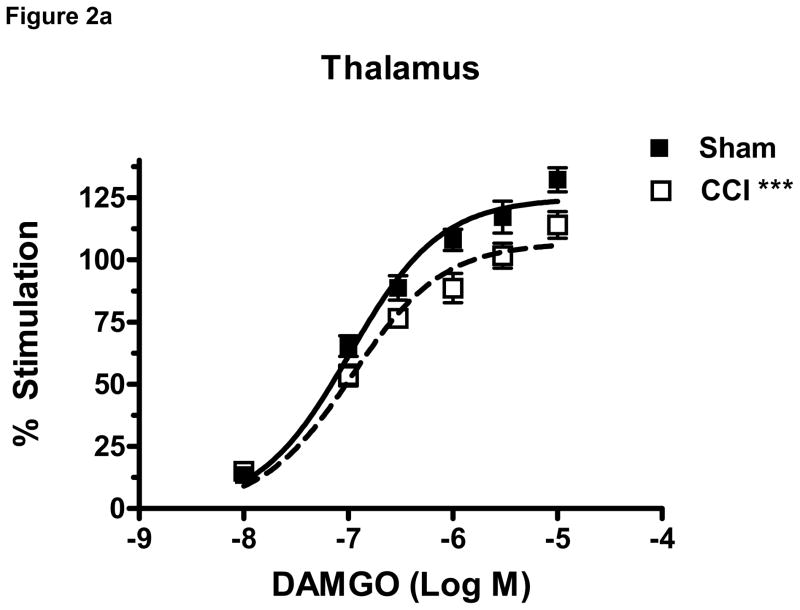
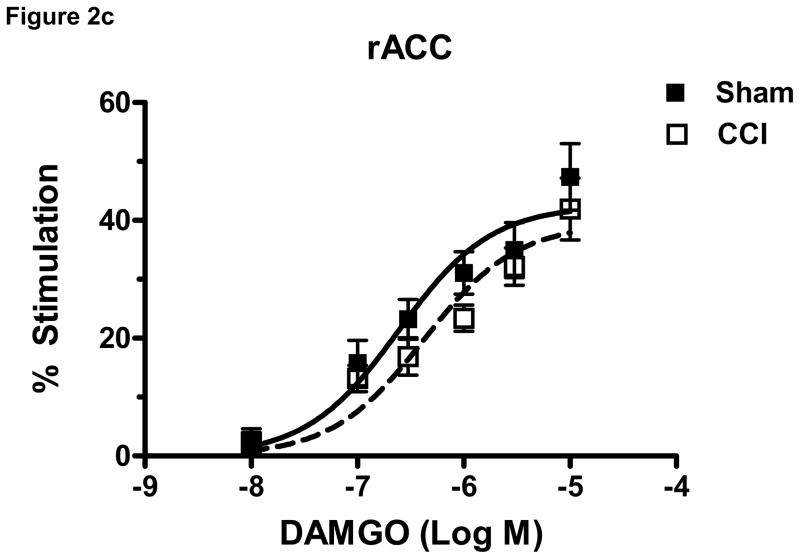
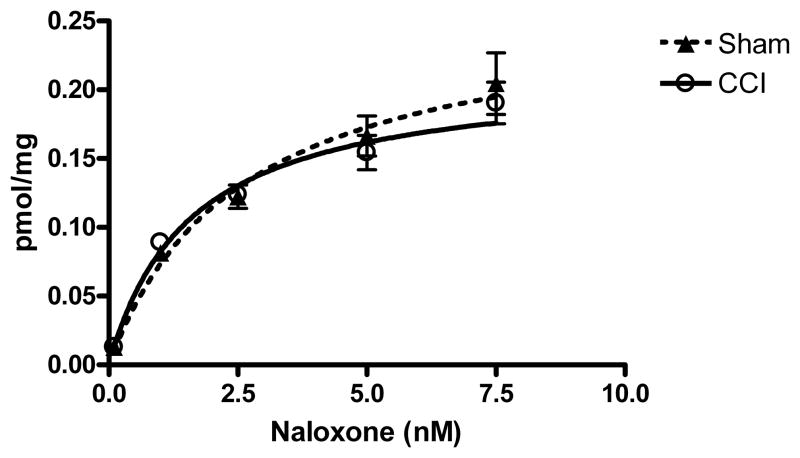
Neuropathic pain is a debilitating condition that is often difficult to treat using conventional pharmacological interventions and the exact mechanisms involved in the establishment and maintenance of this type of chronic pain have yet to be fully elucidated. The present studies examined the effect of chronic nerve injury on μ-opioid receptors and receptor-mediated G-protein activity within the supraspinal brain regions involved in pain processing of mice. Chronic constriction injury (CCI) reduced paw withdrawal latency, which was maximal at 10 days post-injury. [d-Ala2,(N-Me)Phe4,Gly5-OH] enkephalin (DAMGO)-stimulated [(35)S]GTPγS binding was then conducted at this time point in membranes prepared from the rostral ACC (rACC), thalamus and periaqueductal grey (PAG) of CCI and sham-operated mice. Results showed reduced DAMGO-stimulated [(35)S]GTPγS binding in the thalamus and PAG of CCI mice, with no change in the rACC. In thalamus, this reduction was due to decreased maximal stimulation by DAMGO, with no difference in EC(50) values. In PAG, however, DAMGO E(max) values did not significantly differ between groups, possibly due to the small magnitude of the main effect. [(3)H]Naloxone binding in membranes of the thalamus showed no significant differences in B(max) values between CCI and sham-operated mice, indicating that the difference in G-protein activation did not result from differences in μ-opioid receptor levels. These results suggest that CCI induced a region-specific adaptation of μ-opioid receptor-mediated G-protein activity, with apparent desensitization of the μ-opioid receptor in the thalamus and PAG and could have implications for treatment of neuropathic pain.
Copyright © 2011 Elsevier B.V. All rights reserved.
Figures

References
-
- Beyer A, Koch T, Schroder H, Schulz S, Hollt V. Effect of the A118G polymorphism on binding affinity, potency and agonist-mediated endocytosis, desensitization, and resensitization of the human mu-opioid receptor. J Neurochem. 2004;89:553–60. - PubMed
-
- Bradford MM. A rapid and sensitive method for the quantitation of microgram quantities of protein utilizing the principle of protein-dye binding. Anal Biochem. 1976;72:248–54. - PubMed
-
- Bragin EO, Yeliseeva ZV, Vasilenko GF, Meizerov EE, Chuvin BT, Durinyan RA. Cortical projections to the periaqueductal grey in the cat: a retrograde horseradish peroxidase study. Neurosci Lett. 1984;51:271–5. - PubMed
-
- Carr KD, Bak TH. Medial thalamic injection of opioid agonists: mu-agonist increases while kappa-agonist decreases stimulus thresholds for pain and reward. Brain Res. 1988;441:173–84. - PubMed
-
- Chang C, Shyu BC. A fMRI study of brain activations during non-noxious and noxious electrical stimulation of the sciatic nerve of rats. Brain Res. 2001;897:71–81. - PubMed
Publication types
MeSH terms
Substances
Grants and funding
LinkOut - more resources
Full Text Sources
Medical
Research Materials
