


Review
doi: 10.1016/j.devcel.2011.06.015.
A hitchhiker's guide to mechanobiology
Affiliations
- PMID: 21763607
- PMCID: PMC3155761
- DOI: 10.1016/j.devcel.2011.06.015
Item in Clipboard
Review
A hitchhiker's guide to mechanobiology
Dev Cell.
.
Abstract
More than a century ago, it was proposed that mechanical forces could drive tissue formation. However, only recently with the advent of enabling biophysical and molecular technologies are we beginning to understand how individual cells transduce mechanical force into biochemical signals. In turn, this knowledge of mechanotransduction at the cellular level is beginning to clarify the role of mechanics in patterning processes during embryonic development. In this perspective, we will discuss current mechanotransduction paradigms, along with the technologies that have shaped the field of mechanobiology.
Copyright © 2011 Elsevier Inc. All rights reserved.
Figures
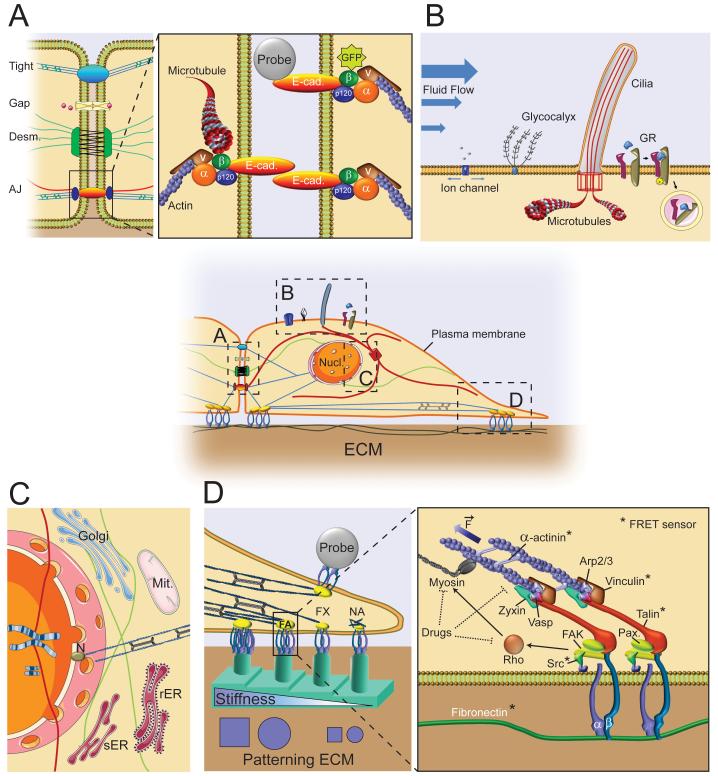
Center: An overview of a cell connected to ECM and a neighboring cell. The boxes (A - D) zoom in on areas of interest where mechanotransduction in the cell-ECM unit occurs. The blue lines represent actomyosin filaments, green lines embody intermediate filaments and the red lines correspond to microtubules. This color code is maintained in all panels. The blue structures linking the cell with the ECM represent integrins (detailed in D). nucl.: nucleus; pm: plasma membrane. A: Mechanotransduction at Adherens Junctions. (Left panel) Different cell-cell junctions connect neighboring cells. Tight junctions (Tight) constitute of sealing strands of protein complexes (blue ellipse) in the intercellular space that are anchored to the actomyosin skeleton in the cytoplasm. Gap junctions (GAP) are clusters of connexon channels that allow ion exchange (pink circles) and electrochemical communication between two cells. Desmosomes (Desm.) link intermediate filaments through adhesion plaques (green). Adherens junctions (AJ) tether actomyosin skeleton and microtubules via cadherin complexes (orange). (Right panel) Molecular structure of AJ: E-cad: E-Cadherin, α: Alpha Catenin, β: Beta Catenin, p120: p120 Catenin, v: Vinculin, Probe: Atomic Force Microscope, Optical tweezers, and Magnetic tweezers can be used to manipulate and measure force at the AJ. In addition, labeling molecules such as beta catenin with GFP allows measuring of the size of the AJs, which can be used to estimate the force acting on the AJs. B: Mechanoreceptors at the cell membrane. Fluid flow or stretch deforms the plasma membrane which can lead to activation of ion channels that results in an influx of ions. In addition, fluid flow directly impacts glycocalyx and cilia movement which triggers diverse downstream signaling cascades. Moreover, mechanical forces mediate growth factor receptor (GR) clustering and endocytosis, and thus affect GR signal transduction as well. C: Mechanotransduction at the nucleus. The nucleus and surrounding organelles (Golgi apparatus, Mit: Mitochondria, rER/sER: rough and smooth endoplasmic reticulum) are interconnected by intermediate filaments and microtubules. Nesprins (N) tether the nucleus with the actomyosin cytoskeleton. Changing cell shape/contractility can alter spatial localization of organelles and induce conformational changes of nuclear pores. D: Mechanotransduction at the Focal Adhesion (FA). (Left): Integrin clustering develops Nascent Adhesions (NA) that mature to Focal Complexes (FXs) and Focal Adhesions (FA), a process controlled by actomyosin contractility which can be modified by stiffness (step rigidity posts or crosslinked polymer substrates, in green), cell shape (patterning, in blue) or external application of force with atomic force microscopy, optical tweezers, or magnetic tweezers (Probe). (Right): simplified molecular structure of FA. α/β: alpha and beta unit of integrins, Pax: paxillin, F: Force delivered by actomyosin contraction. Clustering of integrins can induce RhoA signaling, thereby increasing myosin contractility which leads to unfolding of proteins as observed by FRET. The molecules for which a FRET sensor has been developed are marked with an asterisk (*). Pharmacological drugs can be used to alter myosin contractility and actin polymerization.
References
-
- Alenghat FJ, Fabry B, Tsai KY, Goldmann WH, Ingber DE. Analysis of cell mechanics in single vinculin-deficient cells using a magnetic tweezer. Biochem. Biophys. Res. Commun. 2000;277:93–99. - PubMed
-
- Altman D, Sweeney HL, Spudich JA. The mechanism of myosin VI translocation and its load-induced anchoring. Cell. 2004;116:737–749. - PubMed
-
- Arrenberg AB, Stainier DY, Baier H, Huisken J. Optogenetic control of cardiac function. Science. 2010;330:971–974. - PubMed
-
- Balaban NQ, Schwarz US, Riveline D, Goichberg P, Tzur G, Sabanay I, Mahalu D, Safran S, Bershadsky A, Addadi L, Geiger B. Force and focal adhesion assembly: a close relationship studied using elastic micropatterned substrates. Nat. Cell Biol. 2001;3:466–472. - PubMed
Publication types
MeSH terms
Grants and funding
LinkOut - more resources
Full Text Sources
Other Literature Sources
