


Prolonged infusion of angiotensin II in apoE(-/-) mice promotes macrophage recruitment with continued expansion of abdominal aortic aneurysm
- PMID: 21763672
- PMCID: PMC3157213
- DOI: 10.1016/j.ajpath.2011.05.049
Prolonged infusion of angiotensin II in apoE(-/-) mice promotes macrophage recruitment with continued expansion of abdominal aortic aneurysm
Abstract
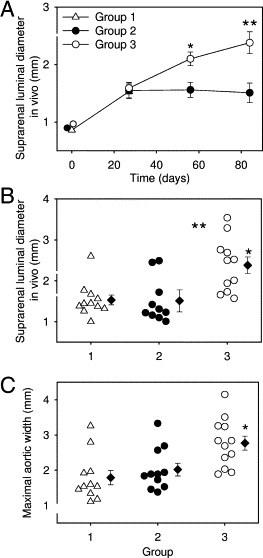
Angiotensin II (AngII) infusion initiates abdominal aortic aneurysm (AAA) development due to medial disruption and results in luminal dilation and thrombus formation. The objective of this study was to determine whether AAA progressed during protracted AngII infusion. Male apoE(-/-) mice were infused with AngII using miniosmotic pumps. On day 27, suprarenal aortic luminal diameters were ultrasonically measured to identify mice exhibiting AAAs. Mice were designated to three groups with similar mean luminal dilation. Group 1 mice were sacrificed on day 28. Group 2 and 3 mice were subsequently infused with saline or AngII, respectively, for an additional 56 days. In Group 2, saline infusion-after the initial 28 days of AngII infusion-led to an immediate decrease in systolic blood pressure. Over the subsequent 56 days of saline infusion, there were no aneurysm-related deaths or significant changes in luminal diameter. In contrast, continuous AngII infusion in Group 3 maintained persistently increased systolic blood pressure, with aneurysmal rupture-associated deaths, increased luminal diameters, and tissue remodeling. Aortic aneurysmal segments that expanded during continuous AngII infusion exhibited macrophage accumulation in regions of medial disruption, predominantly on the adventitial aspect. Macrophages immunostained for CD206 more than for iNOS, consistent with an M2 phenotype. In conclusion, prolonged AngII infusion promotes AAA expansion, and is associated with enhanced rupture rates and increased macrophage infiltration.
Copyright © 2011 American Society for Investigative Pathology. Published by Elsevier Inc. All rights reserved.
Figures



References
-
- Daugherty A., Cassis L. Chronic angiotensin II infusion promotes atherogenesis in low density lipoprotein receptor −/− mice. Ann N Y Acad Sci. 1999;892:108–118. - PubMed
-
- Wang Y.X., Martin-McNulty B., Freay A.D., Sukovich D.A., Halks-Miller M., Li W.W., Vergona R., Sullivan M.E., Morser J., Dole W.P., Deng G.G. Angiotensin II increases urokinase-type plasminogen activator expression and induces aneurysm in the abdominal aorta of apolipoprotein E-deficient mice. Am J Pathol. 2001;159:1455–1464. - PMC - PubMed
-
- Bruemmer D., Collins A.R., Noh G., Wang W., Territo M., Arias-Magallona S., Fishbein M.C., Blaschke F., Kintscher U., Graf K., Law R.E., Hsueh W.A. Angiotensin II-accelerated atherosclerosis and aneurysm formation is attenuated in osteopontin-deficient mice. J Clin Invest. 2003;112:1318–1331. - PMC - PubMed
-
- Ishibashi M., Egashira K., Zhao Q., Hiasa K., Ohtani K., Ihara Y., Charo I.F., Kura S., Tsuzuki T., Takeshita A., Sunagawa K. Bone marrow-derived monocyte chemoattractant protein-1 receptor CCR2 is critical in angiotensin II-induced acceleration of atherosclerosis and aneurysm formation in hypercholesterolemic mice. Arterioscler Thromb Vasc Biol. 2004;24:174–178. - PubMed
Publication types
MeSH terms
Substances
Grants and funding
LinkOut - more resources
Full Text Sources
Molecular Biology Databases
Miscellaneous
