. 2011 Sep 2;411(5):943-50.
doi: 10.1016/j.jmb.2011.06.051. Epub 2011 Jul 12.

Slow myosin ATP turnover in the super-relaxed state in tarantula muscle

Affiliations

Slow myosin ATP turnover in the super-relaxed state in tarantula muscle

Nariman Naber et al. J Mol Biol. .

Abstract

We measured the nucleotide turnover rate of myosin in tarantula leg muscle fibers by observing single turnovers of the fluorescent nucleotide analog 2'-/3'-O-(N'-methylanthraniloyl)adenosine-5'-O-triphosphate, as monitored by the decrease in fluorescence when 2'-/3'-O-(N'-methylanthraniloyl)adenosine-5'-O-triphosphate (mantATP) is replaced by ATP in a chase experiment. We find a multiexponential process with approximately two-thirds of the myosin showing a very slow nucleotide turnover time constant (∼30 min). This slow-turnover state is termed the super-relaxed state (SRX). If fibers are incubated in 2'-/3'-O-(N'-methylanthraniloyl)adenosine-5'-O-diphosphate and chased with ADP, the SRX is not seen, indicating that trinucleotide-relaxed myosins are responsible for the SRX. Phosphorylation of the myosin regulatory light chain eliminates the fraction of myosin with a very long lifetime. The data imply that the very long-lived SRX in tarantula fibers is a highly novel adaptation for energy conservation in an animal that spends extremely long periods of time in a quiescent state employing a lie-in-wait hunting strategy. The presence of the SRX measured here correlates well with the binding of myosin heads to the core of the thick filament in a structure known as the "interacting-heads motif," observed previously by electron microscopy. Both the structural array and the long-lived SRX require relaxed filaments or relaxed fibers, both are lost upon myosin phosphorylation, and both appear to be more stable in tarantula than in vertebrate skeletal or vertebrate cardiac preparations.


Figures

Figure 1
Figure 1
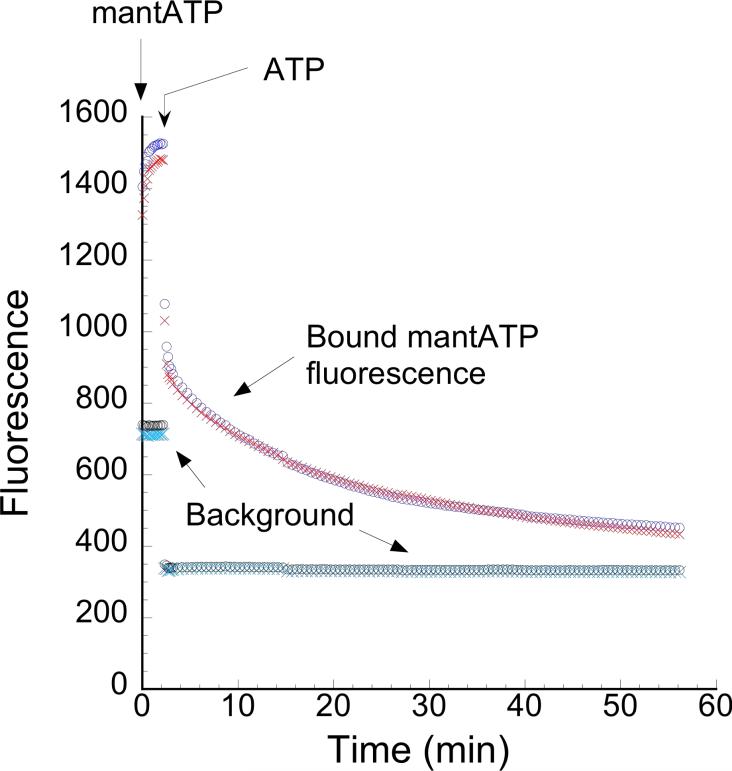
The time course of a chase experiment is shown. At time = 0, the fiber is washed in a relaxing buffer containing 125 μM mantATP. Fiber fluorescence (red and blue traces) rises rapidly and reaches a new equilibrium as the mantATP binds to the nucleotide site. At time = 1 min., the fiber is chased with a wash in 4 mM ATP. Fiber fluorescence then decreases as ATP replaces mantATP at the nucleotide site. The background fluorescence is shown in cyan and black. The microscope system allows simultaneous monitoring of the fluorescence intensity of mant-nucleotides in four regions in the field. Two regions are placed on the fiber (red and blue traces). The other two regions (black and cyan traces) are placed to record the background. The background signal is averaged and subtracted from the individual observed fiber fluorescences for fluorescence signal analysis.
Figure 2
Figure 2
A comparison of the fluorescence decay for three conditions is shown: (1) incubation in 125μM mantATP chased by 4mM ATP (red); (2) incubation in 125μM mantADP chased by 4mM ADP (blue); (3) incubation in 125μM mantATP and 4 mM ATP chased by 4mM ATP (green). The experiment for 125μM mantATP chased by 4mM ATP was recorded and fit out to 3000s. Only the initial 800s are shown to facilitate comparison with the other two conditions. Parameters of the fits: (1) P1=0.42, T1=15s, P2=0.15, T2=221s, P3=0.40, T3=1730; (2) P1=0.55, T1=6s, P2=0.26, T2=21.4s, P3=0.10, T3=164s; (3) P1=0.77, T1=12.4s, P3=0.15, T3=63s. Data for case (2) were well fit (χ2 = 0.000015) using only a two-exponential fit. Only for case (1) is there a significant SRX component (P3) to the fluorescence decay.
Figure 3
Figure 3
Isoelectric focusing gel of tarantula fibers showing the change in isoelectric focusing point of the myosin RLC between the normal preparation and that obtained using phosphatase inhibitors in the glycerol solutions. Lanes 1 and 2 are from the phosphorylated preparation. Lanes 3 and 4 are from the normal preparation. Both preparations had been stored in rigor/glycerol solution for 2 weeks. The bands are identified by their isoelectric point, which is similar to that of vertebrate skeletal myosin light chains, and by the shift occurring in the phosphorylated preparation. The three bands are identified as unphosphorylated RLC, singly and doubly RLC by comparison with the gels of Hidalgo et. al..
Figure 4
Figure 4
The fluorescence intensity during the chase phase of the single nucleotide turnover experiments in dephosphorylated (●) and phosphorylated (○) tarantula fiber bundles muscle. The data for dephosphorylated fibers are from Fig. 2. The fiber bundles were incubated in mantATP and chased by ATP. As can be seen the component of fluorescence decay with the very long time constant was eliminated in the phosphorylated fibers. Fit to the data for phosphorylated fibers: P1= 0.44, T1=15s, P2=0.26, T2= 38s, P3=0.20, T3=262s.

References

    1. Hooijman P, Stewart MA, Cooke R. A new state of cardiac myosin with very slow ATP turnover: a potential cardioprotective mechanism in the heart. Biophys J. 2011;100:1969–1976. - PMC - PubMed
    1. Stewart MA, Franks-Skiba K, Chen S, Cooke R. Myosin ATP turnover rate is a mechanism involved in thermogenesis in resting skeletal muscle fibers. Proc Natl Acad Sci U S A. 2010;107:430–435. - PMC - PubMed
    1. Gordon AM, Homsher E, Regnier M. Regulation of contraction in striated muscle. Physiol Rev. 2000;80:853–924. - PubMed
    1. Adelstein RS, Eisenberg E. Regulation and kinetics of the actin-myosin-ATP interaction. Annu Rev Biochem. 1980;49:921–56. - PubMed
    1. Kendrick-Jones J, Lehman W, Szent-Gyorgyi AG. Regulation in molluscan muscles. J Mol Biol. 1970;54:313–26. - PubMed

Publication types

LinkOut - more resources