


Telomere biology in hematopoiesis and stem cell transplantation
- PMID: 21764192
- PMCID: PMC7737640
- DOI: 10.1016/j.blre.2011.06.004
Telomere biology in hematopoiesis and stem cell transplantation
Abstract
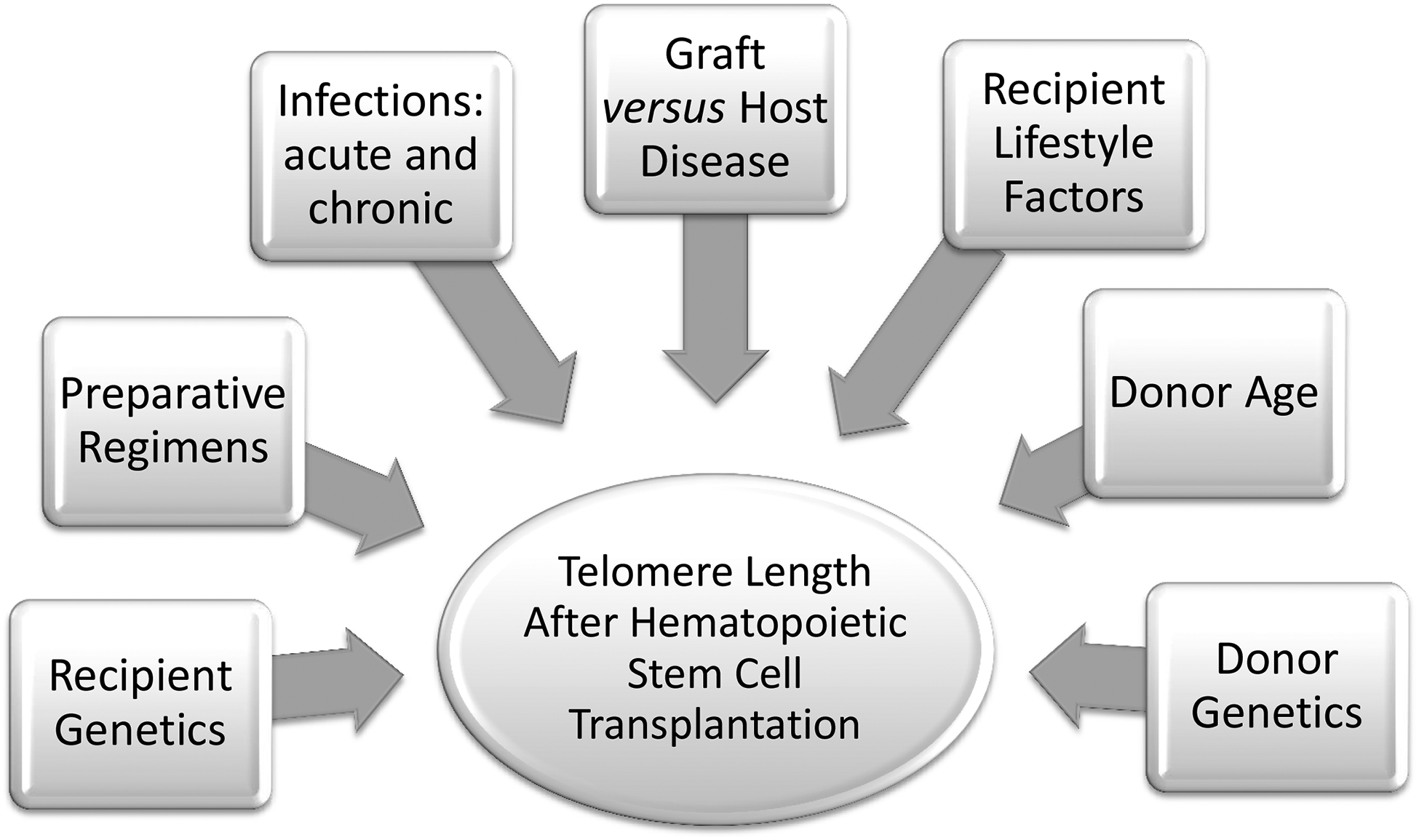
Telomeres are long (TTAGGG)(n) nucleotide repeats and an associated protein complex located at the end of the chromosomes. They shorten with every cell division and, thus are markers for cellular aging, senescence, and replicative capacity. Telomere dysfunction is linked to several bone marrow disorders, including dyskeratosis congenita, aplastic anemia, myelodysplastic syndrome, and hematopoietic malignancies. Hematopoietic stem cell transplantation (HSCT) provides an opportunity in which to study telomere dynamics in a high cell proliferative environment. Rapid telomere shortening of donor cells occurs in the recipient shortly after HSCT; the degree of telomere attrition does not appear to differ by graft source. As expected, telomeres are longer in recipients of grafts with longer telomeres (e.g., cord blood). Telomere attrition may play a role in, or be a marker of, long term outcome after HSCT, but these data are limited. In this review, we discuss telomere biology in normal and abnormal hematopoiesis, including HSCT.
Published by Elsevier Ltd.
Conflict of interest statement
Conflict of interest:
The authors have no conflicts of interest to disclose.
Figures

References
-
- Olovnikov AM. A theory of marginotomy. The incomplete copying of template margin in enzymic synthesis of polynucleotides and biological significance of the phenomenon. J Theor. Biol 1973; 41: 181–190. - PubMed
-
- Greider CW, Blackburn EH. Identification of a specific telomere terminal transferase activity in Tetrahymena extracts. Cell 1985; 43: 405–413. - PubMed
-
- Blackburn EH. Structure and function of telomeres. Nature 1991; 350: 569–573. - PubMed
-
- Harley CB, Futcher AB, Greider CW. Telomeres shorten during ageing of human fibroblasts. Nature 1990; 345: 458–460. - PubMed
-
- Nalapareddy K, Jiang H, Guachalla Gutierrez LM, Rudolph KL. Determining the influence of telomere dysfunction and DNA damage on stem and progenitor cell aging: what markers can we use? Exp. Gerontol 2008; 43: 998–1004. - PubMed
Publication types
MeSH terms
Grants and funding
LinkOut - more resources
Full Text Sources
Other Literature Sources
Research Materials
