


A quantitative meta-analysis of population-based studies of premorbid intelligence and schizophrenia
- PMID: 21764562
- PMCID: PMC3485562
- DOI: 10.1016/j.schres.2011.06.017
A quantitative meta-analysis of population-based studies of premorbid intelligence and schizophrenia
Abstract
Objective: A premorbid IQ deficit supports a developmental dimension to schizophrenia and its cognitive aspects that are crucial to functional outcome. Better characterisation of the association between premorbid IQ and the disorder may provide further insight into its origin and etiology. We aimed to quantify premorbid cognitive function in schizophrenia through systematic review and meta-analysis of longitudinal, population-based studies, and to characterize the risk of schizophrenia across the entire range of premorbid IQ.
Method: Electronic and manual searches identified general population-based cohort or nested case-control studies that measured intelligence before onset of schizophrenic psychosis using standard psychometric tests, and that defined cases using contemporaneous ICD or DSM. Meta-analyses explored dose-response relationships between premorbid cognitive deficit (using full-scale, verbal and performance IQ) and risk of schizophrenia. Meta-regression analyses explored relationships with age of illness onset, change in premorbid intelligence over time and gender differences.
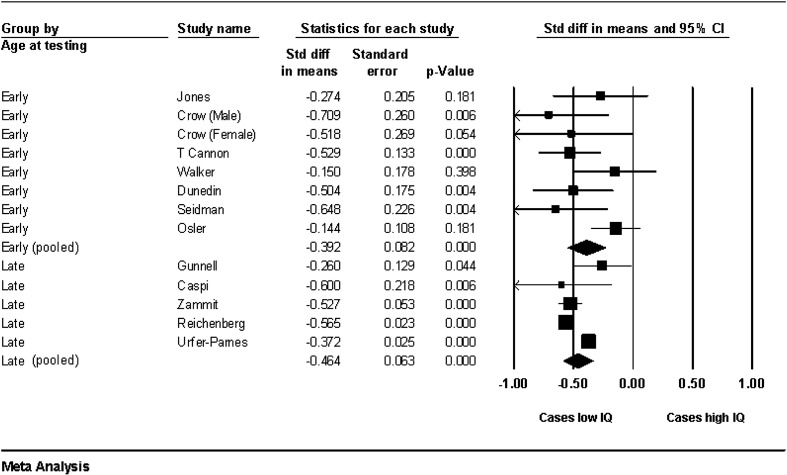
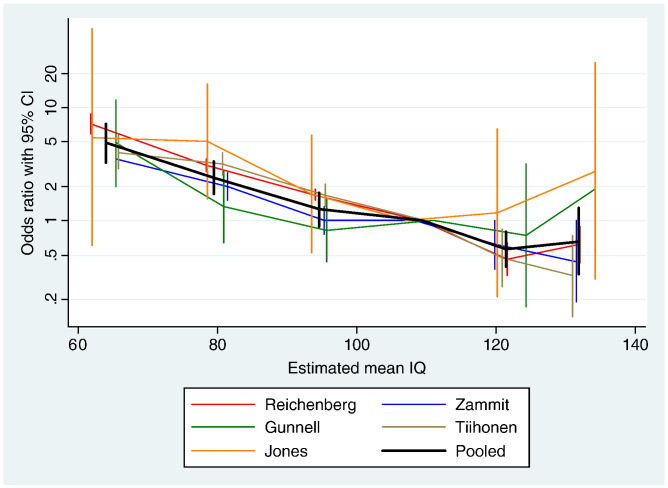
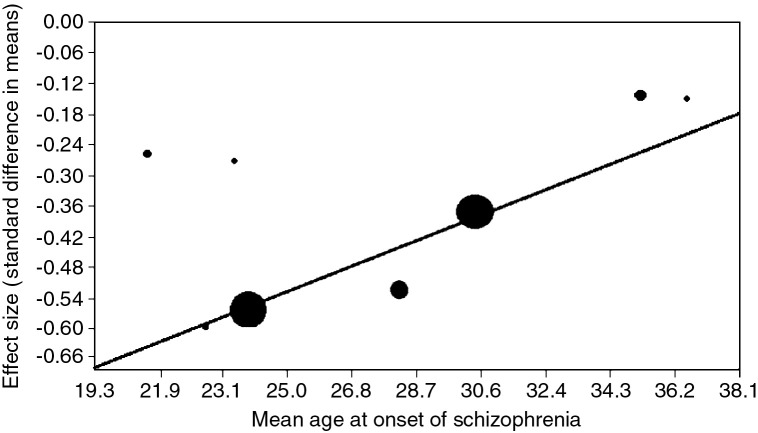
Results: Meta-analysis of 4396 cases and over 745000 controls from 12 independent studies confirmed significant decrements in premorbid IQ (effect size -0.43) among future cases. Risk of schizophrenia operated as a consistent dose-response effect, increasing by 3.7% for every point decrease in IQ (p<0.0001). Verbal and nonverbal measures were equally affected. Greater premorbid IQ decrement was associated with earlier illness onset (p<0.0001). There was no evidence of a progressively increasing deficit during the premorbid period toward illness onset.
Conclusions: Strong associations between premorbid IQ and risk for schizophrenia, and age of illness onset argue for a widespread neurodevelopmental contribution to schizophrenia that operates across the entire range of intellectual ability. This also suggests higher IQ may be protective in schizophrenia, perhaps by increasing active cognitive reserve.
Copyright © 2011 Elsevier B.V. All rights reserved.
Figures
Comment in
-
Review: premorbid IQ is inversely associated with future risk of schizophrenia.Evid Based Ment Health. 2012 May;15(2):33. doi: 10.1136/ebmental-2012-100640. Evid Based Ment Health. 2012. PMID: 22509054 No abstract available.
References
-
- Aylward E., Walker E., Bettes B. Intelligence in schizophrenia: meta-analysis of the research. Schizophr. Bull. 1984;10(3):430–459. - PubMed
-
- Barnett J.H., Salmond C.H., Jones P.B., Sahakian B.J. Cognitive reserve in neuropsychiatry. Psychol. Med. 2006;36(8):1053–1064. - PubMed
-
- Belenky M., Tarule J., Goldberger N. Basic Books; New York: 1986. Women's Ways of Knowing.
-
- Brewer W.J., Francey S.M., Wood S.J., Jackson H.J., Pantelis C., Phillips L.J., Yung A.R., Anderson V.A., McGorry P.D. Memory impairments identified in people at ultra-high risk for psychosis who later develop first-episode psychosis. Am. J. Psychiatry. 2005;162(1):71–78. - PubMed
Publication types
MeSH terms
Grants and funding
LinkOut - more resources
Full Text Sources
Medical
