


Changes in diversity and functional gene abundances of microbial communities involved in nitrogen fixation, nitrification, and denitrification in a tidal wetland versus paddy soils cultivated for different time periods
- PMID: 21764972
- PMCID: PMC3165419
- DOI: 10.1128/AEM.01751-10
Changes in diversity and functional gene abundances of microbial communities involved in nitrogen fixation, nitrification, and denitrification in a tidal wetland versus paddy soils cultivated for different time periods
Abstract
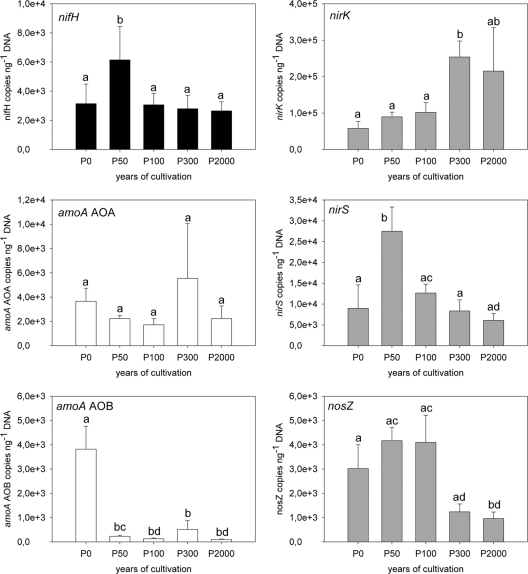
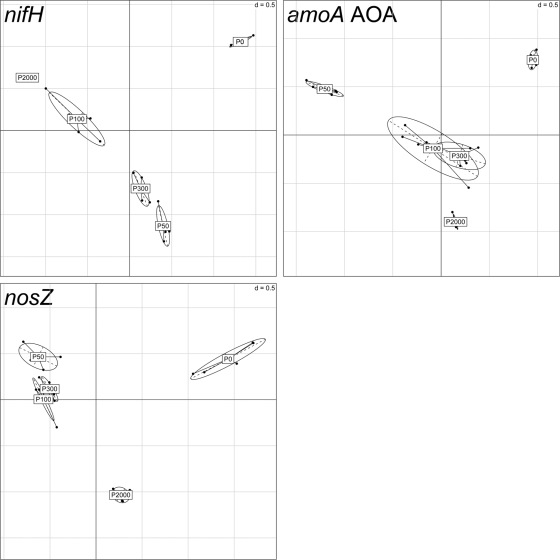
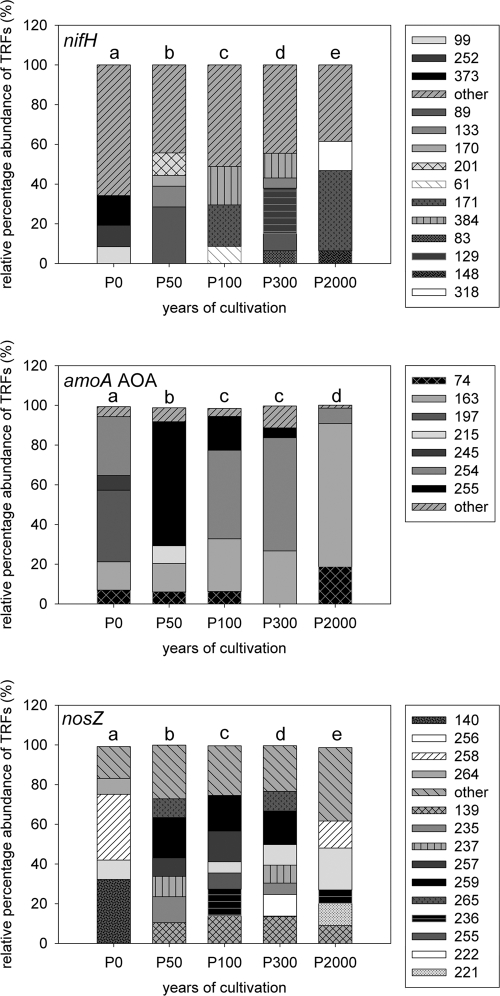
In many areas of China, tidal wetlands have been converted into agricultural land for rice cultivation. However, the consequences of land use changes for soil microbial communities are poorly understood. Therefore, we investigated bacterial and archaeal communities involved in inorganic nitrogen turnover (nitrogen fixation, nitrification, and denitrification) based on abundances and relative species richness of the corresponding functional genes along a soil chronosequence ranging between 50 and 2,000 years of paddy soil management compared to findings for a tidal wetland. Changes in abundance and diversity of the functional groups could be observed, reflecting the different chemical and physical properties of the soils, which changed in terms of soil development. The tidal wetland was characterized by a low microbial biomass and relatively high abundances of ammonia-oxidizing microbes. Conversion of the tidal wetlands into paddy soils was followed by a significant increase in microbial biomass. Fifty years of paddy management resulted in a higher abundance of nitrogen-fixing microbes than was found in the tidal wetland, whereas dominant genes of nitrification and denitrification in the paddy soils showed no differences. With ongoing rice cultivation, copy numbers of archaeal ammonia oxidizers did not change, while that of their bacterial counterparts declined. The nirK gene, coding for nitrite reductase, increased with rice cultivation time and dominated its functionally redundant counterpart, nirS, at all sites under investigation. Relative species richness showed significant differences between all soils with the exception of the archaeal ammonia oxidizers in the paddy soils cultivated for 100 and 300 years. In general, changes in diversity patterns were more pronounced than those in functional gene abundances.
Figures
References
-
- Abell G. C. J., et al. 2010. Archaeal ammonia oxidizers and nirS-type denitrifiers dominate sediment nitrifying and denitrifying populations in a subtropical macrotidal estuary. ISME J. 4:286–300 - PubMed
-
- Anderson M. J. 2003. Review of analysis of ecological communities (B McCune and J. B. Grace, 2002, MjM Software Design). J. Exp. Mar. Biol. Ecol. 289:303–305
-
- Anderson T.-H., Domsch K. H. 1989. Ratios of microbial biomass carbon to total organic carbon in arable soils. Soil Biol. Biochem. 21:471–479
-
- Attard E., et al. 2010. Shifts between Nitrospira- and Nitrobacter-like nitrite oxidizers underlie the response of soil potential nitrite oxidation to changes in tillage practices. Environ. Microbiol. 12:315–326 - PubMed
-
- Azul A. M., Sousa J. P., Agerer R., Martin M. P., Freitas H. 2010. Land use practices and ectomycorrhizal fungal communities from oak woodlands dominated by Quercus suber L. considering drought scenarios. Mycorrhiza 20:73–88 - PubMed
Publication types
MeSH terms
Substances
LinkOut - more resources
Full Text Sources
