


Control of hydrogen photoproduction by the proton gradient generated by cyclic electron flow in Chlamydomonas reinhardtii
- PMID: 21764992
- PMCID: PMC3226202
- DOI: 10.1105/tpc.111.086876
Control of hydrogen photoproduction by the proton gradient generated by cyclic electron flow in Chlamydomonas reinhardtii
Abstract
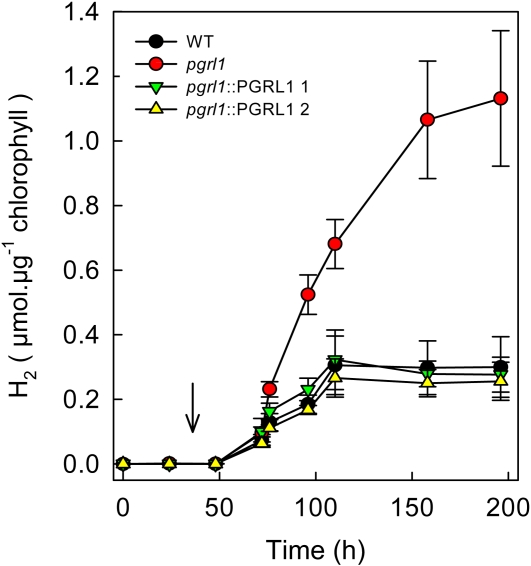
Hydrogen photoproduction by eukaryotic microalgae results from a connection between the photosynthetic electron transport chain and a plastidial hydrogenase. Algal H₂ production is a transitory phenomenon under most natural conditions, often viewed as a safety valve protecting the photosynthetic electron transport chain from overreduction. From the colony screening of an insertion mutant library of the unicellular green alga Chlamydomonas reinhardtii based on the analysis of dark-light chlorophyll fluorescence transients, we isolated a mutant impaired in cyclic electron flow around photosystem I (CEF) due to a defect in the Proton Gradient Regulation Like1 (PGRL1) protein. Under aerobiosis, nonphotochemical quenching of fluorescence (NPQ) is strongly decreased in pgrl1. Under anaerobiosis, H₂ photoproduction is strongly enhanced in the pgrl1 mutant, both during short-term and long-term measurements (in conditions of sulfur deprivation). Based on the light dependence of NPQ and hydrogen production, as well as on the enhanced hydrogen production observed in the wild-type strain in the presence of the uncoupling agent carbonyl cyanide p-trifluoromethoxyphenylhydrazone, we conclude that the proton gradient generated by CEF provokes a strong inhibition of electron supply to the hydrogenase in the wild-type strain, which is released in the pgrl1 mutant. Regulation of the trans-thylakoidal proton gradient by monitoring pgrl1 expression opens new perspectives toward reprogramming the cellular metabolism of microalgae for enhanced H₂ production.
Figures




References
-
- Alric J., Lavergne J., Rappaport F. (2010). Redox and ATP control of photosynthetic cyclic electron flow in Chlamydomonas reinhardtii (I) aerobic conditions. Biochim. Biophys. Acta 1797: 44–51 - PubMed
-
- Antal T.K., Krendeleva T.E., Laurinavichene T.V., Makarova V.V., Ghirardi M.L., Rubin A.B., Tsygankov A.A., Seibert M. (2003). The dependence of algal H2 production on Photosystem II and O2 consumption activities in sulfur-deprived Chlamydomonas reinhardtii cells. Biochim. Biophys. Acta 1607: 153–160 - PubMed
-
- Antal T.K., Volgusheva A.A., Kukarskih G.P., Krendeleva T.E., Rubin A.B. (2009). Relationships between H2 photoproduction and different electron transport pathways in sulfur-deprived Chlamydomonas reinhardtii. Int. J. Hydrogen Energy 34: 9087–9094
-
- Berthold P., Schmitt R., Mages W. (2002). An engineered Streptomyces hygroscopicus aph 7″ gene mediates dominant resistance against hygromycin B in Chlamydomonas reinhardtii. Protist 153: 401–412 - PubMed
-
- Chochois V., Constans L., Dauvillée D., Beyly A., Solivérès M., Ball S., Peltier G., Cournac L. (2010). Relationships between PSII-independent hydrogen bioproduction and starch metabolism as evidenced from isolation of starch catabolism mutants in the green alga Chlamydomonas reinhardtii. Int. J. Hydrogen Energy 35: 10731–10740
Publication types
MeSH terms
Substances
LinkOut - more resources
Full Text Sources
Other Literature Sources
