


Diagnostic accuracy of a urine lipoarabinomannan enzyme-linked immunosorbent assay for screening ambulatory HIV-infected persons for tuberculosis
- PMID: 21765364
- PMCID: PMC3175281
- DOI: 10.1097/QAI.0b013e31822b75d4
Diagnostic accuracy of a urine lipoarabinomannan enzyme-linked immunosorbent assay for screening ambulatory HIV-infected persons for tuberculosis
Abstract
Objective: To assess the diagnostic accuracy of the urine lipoarabinomannan (LAM) test among ambulatory HIV-infected persons.
Design: Cross-sectional.
Methods: HIV-infected persons consecutively presenting to the HIV Clinic at Tembisa Main Clinic in Ekhuruleni, South Africa, were screened for symptoms of tuberculosis (TB) and asked to provide sputum and blood samples for smears for acid-fast bacilli and mycobacterial culture and a urine specimen for a LAM enzyme-linked immunosorbent assay. Fine needle aspirates were obtained from participants with enlarged lymph nodes and sent for histopathology. Nonpregnant participants underwent chest x-ray.
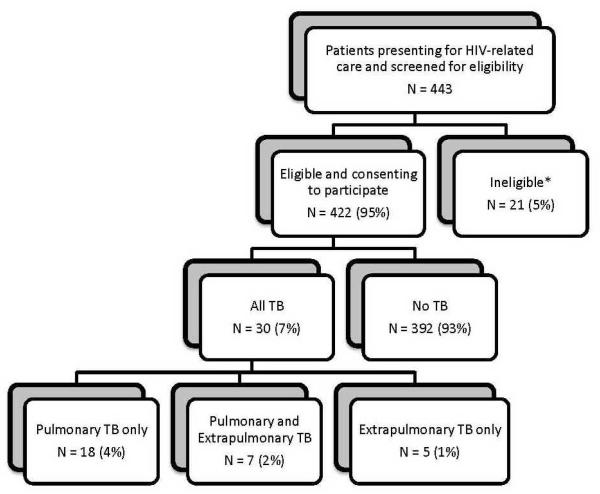
Results: : Four hundred twenty-two HIV-infected participants were enrolled with median age 37 years (interquartile range: 31-44 years), median CD4+ T-cell count 215 cells per microliter (interquartile range: 107-347 cells/μL), and 212 (50%) receiving antiretroviral therapy. Thirty (7%) had active TB: 18 with only pulmonary TB, 5 with only extrapulmonary TB, and 7 with both pulmonary TB and extrapulmonary TB. Twenty-seven percent [95% confidence interval (CI): 12% to 48%] of TB cases were sputum acid-fast bacilli positive. The sensitivity and specificity of the urine LAM compared with the gold standard of positive bacteriology or histopathology were 32% (95% CI: 16% to 52%) and 98% (95% CI: 96% to 99%), respectively. Urine LAM had higher sensitivity in TB cases with higher bacillary burdens, though these differences were not statistically significant.
Conclusions: The sensitivity of urine LAM testing is inadequate to replace mycobacterial culture. In contrast to prior research on the urine LAM, this study was conducted among less sick, ambulatory HIV-infected patients presenting for routine care.
Figures
References
-
- Wilson D, Nachega J, Morroni C, et al. Diagnosing smear-negative tuberculosis using case definitions and treatment response in HIV-infected adults. Int J Tuberc Lung Dis. 2006;10:31–8. - PubMed
-
- Foulds J, O’Brien R. New tools for the diagnosis of tuberculosis: the perspective of developing countries. Int J Tuberc Lung Dis. 1998;2:778–83. - PubMed
-
- Daffe M, Draper P. The envelope layers of mycobacteria with reference to their pathogenicity. Adv Microb Physiol. 1998;39:131–203. - PubMed
-
- Hunter SW, Gaylord H, Brennan PJ. Structure and antigenicity of the phosphorylated lipopolysaccharide antigens from the leprosy and tubercle bacilli. J Biol Chem. 1986;261:12345–51. - PubMed
Publication types
MeSH terms
Substances
Grants and funding
LinkOut - more resources
Full Text Sources
Other Literature Sources
Medical
Research Materials
