


Therapeutic strategies to enhance the anticancer efficacy of histone deacetylase inhibitors
- PMID: 21765634
- PMCID: PMC3134392
- DOI: 10.1155/2011/514261
Therapeutic strategies to enhance the anticancer efficacy of histone deacetylase inhibitors
Abstract
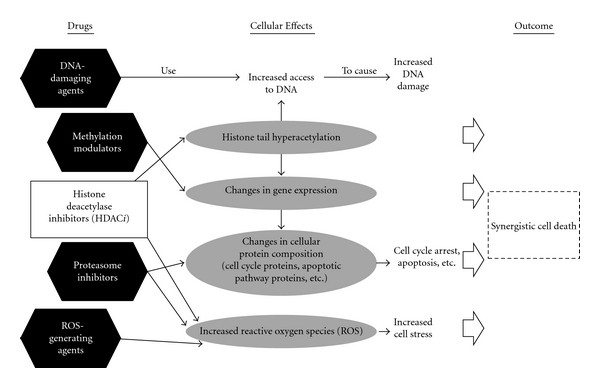
Histone acetylation is a posttranslational modification that plays a role in regulating gene expression. More recently, other nonhistone proteins have been identified to be acetylated which can regulate their function, stability, localization, or interaction with other molecules. Modulating acetylation with histone deacetylase inhibitors (HDACi) has been validated to have anticancer effects in preclinical and clinical cancer models. This has led to development and approval of the first HDACi, vorinostat, for the treatment of cutaneous T cell lymphoma. However, to date, targeting acetylation with HDACi as a monotherapy has shown modest activity against other cancers. To improve their efficacy, HDACi have been paired with other antitumor agents. Here, we discuss several combination therapies, highlighting various epigenetic drugs, ROS-generating agents, proteasome inhibitors, and DNA-damaging compounds that together may provide a therapeutic advantage over single-agent strategies.
Figures


References
-
- Hong L, Schroth GP, Matthews HR, Yau P, Bradbury EM. Studies of the DNA binding properties of histone H4 amino terminus. Thermal denaturation studies reveal that acetylation markedly reduces the binding constant of the H4 ’tail’ to DNA. Journal of Biological Chemistry. 1993;268(1):305–314. - PubMed
-
- Strahl BD, Allis CD. The language of covalent histone modifications. Nature. 2000;403(6765):41–45. - PubMed
-
- Gao L, Cueto MA, Asselbergs F, Atadja P. Cloning and functional characterization of HDAC11, a novel member of the human histone deacetylase family. Journal of Biological Chemistry. 2002;277(28):25748–25755. - PubMed
Publication types
MeSH terms
Substances
LinkOut - more resources
Full Text Sources
Other Literature Sources
