LED fluorescence microscopy for the diagnosis of pulmonary tuberculosis: a multi-country cross-sectional evaluation
- PMID: 21765809
- PMCID: PMC3134458
- DOI: 10.1371/journal.pmed.1001057
LED fluorescence microscopy for the diagnosis of pulmonary tuberculosis: a multi-country cross-sectional evaluation
Abstract
Background: The diagnosis of tuberculosis (TB) in resource-limited settings relies on Ziehl-Neelsen (ZN) smear microscopy. LED fluorescence microscopy (LED-FM) has many potential advantages over ZN smear microscopy, but requires evaluation in the field. The aim of this study was to assess the sensitivity/specificity of LED-FM for the diagnosis of pulmonary TB and whether its performance varies with the timing of specimen collection.
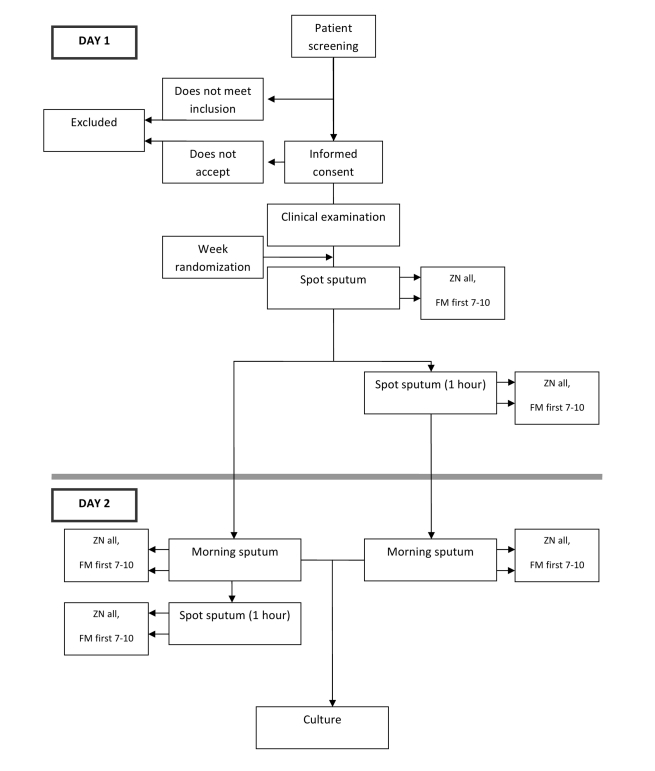
Methods and findings: Adults with cough ≥2 wk were enrolled consecutively in Ethiopia, Nepal, Nigeria, and Yemen. Sputum specimens were examined by ZN smear microscopy and LED-FM and compared with culture as the reference standard. Specimens were collected using a spot-morning-spot (SMS) or spot-spot-morning (SSM) scheme to explore whether the collection of the first two smears at the health care facility (i.e., "on the spot") the first day of consultation followed by a morning sample the next day (SSM) would identify similar numbers of smear-positive patients as smears collected via the SMS scheme (i.e., one on-the-spot-smear the first day, followed by a morning specimen collected at home and a second on-the-spot sample the second day). In total, 529 (21.6%) culture-positive and 1,826 (74.6%) culture-negative patients were enrolled, of which 1,156 (49%) submitted SSM specimens and 1,199 (51%) submitted SMS specimens. Single LED-FM smears had higher sensitivity but lower specificity than single ZN smears. Using two LED-FM or two ZN smears per patient was 72.8% (385/529, 95% CI 68.8%-76.5%) and 65.8% (348/529, 95% CI 61.6%-69.8%) sensitive (p<0.001) and 90.9% (1,660/1,826, 95% CI 89.5%-92.2%) and 98% (1,790/1,826, 95% CI 97.3%-98.6%) specific (p<0.001). Using three LED-FM or three ZN smears per patient was 77% (408/529, 95% CI 73.3%-80.6%) and 70.5% (373/529, 95% CI 66.4%-74.4%, p<0.001) sensitive and 88.1% (95% CI 86.5%-89.6%) and 96.5% (95% CI 96.8%-98.2%, p<0.001) specific. The sensitivity/specificity of ZN smear microscopy and LED-FM did not vary between SMS and SSM.
Conclusions: LED-FM had higher sensitivity but, in this study, lower specificity than ZN smear microscopy for diagnosis of pulmonary TB. Performance was independent of the scheme used for collecting specimens. The introduction of LED-FM needs to be accompanied by appropriate training, quality management, and monitoring of performance in the field.
Trial registration: Current Controlled Trials ISRCTN53339491. Please see later in the article for the Editors' Summary.
Conflict of interest statement
Andrew Ramsay is employed by WHO/TDR, the institution administering the grants from USAID and the Bill & Melinda Gates Foundation that funded this work. The other authors have declared that no competing interests exist.
Figures
References
-
- World Health Organization. Global tuberculosis control: epidemiology, strategy, financing. Geneva: World Health Organization. WHO/HTM/TB/ 2009;2009411
-
- Marais BJ, Brittle W, Painczyk K, Hesseling AC, Beyers N, et al. Use of light-emitting diode fluorescence microscopy to detect acid-fast bacilli in sputum. Clin Infect Dis. 2008;47:203–207. - PubMed
-
- Ramsay A, Cuevas LE, Mundy CJ, Nathanson CM, Chirambo P, et al. New policies, new technologies: modelling the potential for improved smear microscopy services in Malawi. PLoS ONE. 2009;4:e7760. doi: 10.1371/journal.pone.0007760. - DOI - PMC - PubMed
-
- Hanscheid T. The future looks bright: low-cost fluorescent microscopes for detection of Mycobacterium tuberculosis and Coccidiae. Trans R Soc Trop Med Hyg. 2008;102:520–521. - PubMed
-
- Minion J, Sohn H, Pai M. Light-emitting diode technologies for TB diagnosis: what is on the market? Expert Rev Med Devices. 2009;6:341–345. - PubMed
Publication types
MeSH terms
Associated data
LinkOut - more resources
Full Text Sources
Medical