


Estrogen action and prostate cancer
- PMID: 21765856
- PMCID: PMC3134227
- DOI: 10.1586/eem.11.20
Estrogen action and prostate cancer
Abstract
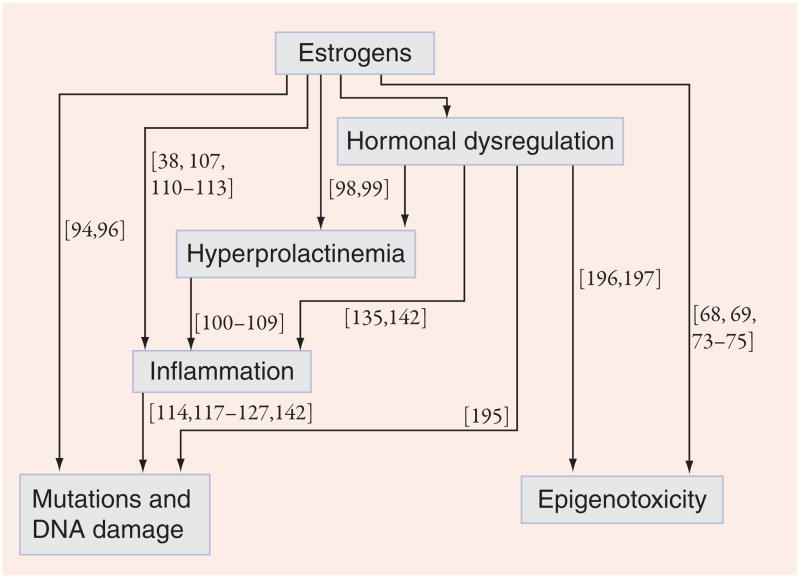
Early work on the hormonal basis of prostate cancer focused on the role of androgens, but more recently estrogens have been implicated as potential agents in the development and progression of prostate cancer. In this article, we review the epidemiological, laboratory and clinical evidence that estrogen may play a causative role in human prostate cancer, as well as rodent and grafted in vivo models. We then review recent literature highlighting potential mechanisms by which estrogen may contribute to prostate cancer, including estrogenic imprinting and epigenetic modifications, direct genotoxicity, hyperprolactinemia, inflammation and immunologic changes, and receptor-mediated actions. We discuss the work performed so far separating the actions of the different known estrogen receptors (ERs), ERα and ERβ, as well as G-protein-coupled receptor 30 and their specific roles in prostate disease. Finally, we predict that future work in this field will involve more investigations into epigenetic changes, experiments using new models of hormonal dysregulation in developing human prostate tissue, and continued delineation of the roles of the different ER subtypes, as well as their downstream signaling pathways that may serve as therapeutic targets.
Figures
References
-
- Huggins C, Hodges CV. Studies on prostate cancer: I. The effect of castration, of estrogen and of androgen injection on serum phosphatases in metastatic carcinoma of the prostate. Cancer Res. 1941;1:293–297.
-
- Huggins C. Endocrine control of prostate cancer. Science. 1943;97:541–544. - PubMed
-
- Wibowo E, Schellhammer P, Wassersug RJ. Role of estrogen in normal male function: clinical implications for patients with prostate cancer on androgen deprivation therapy. J Urol. 2010;185:17–23. - PubMed
-
- Citrin DL, Resnick MI, Guinan P, et al. A comparison of Zoladex and DES in the treatment of advanced prostate cancer: results of a randomized, multicenter trial. Prostate. 1991;18:139–146. - PubMed
Websites
-
- National Cancer Institute. Office of Budget and Finance. http://obf.cancer.gov.
-
- NIH. Estimates of Funding for Various Research, Condition and Disease Categories (RCDC) http://report.nih.gov/rcdc/categories.
Grants and funding
LinkOut - more resources
Full Text Sources
Other Literature Sources
