


Phase I Study to Assess the Safety, Tolerability and Pharmacokinetics of AZD4877 in Japanese Patients with Solid Tumors
- PMID: 21765863
- PMCID: PMC3130141
- DOI: 10.1111/j.1753-5174.2011.00034.x
Phase I Study to Assess the Safety, Tolerability and Pharmacokinetics of AZD4877 in Japanese Patients with Solid Tumors
Abstract
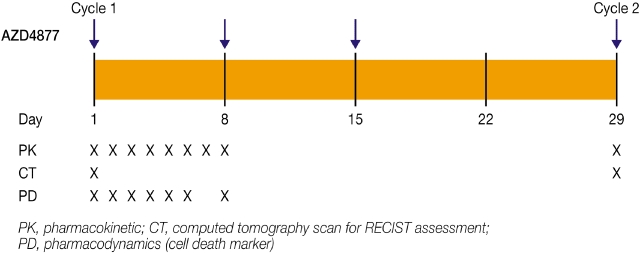
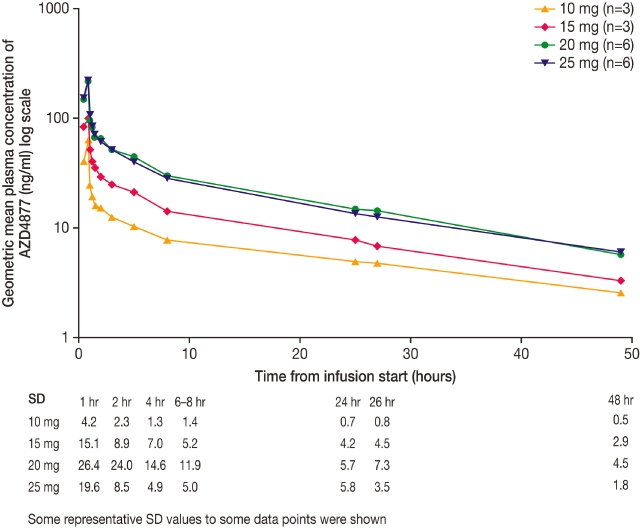
INTRODUCTION: AZD4877 is a potent Eg5 inhibitor that has been shown to have an acceptable tolerability profile in a Phase I study of Western patients with solid tumors. This study was conducted to evaluate the safety, pharmacokinetic (PK) profile, maximum tolerated dose (MTD) and efficacy of AZD4877 in a Japanese population with solid tumors. METHODS: In this Phase I, open-label, dose-escalation study, AZD4877 (10, 15, 20 or 25 mg) was administered as a 1-hour intravenous infusion on days 1, 8 and 15 of repeated 28-day cycles to Japanese patients with advanced solid tumors. Adverse events (AEs) were evaluated according to Common Terminology Criteria for Adverse Events (CTCAE) version 3.0. PK variables were assessed pre- and post dosing. The MTD of AZD4877 was determined by evaluating dose-limiting toxicities (DLTs). Efficacy was evaluated by assessing best response according to Response Evaluation Criteria In Solid Tumors version 1.0. RESULTS: Of the 21 patients enrolled, 18 received at least one dose of AZD4877 (N = 3 in both the 10 and 15 mg cohorts, N = 6 in both the 20 and 25 mg cohorts). The most commonly reported AEs were fatigue and nausea (39% of patients each). One patient in each of the 20 and 25 mg cohorts experienced a DLT (neutropenia and febrile neutropenia). Dose escalation was halted at 25 mg and the MTD was not defined in this population. CTCAE grade ≥3 abnormal laboratory findings/vital signs were reported in 12 patients, with neutropenia (56%) and leukopenia (44%) being the most commonly reported. Exposure to AZD4877 was not fully dose proportional and AZD4877 clearance and elimination half-life appeared independent of dose. The best response to AZD4877 was stable disease in five of 16 evaluable patients. CONCLUSION: AZD4877 up to doses of 25 mg was well tolerated in Japanese patients. There was little evidence of clinical efficacy.
Figures
References
-
- Blangy A, Lane HA, d'Herin P, Harper M, Kress M, Nigg EA. Phosphorylation by p34cdc2 regulates spindle association of human Eg5, a kinesin-related motor essential for bipolar spindle formation in vivo. Cell. 1995;83:1159–69. - PubMed
-
- Sakowicz R, Finer JT, Beraud C, Crompton A, Lewis E, Fritsch A, et al. Antitumor activity of a kinesin inhibitor. Cancer Res. 2004;64:3276–80. - PubMed
-
- Hedge PS, Cogswell J, Carrick J, Jackson J, Wood KW, Eng WK, et al. Differential gene expression analysis of kinesin spindle protein in human solid tumors. Proc Am Soc Clin Oncol. 2003;22:abst 535.
-
- Castillo A, Morse HC, III, Godfrey VL, Naeem R, Justice MJ. Overexpression of Eg5 causes genomic instability and tumor formation in mice. Cancer Res. 2007;67:10138–47. - PubMed
-
- Compton DA. Spindle assembly in animal cells. Annu Rev Biochem. 2000;69:95–114. - PubMed
LinkOut - more resources
Full Text Sources