


Complex odor from plants under attack: herbivore's enemies react to the whole, not its parts
- PMID: 21765908
- PMCID: PMC3135591
- DOI: 10.1371/journal.pone.0021742
Complex odor from plants under attack: herbivore's enemies react to the whole, not its parts
Abstract
Background: Insect herbivory induces plant odors that attract herbivores' natural enemies. Assuming this attraction emerges from individual compounds, genetic control over odor emission of crops may provide a rationale for manipulating the distribution of predators used for pest control. However, studies on odor perception in vertebrates and invertebrates suggest that olfactory information processing of mixtures results in odor percepts that are a synthetic whole and not a set of components that could function as recognizable individual attractants. Here, we ask if predators respond to herbivore-induced attractants in odor mixtures or to odor mixture as a whole.
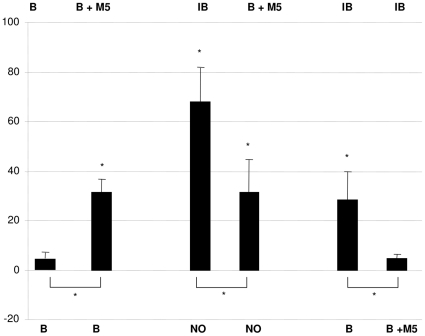
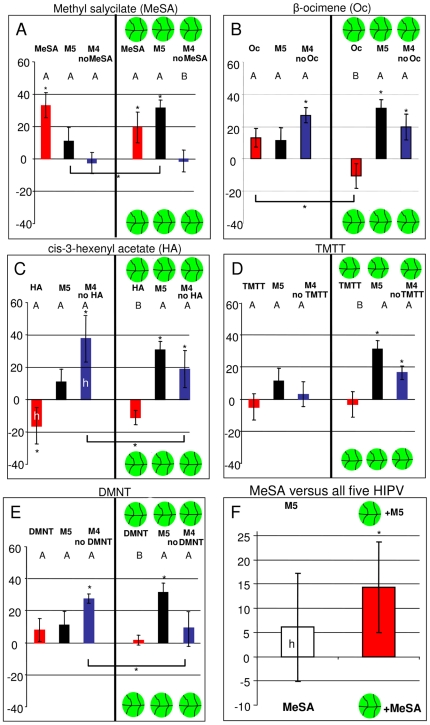
Methodology/principal findings: We studied a system consisting of Lima bean, the herbivorous mite Tetranychus urticae and the predatory mite Phytoseiulus persimilis. We found that four herbivore-induced bean volatiles are not attractive in pure form while a fifth, methyl salicylate (MeSA), is. Several reduced mixtures deficient in one component compared to the full spider-mite induced blend were not attractive despite the presence of MeSA indicating that the predators cannot detect this component in these odor mixtures. A mixture of all five HIPV is most attractive, when offered together with the non-induced odor of Lima bean. Odors that elicit no response in their pure form were essential components of the attractive mixture.
Conclusions/significance: We conclude that the predatory mites perceive odors as a synthetic whole and that the hypothesis that predatory mites recognize attractive HIPV in odor mixtures is unsupported.
Conflict of interest statement
Figures
References
-
- El-Sayed AM. 2011. Pherobase: Database of insect pheromones and semiochemicals ( http://www.pherobase.com). Accessed 2011 Jun 22.
-
- Kappers IF, Aharoni A, van Herpen T, Luckerhoff LLP, Dicke M, et al. Genetic engineering of terpenoid metabolism attracts, bodyguards to Arabidopsis. Science. 2005;309:2070–2072. - PubMed
-
- Laurent G, Stopfer M, Friedrich RW, Rabinovich MI, Volkovskii A, et al. Odor encoding as an active, dynamical process: Experiments, computation, and theory. Annual Review of Neuroscience. 2001;24:263–297. - PubMed
-
- Lledo PM, Gheusi G, Vincent JD. Information processing in the mammalian olfactory system. Physiological Reviews. 2005;85:281–317. - PubMed
-
- Webster B, Bruce T, Pickett J, Hardie J. Volatiles functioning as host cues in a blend become nonhost cues when presented alone to the black bean aphid. Animal Behaviour. 2010;79:451–457.
Publication types
MeSH terms
Substances
LinkOut - more resources
Full Text Sources
