. 2011;6(7):e22187.
doi: 10.1371/journal.pone.0022187. Epub 2011 Jul 13.

Network neighbors of drug targets contribute to drug side-effect similarity

Affiliations

Network neighbors of drug targets contribute to drug side-effect similarity

Lucas Brouwers et al. PLoS One. 2011.

Abstract

In pharmacology, it is essential to identify the molecular mechanisms of drug action in order to understand adverse side effects. These adverse side effects have been used to infer whether two drugs share a target protein. However, side-effect similarity of drugs could also be caused by their target proteins being close in a molecular network, which as such could cause similar downstream effects. In this study, we investigated the proportion of side-effect similarities that is due to targets that are close in the network compared to shared drug targets. We found that only a minor fraction of side-effect similarities (5.8 %) are caused by drugs targeting proteins close in the network, compared to side-effect similarities caused by overlapping drug targets (64%). Moreover, these targets that cause similar side effects are more often in a linear part of the network, having two or less interactions, than drug targets in general. Based on the examples, we gained novel insight into the molecular mechanisms of side effects associated with several drug targets. Looking forward, such analyses will be extremely useful in the process of drug development to better understand adverse side effects.


Conflict of interest statement

Competing Interests: The authors have declared that no competing interests exist.

Figures

Figure 1
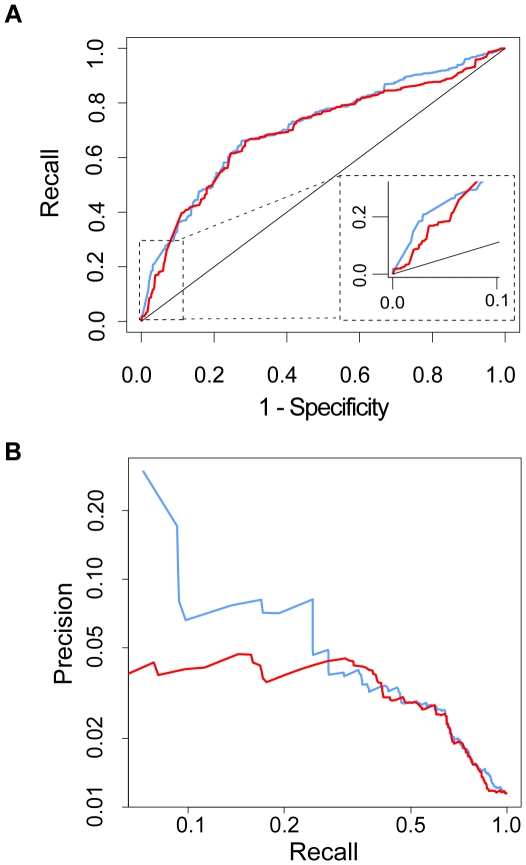
Figure 1. The predictive performance of normalized and direct pathway neighborhood scores for predicting side-effect similarity.
This performance is estimated with a ROC curve (A) and a precision/recall plot (B). For these analyses, we discretize the side-effect similarity p-values into binary values at a cutoff of 0.10 as the target drug pairs to predict. This is a relatively strict cutoff that captures those drug pairs that are sufficiently similar in terms of their adverse effects. Blue: normalized pathway neighborhood scores Red: direct confidence scores STRING.
Figure 2
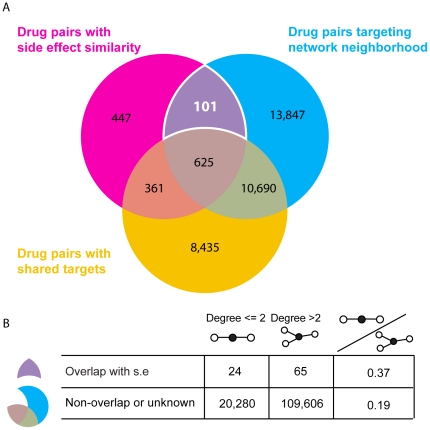
Figure 2. Drug pairs with side effect similarity overlap with drug drug pairs targeting network neighborhood.
(A) Venn diagram of drug pairs with side-effect similarity, shared targets and targeting network neighborhood. We define drug pairs that have side effect p-values ≤0.10 as pairs having significant side-effect similarity. Pairs that target neighboring proteins are defined as having normalized neighborhood score ≥1. Drug pairs that share one or more drug targets are based on data from DrugBank, Matador and PDSP Ki. Only drug-pairs are taken into consideration where at least one drug target is known for both drugs and the side-effect similarity is also available. After removing 12 drug pairs (from 101) where we might expect target-sharing based on chemical or protein similarity, 89 drug pairs are left that target neighboring proteins and have similar side-effects. This is 5.8% of drug pairs with side-effect similarity where we have both target and network information. A minimum of 986 (64%) of side-effect similarities can be explained by sharing drug-targets in the set where at least one drug target is known. (B) Degree distribution of drug pairs with side-effect similarity that target the same network neighborhood. The drugs have been divided in two categories, drugs that target proteins with two or less interaction partners and more than two interaction partners. The drugs in drug pairs that have side-effect similarity target significantly more target proteins with fewer interaction partners than when we consider all drug pairs that target the same network neighborhood. Drug pairs with high chemical similarity or with high sequence similarity of protein binding partners have been removed from the overlapping set, to avoid possible undetected shared targets between drug pairs.
Figure 3
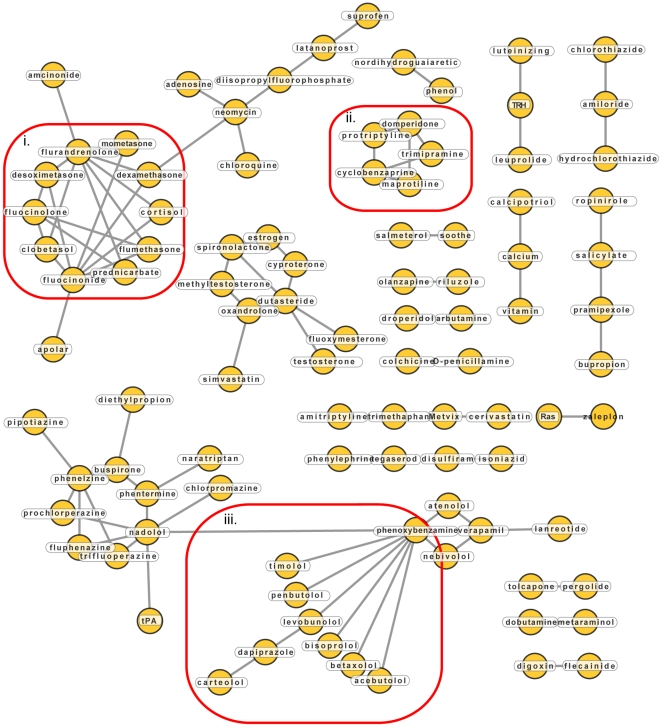
Figure 3. Drug-drug network of drugs targeting network neighbors and having side-effect similarity.
Drugs are drawn as yellow circles, grey lines between them indicate drug targets that are network neighbors.

References

    1. Kola I, Landis J. Can the pharmaceutical industry reduce attrition rates? Nature reviews Drug discovery. 2004;3:711–715. - PubMed
    1. Kuhn M, Campillos M, Gonzalez P, Jensen LJ, Bork P. Large-scale prediction of drug-target relationships. FEBS letters. 2008;582:1283–1290. - PubMed
    1. Bender A, Scheiber J, Glick M, Davies JW, Azzaoui K, et al. Analysis of pharmacology data and the prediction of adverse drug reactions and off-target effects from chemical structure. ChemMedChem. 2007;2:861–873. - PubMed
    1. Campillos M, Kuhn M, Gavin AC, Jensen LJ, Bork P. Drug target identification using side-effect similarity. Science. 2008;321:263–266. - PubMed
    1. Yamanishi Y, Kotera M, Kanehisa M, Goto S. Drug-target interaction prediction from chemical, genomic and pharmacological data in an integrated framework. Bioinformatics. 2010;26:i246–254. - PMC - PubMed

Publication types

MeSH terms