Review
. 2012 Jan;1824(1):34-43.
doi: 10.1016/j.bbapap.2011.07.003. Epub 2011 Jul 13.

Specific functions of lysosomal proteases in endocytic and autophagic pathways

Affiliations
Review

Specific functions of lysosomal proteases in endocytic and autophagic pathways

Sabrina Müller et al. Biochim Biophys Acta. 2012 Jan.

Abstract

Endolysosomal vesicles form a highly dynamic multifunctional cellular compartment that contains multiple highly potent proteolytic enzymes. Originally these proteases have been assigned to cooperate solely in executing the unselective 'bulk proteolysis' within the acidic milieu of the lysosome. Although to some degree this notion still holds true, evidence is accumulating for specific and regulatory functions of individual 'acidic' proteases in many cellular processes linked to the endosomal/lysosomal compartment. Here we summarize and discuss the functions of individual endolysosomal proteases in such diverse processes as the termination of growth factor signaling, lipoprotein particle degradation, infection, antigen presentation, and autophagy. This article is part of a Special Issue entitled: Proteolysis 50 years after the discovery of lysosome.


Figures

Fig. 1
Fig. 1
Cathepsins in growth factor signaling—the EGF example. After binding of epidermal growth factor (EGF) to the EGF-receptor at the cell surface, receptor–ligand complexes are internalized. The complexes are then transported by vesicles termed early endosomes (EE), where EGF dissociates from its receptor, to late endosomes (LE) (1). Under physiological conditions some receptors are recycled to the plasma membrane (3) by transporting vesicles (TV), however, the majority of the receptors as well as EGF are terminally transported to lysosomes (LY), where they are degraded to shut off the signaling cascade (2). In cathepsin L deficient keratinocytes the receptor–ligand complexes are taken up normally and are transported by EE to the LE compartment (4). The loss of the protease, however, leads to reduced degradation of the receptor and its ligand in LY (5), and consequently to enhanced recycling of the EGF receptor, and notably, of intact EGF by TV to the plasma membrane (6). This results in increased EGF signal transduction (indicated by the red arrow) and hence in increased cell proliferation. formula image Active endolysosomal protease, formula image deficient endolysosomal protease, formula image dimerized EGF receptors, formula image two EGF molecules.
Fig. 2
Fig. 2
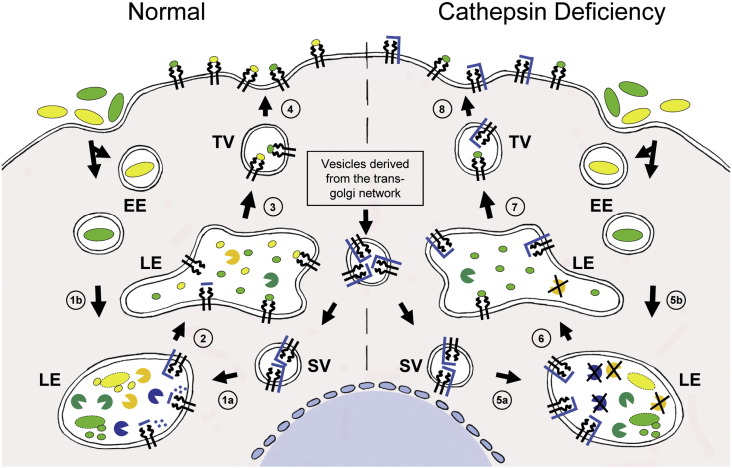
Cathepsins in MHC class II antigen presentation. In APCs, newly synthesized MHC class II molecules are transported by sorting vesicles (SV) from the trans-Golgi network to the late endosomes (LE) (1a) where the invariant chain is proteolytically processed by endolysosomal proteases. Extracellular bacteria, which are taken up by phagocytosis, are transported by early endosomes (EE; also named phagosomes) to the late endosomal compartment (1b). Within this compartment antigenic protein complexes are degraded by various endolysosomal proteases to antigenic peptides. These newly generated antigenic peptides are loaded into the binding groove of MHC class II molecules in LE (2). These complexes are routed to the cell surface by transporting vesicles (TV) (3) and are subsequently presented to CD4+ T helper cells to initiate an adaptive immune response. In cathepsin S deficient APCs, the MHC class II molecules reach the LE from the trans-Golgi network as previously described (5a). However, the invariant chain is incompletely processed within the LE, leading to a blocked peptide binding groove. Because of this, antigenic peptides are insufficiently loaded onto MHC class II molecules (6), which in turn results, after transport to the cell surface (7), in reduced presentation of antigenic peptides to CD4+ T helper cells (8). Furthermore, the deficiency for a single endolysosomal protease, i.e. AEP, leads to a reduction in the repertoire of antigenic peptides generated in LE (5b;6), which can be presented by MHC class II molecules (7;8). This finally results in an impaired immune response, normally induced by the particular antigenic peptides. formula image Active endolysosomal protease, formula image deficient endolysosomal protease, formula image MHC class II molecule, formula image invariant chain, formula image antigenic peptide, formula image bacterium/pathogen/antigenic protein.
Fig. 3
Fig. 3
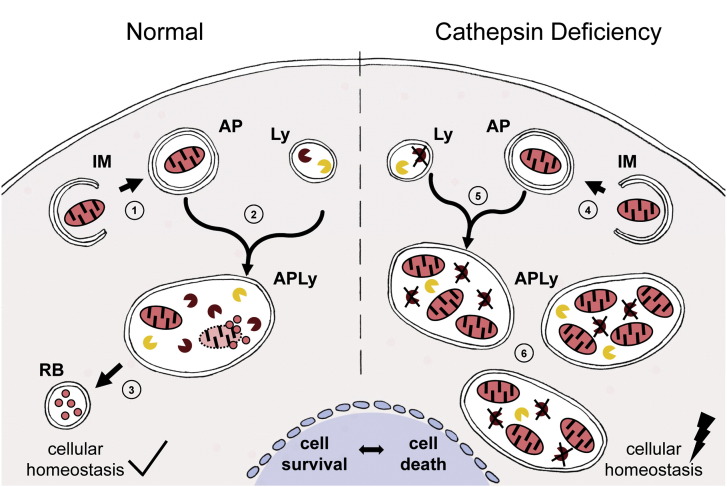
Cathepsins in macroautophagy and cellular homeostasis. In the process of macroautophagy, dysfunctional organelles, such as mitochondria, are enclosed by a double membrane, the so-called isolation membrane (IM), and subsequently an autophagosome (AP) is formed (1). AP fusion with lysosomes (LY) results in autophagolysosomes (APLy) in which AP cargo is degraded (2). In healthy cells, only small residual bodies (RB) remain (3). Lack of critical protease activities in the lysosome, i.e. cathepsin D or cathepsin L deficiency, does not primarily impair IM (4) nor APLy (5) formation. However, in the case of protease deficiency material enclosed by autophagolysosomes cannot be degraded, resulting in an accumulation of unusually large vesicles, i.e. APLy (6), defective in termination of the autophagic process. This pathomechanism of lysosomal storage may impair tissue function and eventually cause cell death which in turn results in a clinically relevant lysosomal storage disorder. formula image Active endolysosomal protease, formula image deficient endolysosomal protease, formula image mitochondrion.

References

    1. De Duve C., Wattiaux R. Functions of lysosomes. Annu. Rev. Physiol. 1966;28:435–492. - PubMed
    1. Willstätter R., Bamann E. Über die Proteasen der Magenschleimhaut. Erste Abhandlung über die Enzyme der Leukozyten., Hoppe-Seyler's. Z. Physiol. Chem. 1929;180:127–143.
    1. Rawlings N.D., Barrett A.J., Bateman A. MEROPS: the peptidase database. Nucleic Acids Res. 2010;38:D227–D233. - PMC - PubMed
    1. Goulet B., Baruch A., Moon N.S., Poirier M., Sansregret L.L., Erickson A., Bogyo M., Nepveu A. A cathepsin L isoform that is devoid of a signal peptide localizes to the nucleus in S phase and processes the CDP/Cux transcription factor. Mol. Cell. 2004;14:207–219. - PubMed
    1. Sever S., Altintas M.M., Nankoe S.R., Moller C.C., Ko D., Wei C., Henderson J., del Re E.C., Hsing L., Erickson A., Cohen C.D., Kretzler M., Kerjaschki D., Rudensky A., Nikolic B., Reiser J. Proteolytic processing of dynamin by cytoplasmic cathepsin L is a mechanism for proteinuric kidney disease. J. Clin. Invest. 2007;117:2095–2104. - PMC - PubMed

Publication types

Substances

LinkOut - more resources