. 2011 Aug 2;108(31):12931-6.
doi: 10.1073/pnas.1104495108. Epub 2011 Jul 18.

Identification of transmitter systems and learning tag molecules involved in behavioral tagging during memory formation

Affiliations

Identification of transmitter systems and learning tag molecules involved in behavioral tagging during memory formation

Diego Moncada et al. Proc Natl Acad Sci U S A. .

Abstract

Long-term memory (LTM) consolidation requires the synthesis of plasticity-related proteins (PRPs). In addition, we have shown recently that LTM formation also requires the setting of a "learning tag" able to capture those PRPs. Weak training, which results only in short-term memory, can set a tag to use PRPs derived from a temporal-spatial closely related event to promote LTM formation. Here, we studied the involvement of glutamatergic, dopaminergic, and noradrenergic inputs on the setting of an inhibitory avoidance (IA) learning tag and the synthesis of PRPs. Rats explored an open field (PRP donor) followed by weak (tag inducer) or strong (tag inducer plus PRP donor) IA training. Throughout pharmacological interventions around open-field and/or IA sessions, we found that hippocampal dopamine D1/D5- and β-adrenergic receptors are specifically required to induce PRP synthesis. Moreover, activation of the glutamatergic NMDA receptors is required for setting the learning tags, and this machinery further required α-Ca(2+)/calmodulin-dependent protein kinase II and PKA but not ERK1/2 activity. Together, the present findings emphasize an essential role of the induction of PRPs and learning tags for LTM formation. The existence of only the PRP or the tag was insufficient for stabilization of the mnemonic trace.


Conflict of interest statement

The authors declare no conflict of interest.

Figures
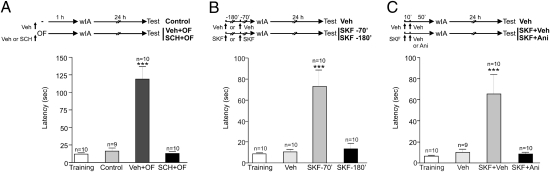
Fig. 1.
Fig. 1.
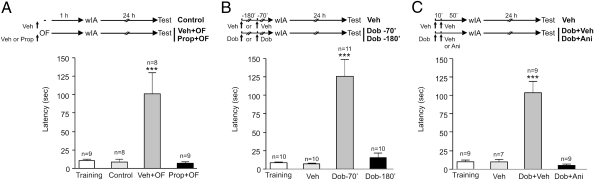
OF promotes IA-LTM through dopamine-dependent PRP synthesis in the hippocampus. In all figures, the top of each panel shows the experimental design. All graphs show step-down latencies expressed as mean ± SEM. Training latency is representative for all groups. (A) OF-induced IA-LTM is impaired by the infusion of SCH into the CA1-dHP 10 min before OF exposure. ***P < 0.001 vs. all groups. (B) SKF injected i.p. 70 min but not 180 min before wIA training promoted IA-LTM. ***P < 0.001 vs. all groups. (C) SKF-induced IA-LTM was impaired by the infusion of Ani in the CA1-dHP 10 min after SKF i.p injection. ***P < 0.001 vs. all groups. Veh, vehicle.
Fig. 2.
Fig. 2.
OF exposure promotes IA-LTM through β-adrenergic–dependent PRP synthesis in the hippocampus. All graphs show step-down latencies expressed as mean ± SEM. Training latency is representative for all groups. (A) OF-induced IA-LTM is impaired by the infusion of Prop in the dentate gyrus-dHP 10 min before OF exposure. ***P < 0.001 vs. all groups. (B) Dob injected i.p. 70 min but not 180 min before wIA training promoted IA-LTM. ***P < 0.001 vs. all groups. (C) Dob-induced IA-LTM was impaired by the infusion of Ani in dentate gyrus-dHP 10 min after Dob i.p injection. ***P < 0.001 vs. all groups.
Fig. 3.
Fig. 3.
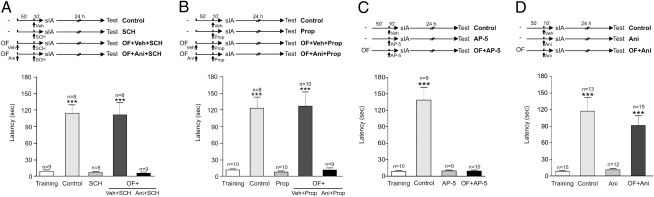
D1/D5 and β-adrenergic receptors are required to trigger PRP synthesis, and NMDA-receptor activation is necessary for tagging in IA-LTM formation. All graphs show step-down latencies expressed as mean ± SEM. Training latency is representative for all groups. (A) OF exploration prevented the anterograde amnesia induced by the infusion of SCH into the CA1-dHP 10 min before sIA training. This preventive effect was impaired by Ani given immediately after OF exposure. ***P < 0.001 vs. training, SCH, and OF + Ani + SCH. (B) As in A but using Prop. (C) OF exploration did not prevent the anterograde amnesia induced by the infusion of AP5 in the CA1-dHP 10 min before sIA training. ***P < 0.001 vs. all groups. (D) OF exploration prevented the anterograde amnesia induced by the infusion of Ani in the CA1-dHP 10 min before sIA training. ***P < 0.001 vs. training and Ani.
Fig. 4.
Fig. 4.
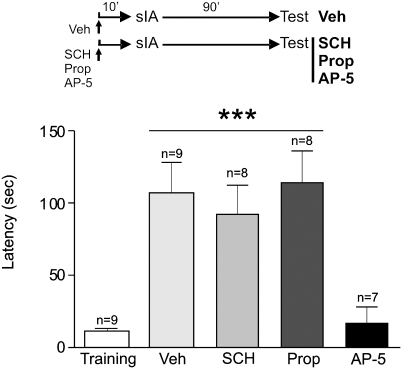
IA-STM depends on NMDA- but not D1/D5- or β-adrenergic–receptor activation during training. Infusion of AP-5 (in CA1) but not vehicle (in CA1 or dentate gyrus), SCH (in CA1), or Prop (in dentate gyrus) 10 min before sIA training impaired IA-STM. Training latency is representative for all groups. ***P < 0.001 vs. training and AP-5.
Fig. 5.
Fig. 5.
All graphs show step-down latencies expressed as mean ± SEM. Training latency is representative for all groups. (A) OF-induced IA-LTM was prevented by AP-5 infusion in CA1-dHP 10 min before wIA training. ***P < 0.001 vs. all groups. (B) OF-induced IA-LTM was prevented by KN62 infusion in CA1-dHP 10 min before and 15 min after but not 60 min after wIA training. Vehicle was infused at each of these three times, and results were pooled. ***P < 0.001 vs. training, control, OF + KN62-10′, and OF + KN62+15′ groups. (C) As in B but using Rp-cAMP infusion. (D) U0126 infusion in CA1-dHP 10 min before wIA training did not impair OF-induced IA-LTM. ***P < 0.001 vs. training and control groups.
Fig. 6.
Fig. 6.
Effects of catecholaminergic or NMDA-receptor activation and protein kinases on protein synthesis and IA learning-tag setting. The timeline at the top indicates the time points of the experimental procedures. The intersection of PRPs and the tag lines represents the moment in which they coexist and therefore protein capture by the learning tags is plausible; however, these lines do not reflect the strict time course of PRPs’ availability or duration of the learning tag.

References

    1. Moncada D, Viola H. Induction of long-term memory by exposure to novelty requires protein synthesis: Evidence for a behavioral tagging. J Neurosci. 2007;27:7476–7481. - PMC - PubMed
    1. Ballarini F, Moncada D, Martinez MC, Alen N, Viola H. Behavioral tagging is a general mechanism of long-term memory formation. Proc Natl Acad Sci USA. 2009;106:14599–14604. - PMC - PubMed
    1. Lisman JE, Grace AA. The hippocampal-VTA loop: Controlling the entry of information into long-term memory. Neuron. 2005;46:703–713. - PubMed
    1. Klukowski G, Harley CW. Locus coeruleus activation induces perforant path-evoked population spike potentiation in the dentate gyrus of awake rat. Exp Brain Res. 1994;102:165–170. - PubMed
    1. Sara SJ, Vankov A, Hervé A. Locus coeruleus-evoked responses in behaving rats: A clue to the role of noradrenaline in memory. Brain Res Bull. 1994;35:457–465. - PubMed

Publication types

MeSH terms