


Activity of abundant and rare bacteria in a coastal ocean
- PMID: 21768380
- PMCID: PMC3150899
- DOI: 10.1073/pnas.1101405108
Activity of abundant and rare bacteria in a coastal ocean
Abstract
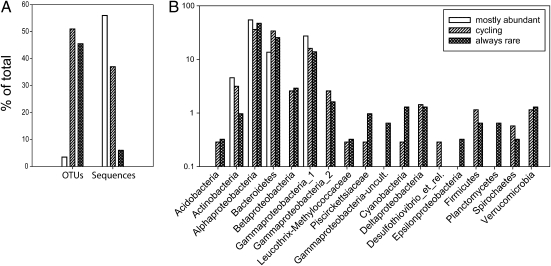
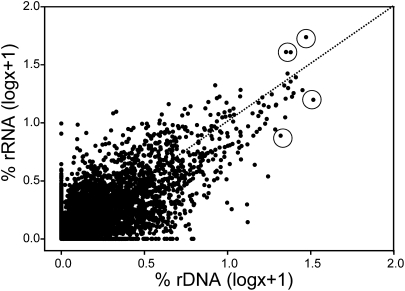
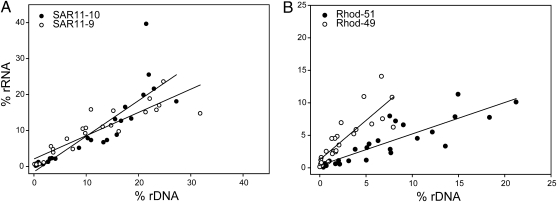
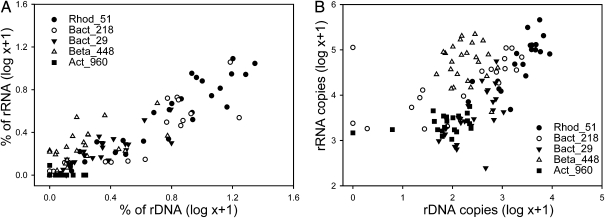
The surface layer of the oceans and other aquatic environments contains many bacteria that range in activity, from dormant cells to those with high rates of metabolism. However, little experimental evidence exists about the activity of specific bacterial taxa, especially rare ones. Here we explore the relationship between abundance and activity by documenting changes in abundance over time and by examining the ratio of 16S rRNA to rRNA genes (rDNA) of individual bacterial taxa. The V1-V2 region of 16S rRNA and rDNA was analyzed by tag pyrosequencing in a 3-y study of surface waters off the Delaware coast. Over half of the bacterial taxa actively cycled between abundant and rare, whereas about 12% always remained rare and potentially inactive. There was a significant correlation between the relative abundance of 16S rRNA and the relative abundance of 16S rDNA for most individual taxa. However, 16S rRNA:rDNA ratios were significantly higher in about 20% of the taxa when they were rare than when abundant. Relationships between 16S rRNA and rDNA frequencies were confirmed for five taxa by quantitative PCR. Our findings suggest that though abundance follows activity in the majority of the taxa, a significant portion of the rare community is active, with growth rates that decrease as abundance increases.
Conflict of interest statement
The authors declare no conflict of interest.
Figures
References
-
- Pedrós-Alió C. Marine microbial diversity: Can it be determined? Trends Microbiol. 2006;14:257–263. - PubMed
-
- Ward BB. Nitrification and the marine nitrogen cycle. In: Kirchman DL, editor. Microbial Ecology of the Oceans. New York: Wiley-Liss; 2000. pp. 427–453.
Publication types
MeSH terms
Substances
LinkOut - more resources
Full Text Sources
