. 2011 Oct;55(10):4712-7.
doi: 10.1128/AAC.00628-11. Epub 2011 Jul 18.

Molecular basis for the selectivity of antituberculosis compounds capreomycin and viomycin

Affiliations

Molecular basis for the selectivity of antituberculosis compounds capreomycin and viomycin

Rashid Akbergenov et al. Antimicrob Agents Chemother. 2011 Oct.

Abstract

Capreomycin and the structurally similar compound viomycin are cyclic peptide antibiotics which are particularly active against Mycobacterium tuberculosis, including multidrug resistant strains. Both antibiotics bind across the ribosomal interface involving 23S rRNA helix 69 (H69) and 16S rRNA helix 44 (h44). The binding site of tuberactinomycins in h44 partially overlaps with that of aminoglycosides, and they share with these drugs the side effect of irreversible hearing loss. Here we studied the drug target interaction on ribosomes modified by site-directed mutagenesis. We identified rRNA residues in h44 as the main determinants of phylogenetic selectivity, predict compensatory evolution to impact future resistance development, and propose mechanisms involved in tuberactinomycin ototoxicity, which may enable the development of improved, less-toxic derivatives.


Figures
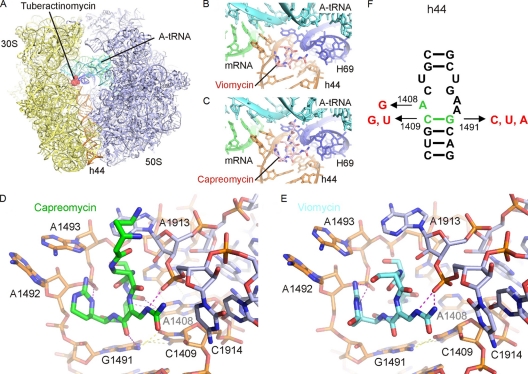
Fig. 1.
Fig. 1.
Binding site of tuberactinomycins viomycin and capreomycin. (A) Overview of the binding site of the tuberactinomycins (red) at the interface between the small (30S) (yellow) and large (50S) (blue) ribosomal subunits (37). A-tRNA (cyan), P-tRNA (green), and h44 (orange) are in color for reference. (B and C) Enlargement of panel A to show binding site of viomycin (B) and capreomycin (C) to h44 (orange) of the 30S and H69 (blue) of the 50S, with the mRNA and A-tRNA in green and cyan, respectively. (D and E) Interaction of the tuberactinomycins within the ribosomal binding site. Capreomycin (D) (green) and viomycin (E) (cyan) form hydrogen bond interactions (magenta) with h44 of the 16S rRNA (orange) and H69 of the 23S rRNA (blue) (37). Intramolecular hydrogen bonds between rRNA nucleotides are yellow. (F) Secondary structure of decoding site rRNA sequences in the small ribosomal subunit. Nucleotides shown in green represent residues that were exchanged to residues shown in red. rRNA nucleotides are numbered according to the bacterial nomenclature; i.e., to homologous E. coli 16S rRNA positions.
Fig. 2.
Fig. 2.
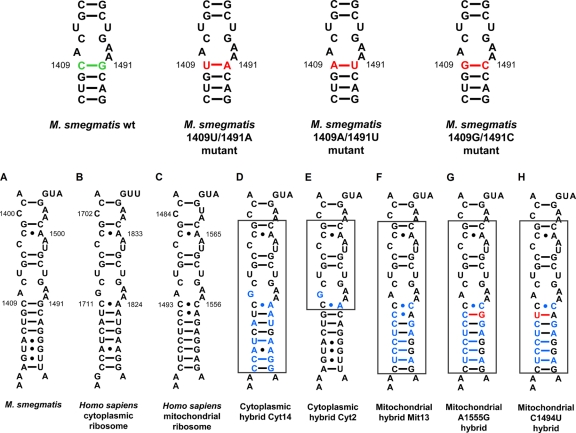
(Top) Compensatory mutations in decoding site of bacterial small ribosomal subunit rRNA. Nucleotides shown in green represent residues that were exchanged to residues shown in red. (Bottom) Secondary-structure comparison of decoding site rRNA sequences in the small ribosomal subunit. (A) Decoding region of 16S rRNA helix 44 in wild-type ribosomes of M. smegmatis; rRNA nucleotides are numbered according to the bacterial nomenclature; i.e., to homologous E. coli 16S rRNA positions. (B) Homologous 18S rRNA sequence in human ribosomes; rRNA residues are numbered according to the human cytoplasmic ribosome nomenclature. (C) Homologous 12S rRNA sequence in human mitochondrial ribosomes; rRNA residues are numbered according to the mitochondrial nomenclature. (D to H) Decoding site rRNA of human-bacterial hybrid ribosomes. The transplanted helix is boxed, and nucleotide positions shown in blue represent residues that are specific for human rRNA. Mutations that are associated with hypersusceptibility to aminoglycoside antibiotics, mitochondrial DNA position 1555A→G (G), and 1494C→U (H) are highlighted in red.
Fig. 3.
Fig. 3.
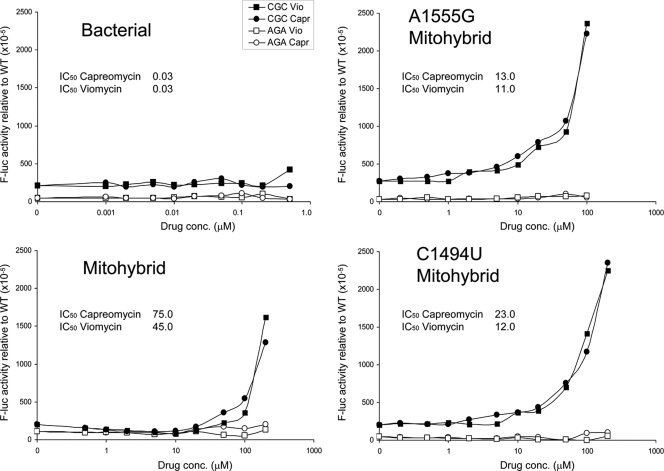
Effect of capreomycin and viomycin on misreading during translation elongation. Drug-induced misreading was quantified using the Arg245 (CGC) near-cognate mutant of firefly luciferase (filled circles, capreomycin [Capr]; filled squares, viomycin [Vio]). The Arg245 (AGA) noncognate mutant of firefly luciferase was used as a misreading control (open circles, capreomycin [Capr]; open squares; viomycin [Vio]). Bacterial ribosomes, mitohybrid ribosomes, mutant 1555G mitohybrid ribosomes, and mutant C1494U mitohybrid ribosomes are indicated. Misreading was calculated by comparing mutant firefly/Renilla luciferase activity to wild-type His245 (CAC) firefly/Renilla luciferase activity. The IC50 inhibitory values (drug concentrations which inhibit protein synthesis to 50%) are indicated; for a comparison, see Table 2.

References

    1. Blumberg H. M., et al. 2003. American Thoracic Society/Centers for Disease Control and Prevention/Infectious Diseases Society of America: treatment of tuberculosis. Am. J. Respir. Crit. Care Med. 167:603–662 - PubMed
    1. Böttger E. C. 2007. Antimicrobial agents targeting the ribosome: the issue of selectivity and toxicity—lessons to be learned. Cell. Mol. Life Sci. 64:791–795 - PMC - PubMed
    1. Böttger E. C., Springer B., Prammananan T., Kidan Y., Sander P. P. 2001. Structural basis for selectivity and toxicity of ribosomal antibiotics. EMBO Rep. 2:318–323 - PMC - PubMed
    1. Böttger E. C., Springer B. 2008. Tuberculosis: drug resistance, fitness, and strategies for global control. Eur. J. Pediatr. 167:141–148 - PubMed
    1. Böttger E. C., Springer B., Pletschette M., Sander P. 1998. Fitness of antibiotic-resistant microorganisms and compensatory mutations. Nat. Med. 4:1343–1344 - PubMed

Publication types

MeSH terms

LinkOut - more resources