


Early treatment with lisinopril and spironolactone preserves cardiac and skeletal muscle in Duchenne muscular dystrophy mice
- PMID: 21768542
- PMCID: PMC3150227
- DOI: 10.1161/CIRCULATIONAHA.111.031716
Early treatment with lisinopril and spironolactone preserves cardiac and skeletal muscle in Duchenne muscular dystrophy mice
Abstract
Background: Nearly universal cardiomyopathy in Duchenne muscular dystrophy (DMD) contributes to heart failure and death. Because DMD patients show myocardial fibrosis well before functional impairment, we postulated that earlier treatment using drugs with antifibrotic effect may be beneficial.
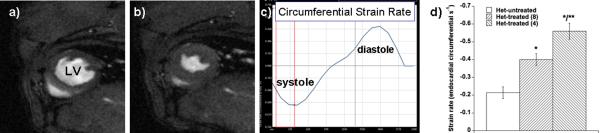
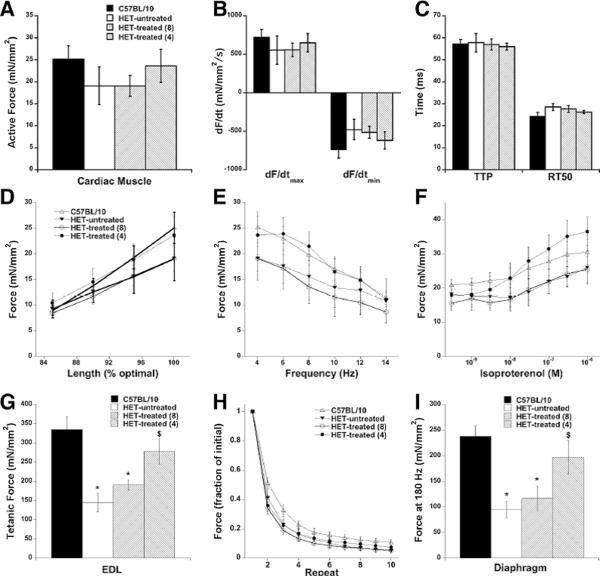
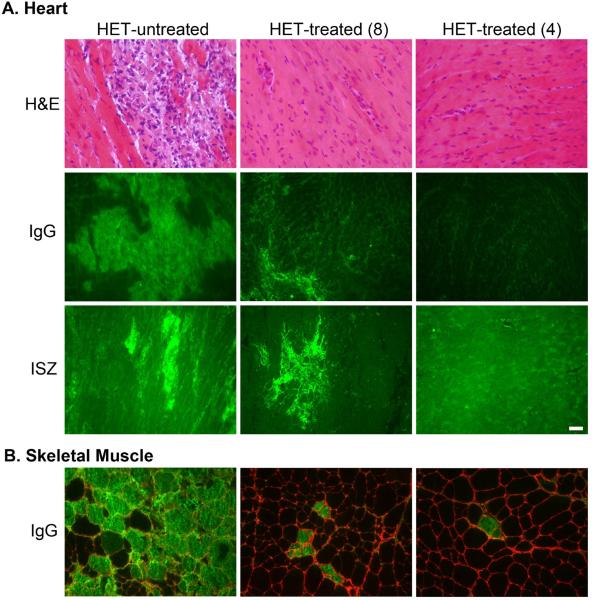
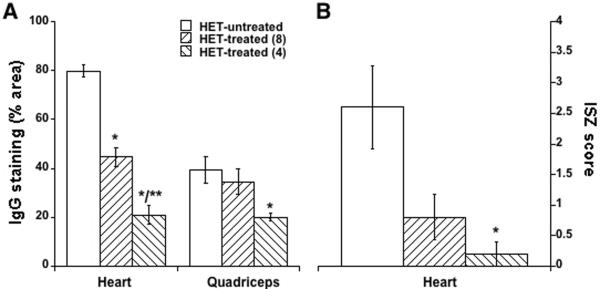
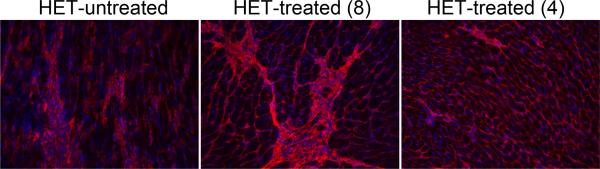
Methods and results: Three groups of 10 utrn(+/-);mdx, or "het" mice, deficient for dystrophin and haploinsufficient for utrophin with skeletal myopathy and cardiomyopathy that closely mimics clinical DMD were studied. One het group received spironolactone and lisinopril starting at 8 weeks of life (het-treated-8); a second received the same starting at 4 weeks of life (het-treated-4), and the third het group was untreated. At 20 weeks, all mice had normal ejection fractions though circumferential strain rate was abnormal (-0.21±0.08) in untreated hets. This improved to -0.40±0.07 in het-treated-8 mice (P=0.003) and further improved to -0.56±0.10 in het-treated-4 mice (P=0.014 for het-treated-4 versus het-treated-8). Treated mice showed less cardiomyocyte damage, with a 44% reduction in intracardiomyocyte serum immunoglobulin G localization in het-treated-8 mice (P<0.0001) and a further 53% reduction in het-treated-4 mice (P=0.0003 versus het-treated-8); matrix metalloproteinases were similarly reduced. Cardiac, limb, and diaphragm function by ex vivo muscle testing remained at 80% of normal with early treatment compared to a decline to 40% of normal skeletal muscle function without treatment.
Conclusions: These findings offer clinically available medications with proven antifibrotic effect as a new therapeutic strategy in DMD. Early initiation greatly attenuated myocardial disease and, for the first time with these drugs, improved skeletal myopathy. Thus, early initiation of such agents warrants further clinical evaluation to maintain ambulatory, respiratory, and cardiac function for patients with DMD and related myopathies.
Figures
Comment in
-
Letter by Fayssoil regarding article, "Early treatment with lisinopril and spironolactone preserves cardiac and skeletal muscle in Duchenne muscular dystrophy mice".Circulation. 2012 Mar 6;125(9):e429. doi: 10.1161/CIRCULATIONAHA.111.061093. Circulation. 2012. PMID: 22392872 No abstract available.
References
-
- English KM, Gibbs JL. Cardiac monitoring and treatment for children and adolescents with neuromuscular disorders. Dev Med Child Neurol. 2006;48:231–235. - PubMed
-
- Bushby K, Muntoni F, Bourke JP. 107th ENMC international workshop: the management of cardiac involvement in muscular dystrophy and myotonic dystrophy. 7th–9th June 2002, Naarden, the Netherlands. Neuromuscul Disord. 2003;13:166–172. - PubMed
-
- Hunt SA, Abraham WT, Chin MH, Feldman AM, Francis GS, Ganiats TG, Jessup M, Konstam MA, Mancini DM, Michl K, Oates JA, Rahko PS, Silver MA, Stevenson LW, Yancy CW, Antman EM, Smith SC, Jr, Adams CD, Anderson JL, Faxon DP, Fuster V, Halperin JL, Hiratzka LF, Jacobs AK, Nishimura R, Ornato JP, Page RL, Riegel B. ACC/AHA 2005 guideline update for the diagnosis and management of chronic heart failure in the adult: a report of the American College of Cardiology/American Heart Association Task Force on Practice Guidelines (Writing Committee to Update the 2001 Guidelines for the Evaluation and Management of Heart Failure): developed in collaboration with the American College of Chest Physicians and the International Society for Heart and Lung Transplantation: Endorsed by the Heart Rhythm Society. Circulation. 2005;112:e154–235. - PubMed
-
- Zannad F, McMurray JJ, Krum H, van Veldhuisen DJ, Swedberg K, Shi H, Vincent J, Pocock SJ, Pitt B. Eplerenone in patients with systolic heart failure and mild symptoms. N Engl J Med. 2010;364:11–21. - PubMed
Publication types
MeSH terms
Substances
Grants and funding
LinkOut - more resources
Full Text Sources
Other Literature Sources
Medical
Molecular Biology Databases
