


The frequency and characteristics of mesiodens in a Turkish patient population
- PMID: 21769282
- PMCID: PMC3137454
The frequency and characteristics of mesiodens in a Turkish patient population
Abstract
Objectives: The aim of this study was to investigate the frequency and characteristics of mesiodens among a group of orthodontic patients in Turkey.
Methods: A retrospective study was performed using panoramic radiographs of 3,351 patients ranging in age from 8 to 16 subjected to dental treatment in the Department of Oral and Maxillofacial Radiology and Department of Orthodontics (Erzurum, Turkey) between 1996 and 2008. All medical and demographic data (age and sex) were obtained from the files. Descriptive characteristics of mesiodentes, including number, shape, position, complication caused by mesiodens and treatment were recorded. The Chi-squared test was used.
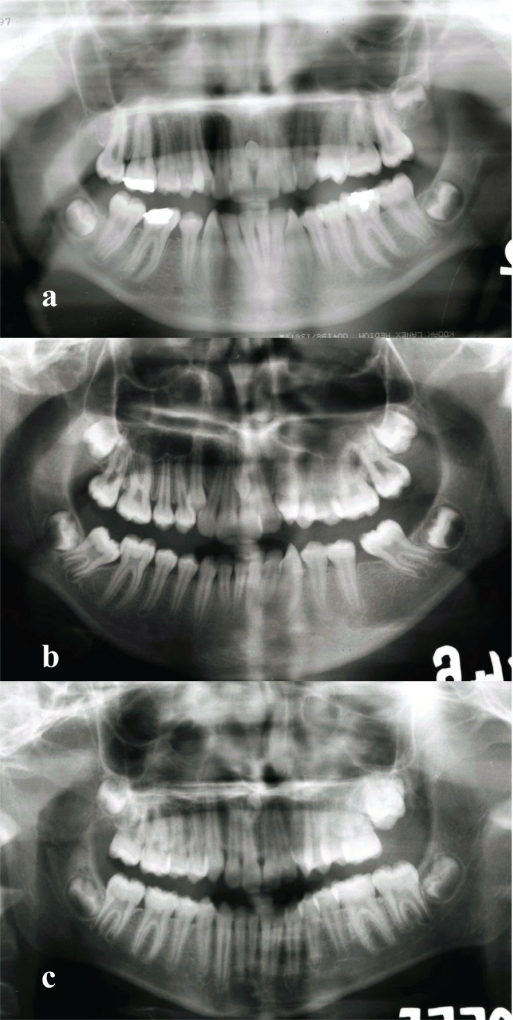
Results: Results show that the frequency of mesiodens was 0.3% with the ratio of boys (6 cases) to girls (4 cases) being 1.5:1 and this was not statistically significant (P>.05). Of the 10 children, 8 (80.0%) had 1 mesiodens and 2 (20.0%) had 2 mesiodentes bilaterally to midline. Of the 12 mesiodentes, 8 (66.7%) were fully impacted, 7 (58.3%) in a vertical position and 9 (75.0%) conical shape. The most common complication caused by mesiodens was delayed eruption of the permanent incisors in 4 cases (40.0%).
Conclusions: The frequency of mesiodens in Turkish orthodontic patients was found to be 0.3% and more frequently in males with the ratio being approximately 1.5:1. Most of the mesiodentes were in conical shape (75.0%). Sixty-seven percent of the cases were fully impacted.
Keywords: Mesiodens; Prevalence; Turkish population.
Figures
References
-
- Sedano HO, Gorlin RJ. Familial occurrence of mesiodens. Oral Surg Oral Med Oral Pathol. 1969;27:360–361. - PubMed
-
- Sykaras SN. Mesiodens in primary and permanent dentitions. Report of a case. Oral Surg Oral Med Oral Pathol. 1975;39:870–874. - PubMed
-
- Primosch RE. Anterior supernumerary teeth-assessment and surgical intervention in children. Pediatr Dent. 1981;3:204–215. - PubMed
-
- Stellzig A, Basdra EK, Komposch G. Mesiodentes: incidence, morphology, etiology. Fortschr Kieferorthop J Orofac Orthop. 1997;58:144–153. - PubMed
-
- Gorlin RJ, CM, Hennekam RC. Syndromes of the head and neck. 4th ed. Oxford University Press; 2001.
LinkOut - more resources
Full Text Sources