. 2012 Apr;21(4):691-7.
doi: 10.1007/s00586-011-1912-5. Epub 2011 Jul 17.

The effect of simulating leg length inequality on spinal posture and pelvic position: a dynamic rasterstereographic analysis

Affiliations

The effect of simulating leg length inequality on spinal posture and pelvic position: a dynamic rasterstereographic analysis

Marcel Betsch et al. Eur Spine J. 2012 Apr.

Abstract

Introduction: Leg length inequalities (LLI) are a common finding. Rasterstereography offers a non-invasive, contact-free and reliable method to detect the effects of LLIs on spinal posture and pelvic position.

Materials and methods: A total of 115 subjects were rasterstereographically examined during different artificially created leg length inequalities (5-15 mm) using a platform. The pelvic obliquity and torsion and the lateral and frontal deviation of the spine, as well as the surface rotation, were measured.

Results: Changes in platform height led to an increase of the pelvic tilt and torsion. Only minor changes in the spinal posture were found by different simulated leg length inequalities.

Conclusions: Our study showed that there was a correlation between an artificial leg length inequality up to 15 mm and pelvic tilt or torsion, but only minor changes in the spinal posture were measured. Further studies should investigate the effects of greater leg length inequalities on spine and pelvis.


Figures
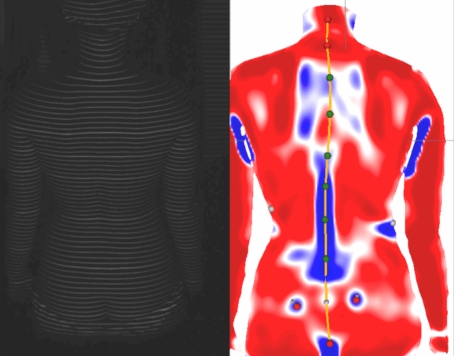
Fig. 1
Fig. 1
A rasterstereographic measurement of a female test subject with a simulated LLI of +15 mm on the right side. The left image shows the back surface of the female test subject with the projected horizontal light lines. This image is then analysed by the computer and transformed into a 3-D surface map of the back surface (right image). The red colour on the back surface represents a convex surface area, while the blue colour stands for a concave surface area
Fig. 2
Fig. 2
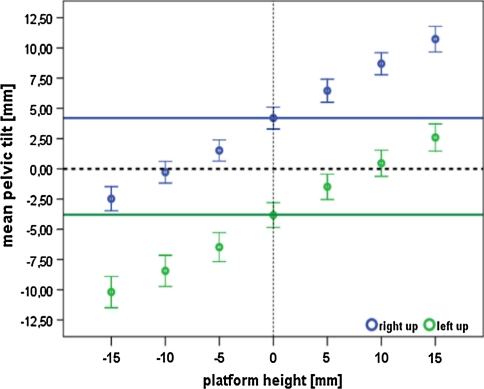
The mean pelvic tilt (with SD) in mm for the simulated different platform heights (0, 5, 10, 15 mm) for the right-up and left-up group. The figure demonstrates an increase in the mean pelvic tilt by raising the platform height. The blue and green horizontal lines show the mean pelvic tilt for both groups in the neutral position. Negative values of the platform height mean an elevation of the platform on the left side, and positive values mean an elevation on the ride side
Fig. 3
Fig. 3
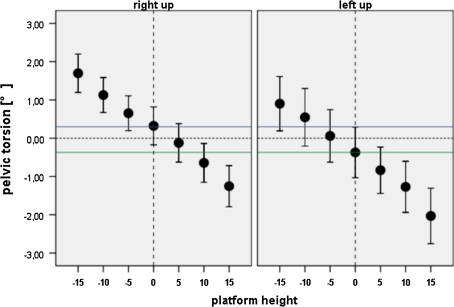
The mean pelvic torsion in degrees for the different platform heights. For both groups an increase in pelvic torsion by raising the platform can be found
Fig. 4
Fig. 4
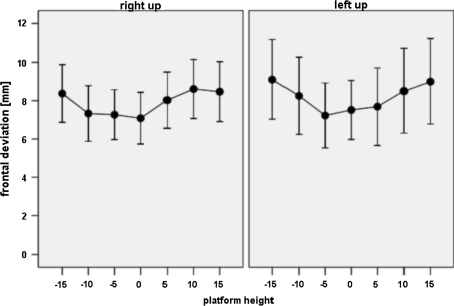
Only minor changes of the mean frontal deviation in both groups for the different simulated platform heights
Fig. 5
Fig. 5
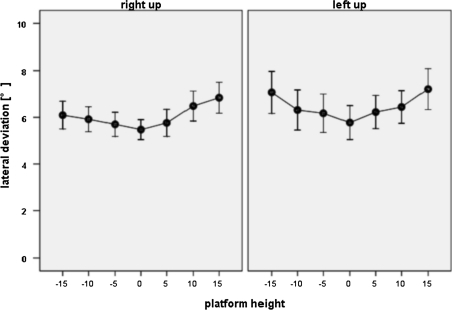
Only minor changes of the mean lateral deviation in both groups for the different simulated platform heights
Fig. 6
Fig. 6
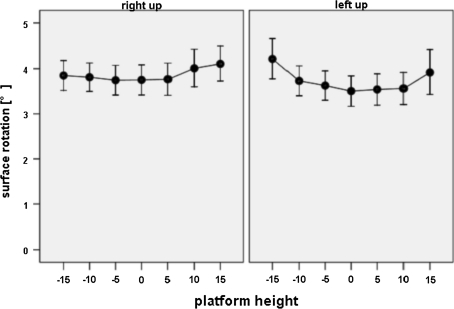
Only minor changes of the mean surface rotation in both groups for the different simulated platform heights

References

    1. Beaudoin L, Zabjek KF, Leroux MA, Coillard C, Rivard CH. Acute systematic and variable postural adaptations induced by an orthopaedic shoe lift in control subjects. Eur Spine J. 1999;8:40–45. doi: 10.1007/s005860050125. - DOI - PMC - PubMed
    1. Betsch M, Wild M, Jungbluth P, Thelen S, Hakimi M, Windolf J, Horstmann T, Rapp W (2010) The rasterstereographic-dynamic analysis of posture in adolescents using a modified Matthiass test. Eur Spine J 19(10):1735–1939 - PMC - PubMed
    1. Brunet ME, Cook SD, Brinker MR, Dickinson JA. A survey of running injuries in 1,505 competitive and recreational runners. J Sports Med Phys Fitness. 1990;30:307–315. - PubMed
    1. Cummings G, Scholz JP, Barnes K. The effect of imposed leg length difference on pelvic bone symmetry. Spine (Phila Pa 1976) 1993;18:368–373. doi: 10.1097/00007632-199303000-00012. - DOI - PubMed
    1. Drerup B, Hierholzer E. Automatic localization of anatomical landmarks on the back surface and construction of a body-fixed coordinate system. J Biomech. 1987;20:961–970. doi: 10.1016/0021-9290(87)90325-3. - DOI - PubMed

Publication types