


Membrane shaping by the Bin/amphiphysin/Rvs (BAR) domain protein superfamily
- PMID: 21769645
- PMCID: PMC11114942
- DOI: 10.1007/s00018-011-0768-5
Membrane shaping by the Bin/amphiphysin/Rvs (BAR) domain protein superfamily
Abstract
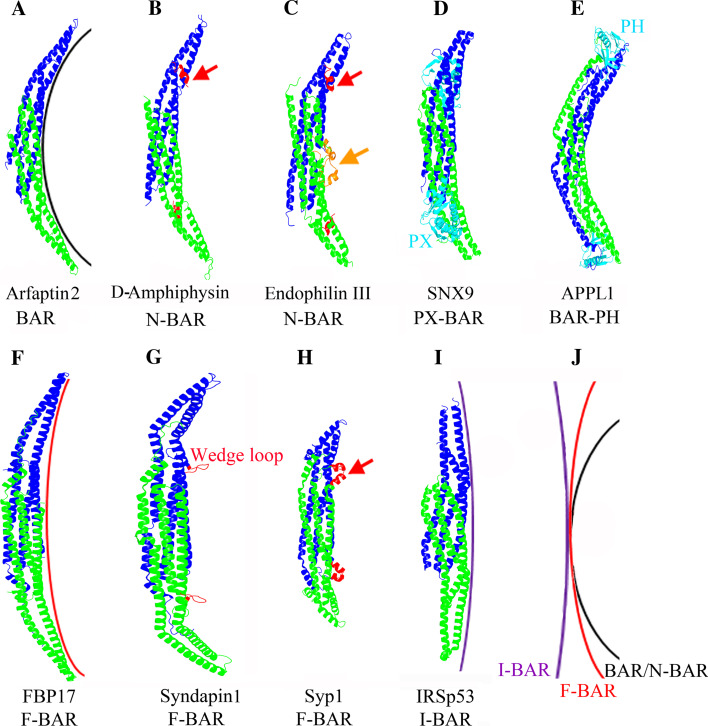
BAR domain superfamily proteins have emerged as central regulators of dynamic membrane remodeling, thereby playing important roles in a wide variety of cellular processes, such as organelle biogenesis, cell division, cell migration, secretion, and endocytosis. Here, we review the mechanistic and structural basis for the membrane curvature-sensing and deforming properties of BAR domain superfamily proteins. Moreover, we summarize the present state of knowledge with respect to their regulation by autoinhibitory mechanisms or posttranslational modifications, and their interactions with other proteins, in particular with GTPases, and with membrane lipids. We postulate that BAR superfamily proteins act as membrane-deforming scaffolds that spatiotemporally orchestrate membrane remodeling.
Figures


References
-
- McMahon HT, Gallop JL. Membrane curvature and mechanisms of dynamic cell membrane remodelling. Nature. 2005;438:590–596. - PubMed
-
- Lim KB, Bu W, Goh WI, Koh E, Ong SH, Pawson T, Sudhaharan T, Ahmed S. The Cdc42 effector IRSp53 generates filopodia by coupling membrane protrusion with actin dynamics. J Biol Chem. 2008;283:20454–20472. - PubMed
-
- Krugmann S, Jordens I, Gevaert K, Driessens M, Vandekerckhove J, Hall A. Cdc42 induces filopodia by promoting the formation of an IRSp53:Mena complex. Curr Biol. 2001;11:1645–1655. - PubMed
-
- Kamioka Y, Fukuhara S, Sawa H, Nagashima K, Masuda M, Matsuda M, Mochizuki N. A novel dynamin-associating molecule, formin-binding protein 17, induces tubular membrane invaginations and participates in endocytosis. J Biol Chem. 2004;279:40091–40099. - PubMed
Publication types
MeSH terms
Substances
LinkOut - more resources
Full Text Sources
