


NaChBac: the long lost sodium channel ancestor
- PMID: 21770445
- PMCID: PMC3153336
- DOI: 10.1021/bi200942y
NaChBac: the long lost sodium channel ancestor
Abstract
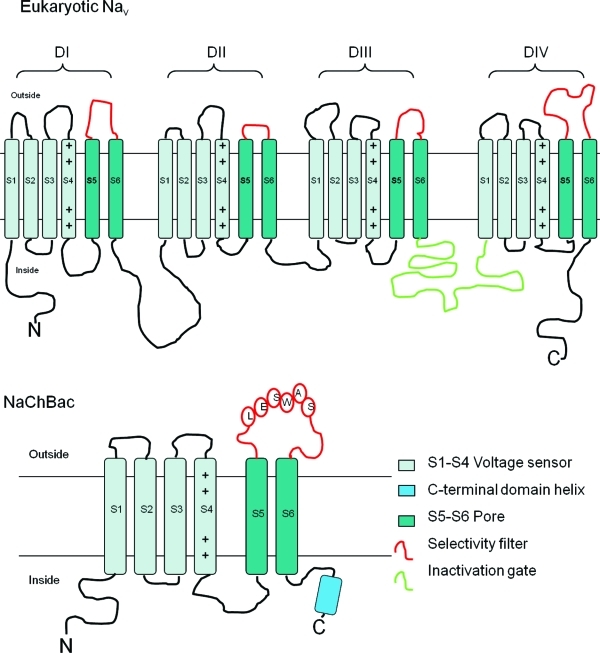
In excitable cells, the main mediators of sodium conductance across membranes are voltage-gated sodium channels (Na(V)s). Eukaryotic Na(V)s are essential elements in neuronal signaling and muscular contraction and in humans have been causally related to a variety of neurological and cardiovascular channelopathies. They are complex heavily glycosylated intrinsic membrane proteins present in only trace quantities that have proven to be challenging objects of study. However, in recent years, a number of simpler prokaryotic sodium channels have been identified, with NaChBac from Bacillus halodurans being the most well-characterized to date. The availability of a bacterial Na(V) that is amenable to heterologous expression and functional characterization in both bacterial and mammalian systems has provided new opportunities for structure--function studies. This review describes features of NaChBac as an exemplar of this class of bacterial channels, compares prokaryotic and eukaryotic Na(V)s with respect to their structural organization, pharmacological profiling, and functional kinetics, and discusses how voltage-gated ion channels may have evolved to deal with the complex functional demands of higher organisms.
Figures


References
-
- Hille B. (2001) Ionic Channels of Excitable Membranes, Sinauer Associates Inc., Sunderland, MA.
-
- Catterall W. A. (2000) From ionic currents to molecular mechanisms: The structure and function of voltage-gated sodium channels. Neuron 26, 13–25. - PubMed
-
- Hanlon M. R.; Wallace B. A. (2002) Structure and function of voltage-dependent ion channel regulatory β subunits. Biochemistry 41, 2886–2894. - PubMed
-
- Sato C.; Ueno Y.; Asai K.; Takahashi K.; Sato M.; Engel A.; Fujiyoshi Y. (2001) The voltage-sensitive sodium channel is a bell-shaped molecule with several cavities. Nature 409, 1047–1051. - PubMed
Publication types
MeSH terms
Substances
Grants and funding
LinkOut - more resources
Full Text Sources
Other Literature Sources
