


Obesity and coronary artery calcium in diabetes: the Coronary Artery Calcification in Type 1 Diabetes (CACTI) study
- PMID: 21770813
- PMCID: PMC3182677
- DOI: 10.1089/dia.2011.0046
Obesity and coronary artery calcium in diabetes: the Coronary Artery Calcification in Type 1 Diabetes (CACTI) study
Abstract
Background: The aim was to examine whether excess weight is associated with coronary artery calcium (CAC), independent of metabolic parameters in adults with type 1 diabetes (T1D).
Methods: Subjects between 19 and 56 years of age with T1D (n=621) from the Coronary Artery Calcification in Type 1 Diabetes study were classified as abnormal on four metabolic parameters: blood pressure ≥130/85 mm Hg or on antihypertensive treatment; high-density lipoprotein-cholesterol of <40 mg/dL for men or <50 mg/dL for women; triglycerides of ≥150 mg/dL; or C-reactive protein of ≥3 μg/mL. Study participants with two or more abnormal parameters were classified as metabolically abnormal. Weight categories by body mass index were normal (<25 kg/m(2)), overweight (25 to <30 kg/m(2)), and obese (≥30 kg/m(2)). CAC was measured at two visits 6.0±0.5 years apart. Progression of CAC was defined as an increase in square root transformed CAC volume of ≥2.5 mm(3) or development of clinical coronary artery disease.
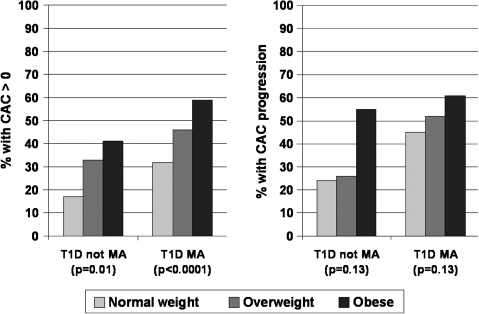
Results: Among subjects with T1D, 48% of normal, 61% of overweight, and 73% of obese participants were classified as metabolically abnormal (P<0.0001). Overweight and obesity were independently associated with presence of CAC, independent of presence of metabolically abnormal. Obesity but not overweight was associated with CAC progression, independent of the other cardiovascular risk factors.
Conclusions: Although obesity is known to increase cardiovascular disease risk through inducing metabolic abnormalities such as dyslipidemia, hypertension, and inflammation, it is also a strong predictor of subclinical atherosclerosis progression in adults with T1D independent of these factors.
Figures
References
-
- Kilpatrick ES. Rigby AS. Atkin SL. Insulin resistance, the metabolic syndrome, and complication risk in type 1 diabetes. Diabetes Care. 2007;30:707–712. - PubMed
-
- Pambianco G. Costacou T. Orchard TJ. The prediction of major outcomes of type 1 diabetes: a 12-year prospective evaluation of three separate definitions of the metabolic syndrome and their components and estimated glucose disposal rate. Diabetes Care. 2007;30:1248–1254. - PubMed
-
- Laakso M. Pyorala K. Adverse effects of obesity on lipid and lipoprotein levels in insulin-dependent and non–insulin-dependent diabetes. Metabolism. 1990;39:117–122. - PubMed
-
- Arai K. Yokoyama H. Okuguchi F. Yamazaki K. Takagi H. Hirao K. Kobayashi M. Japan Diabetes Clinical Data Management Study Group: Association between body mass index and core components of metabolic syndrome in 1486 patients with type 1 diabetes mellitus in Japan (JDDM 13) Endocr J. 2008;55:1025–1032. - PubMed
Publication types
MeSH terms
Substances
Grants and funding
LinkOut - more resources
Full Text Sources
Medical
Research Materials
