


Percutaneous elastic intramedullary nailing of metacarpal fractures: surgical technique and clinical results study
- PMID: 21771311
- PMCID: PMC3151220
- DOI: 10.1186/1749-799X-6-37
Percutaneous elastic intramedullary nailing of metacarpal fractures: surgical technique and clinical results study
Abstract
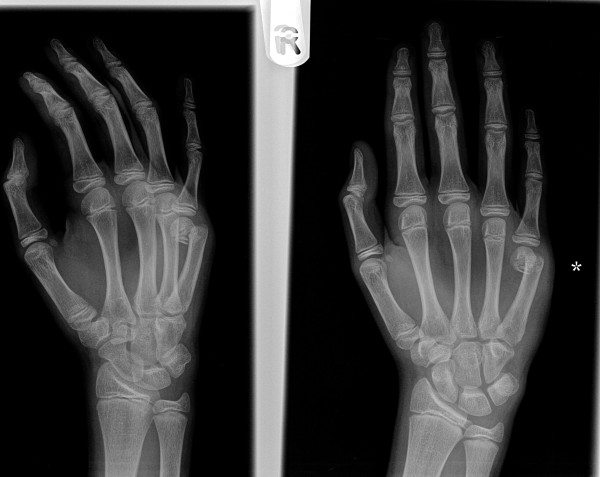
Background: We reviewed our results and complications of using a pre-bent 1.6 mm Kirschner wire (K-wire) for extra-articular metacarpal fractures. The surgical procedure was indicated for angulation at the fracture site in a true lateral radiograph of at least 30 degrees and/or in the presence of a rotatory deformity.
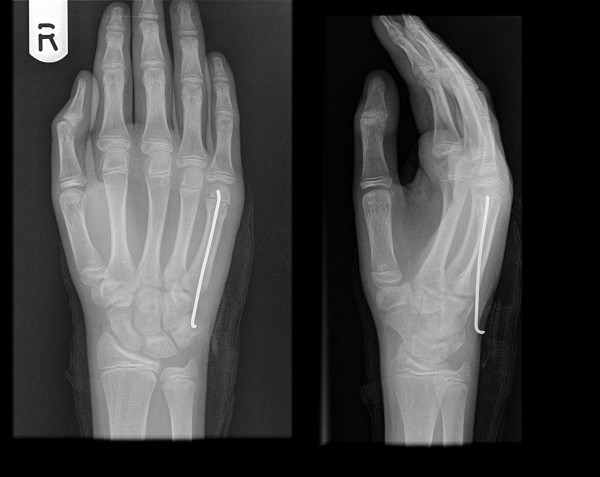
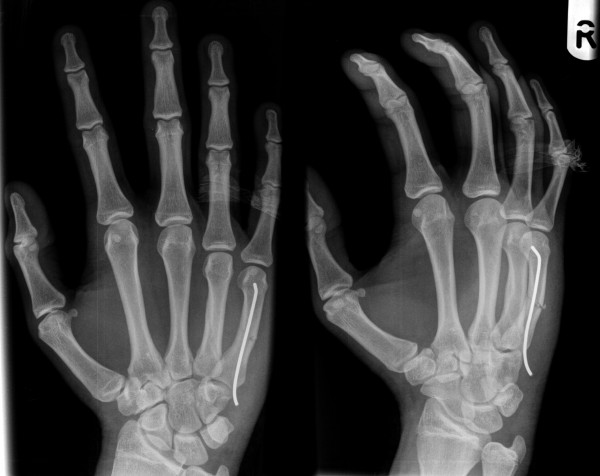
Methods: A single K-wire is pre-bent in a lazy-S fashion with a sharp bend at approximately 5 millimeters and a longer smooth curve bent in the opposite direction. An initial entry point is made at the base of the metacarpal using a 2.5 mm drill by hand. The K-wire is inserted blunt end first in an antegrade manner and the fracture reduced as the wire is passed across the fracture site. With the wire acting as three-point fixation, early mobilisation is commenced at the metacarpo-phalangeal joint in a Futuro hand splint. The wire is usually removed with pliers post-operatively at four weeks in the fracture clinic.
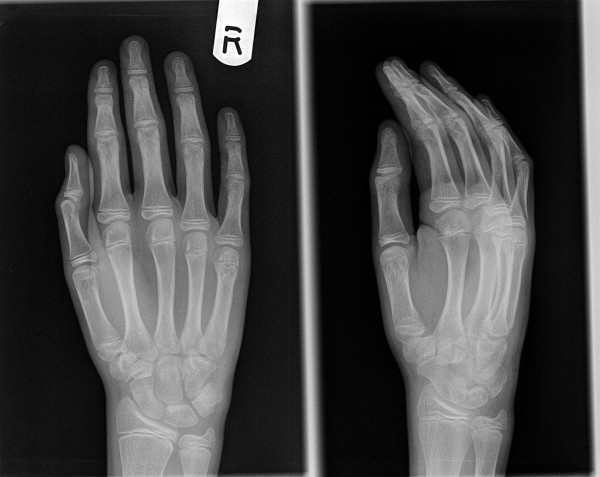
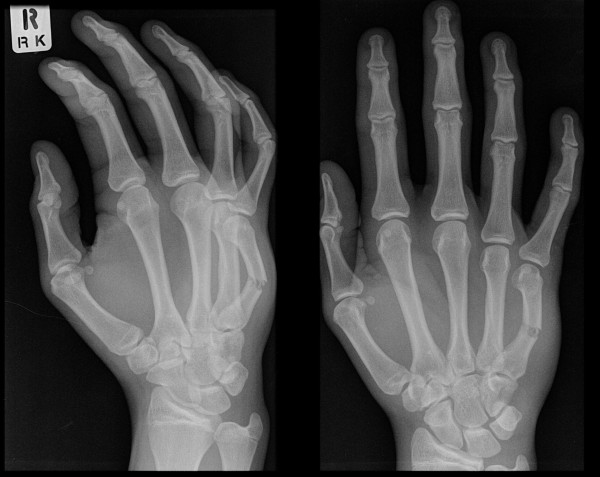
Results: We studied internal fixation of 18 little finger and 2 ring finger metacarpal fractures from November 2007 to August 2009. The average age of the cohort was 25 years with 3 women and 17 men. The predominant mechanism was a punch injury with 5 diaphyseal and 15 metacarpal neck fractures. The time to surgical intervention was a mean 13 days (range 4 to 28 days). All fractures proceeded to bony union. The wire was extracted at an average of 4.4 weeks (range three to six weeks). At an average follow up of 8 weeks, one fracture had to be revised for failed fixation and three superficial wound infections needed antibiotic treatment.
Conclusions: With this simple and minimally invasive technique performed as day-case surgery, all patients were able to start mobilisation immediately. The general outcome was good hand function with few complications.
Figures
Similar articles
-
Fractures of the neck of the fifth metacarpal bone, treated by percutaneous intramedullary nailing: surgical technique, radiological and clinical results study (28 cases).Pan Afr Med J. 2014 Jul 4;18:187. doi: 10.11604/pamj.2014.18.187.3347. eCollection 2014. Pan Afr Med J. 2014. PMID: 25419314 Free PMC article.
-
Modified retrograde percutaneous intramedullary multiple Kirschner wire fixation for treatment of unstable displaced metacarpal neck and shaft fractures.Eur J Orthop Surg Traumatol. 2013 Jul;23(5):535-43. doi: 10.1007/s00590-012-1036-6. Epub 2012 Jul 7. Eur J Orthop Surg Traumatol. 2013. PMID: 23412169
-
Single versus dual Kirschner wires for closed reduction and intramedullary nailing of displaced fractures of the fifth metacarpal neck (1-2 KiWi): a randomized controlled trial.Bone Joint J. 2019 Oct;101-B(10):1263-1271. doi: 10.1302/0301-620X.101B10.BJJ-2019-0410.R1. Bone Joint J. 2019. PMID: 31564142 Clinical Trial.
-
Extraarticular hand fractures in adults: a review of new developments.Clin Orthop Relat Res. 2006 Apr;445:133-45. doi: 10.1097/01.blo.0000205888.04200.c5. Clin Orthop Relat Res. 2006. PMID: 16505726 Review.
-
Operative treatment of metacarpal and phalangeal fractures with Kirschner wire fixation--a review.Acta Chir Iugosl. 2013;60(2):49-52. doi: 10.2298/aci1302049p. Acta Chir Iugosl. 2013. PMID: 24298738 Review.
Cited by
-
Intramedullary Pinning for Displaced Fifth Metacarpal Neck Fractures: Closed Reduction and Fixation Using Either an Open Antegrade or Percutaneous Retrograde Technique.JBJS Essent Surg Tech. 2016 May 25;6(2):e21. doi: 10.2106/JBJS.ST.16.00006. eCollection 2016 Jun 22. JBJS Essent Surg Tech. 2016. PMID: 30237930 Free PMC article.
-
Comparison of functional metacarpal splint and ulnar gutter splint in the treatment of fifth metacarpal neck fractures: a prospective comparative study.BMC Musculoskelet Disord. 2019 Apr 13;20(1):169. doi: 10.1186/s12891-019-2556-6. BMC Musculoskelet Disord. 2019. PMID: 30987619 Free PMC article. Clinical Trial.
-
Fifth metacarpal neck fractures: fixation with antegrade locked flexible intramedullary nailing.Acta Biomed. 2017 Apr 28;88(1):57-64. doi: 10.23750/abm.v88i1.6195. Acta Biomed. 2017. PMID: 28467335 Free PMC article.
-
Comparative Evaluation of the Efficacy of Combined Intramedullary Pinning with K-Wires Pinning in the Treatment of Fifth Metacarpal Neck Fractures versus Conventional Techniques-K-Wires Pinning and Intramedullary Pinning.Medicina (Kaunas). 2023 Nov 3;59(11):1944. doi: 10.3390/medicina59111944. Medicina (Kaunas). 2023. PMID: 38003993 Free PMC article. Clinical Trial.
-
A single antegrade intramedullary k-wire for fifth metacarpal neck fractures.Eur J Trauma Emerg Surg. 2020 Apr;46(2):389-395. doi: 10.1007/s00068-018-01073-2. Epub 2019 Jan 7. Eur J Trauma Emerg Surg. 2020. PMID: 30617399
References
-
- Ashkenaze DM, Rugy LK. Metacarpal fractures and dislocations. Orthop Clin North Am. 1992;23:19. - PubMed
-
- de Jonge JJ, Kingma J, van der Lei B. Fractures of the metacarpals. A retrospective analysis of incidence and etiology and a review of the English-language literature. Injury Aug. 1994;25(6):365–9. - PubMed
MeSH terms
Substances
LinkOut - more resources
Full Text Sources
Medical
