Dosimetric and geometric evaluation of a hybrid strategy of offline adaptive planning and online image guidance for prostate cancer radiotherapy
- PMID: 21772083
- PMCID: PMC3145215
- DOI: 10.1088/0031-9155/56/15/024
Dosimetric and geometric evaluation of a hybrid strategy of offline adaptive planning and online image guidance for prostate cancer radiotherapy
Abstract
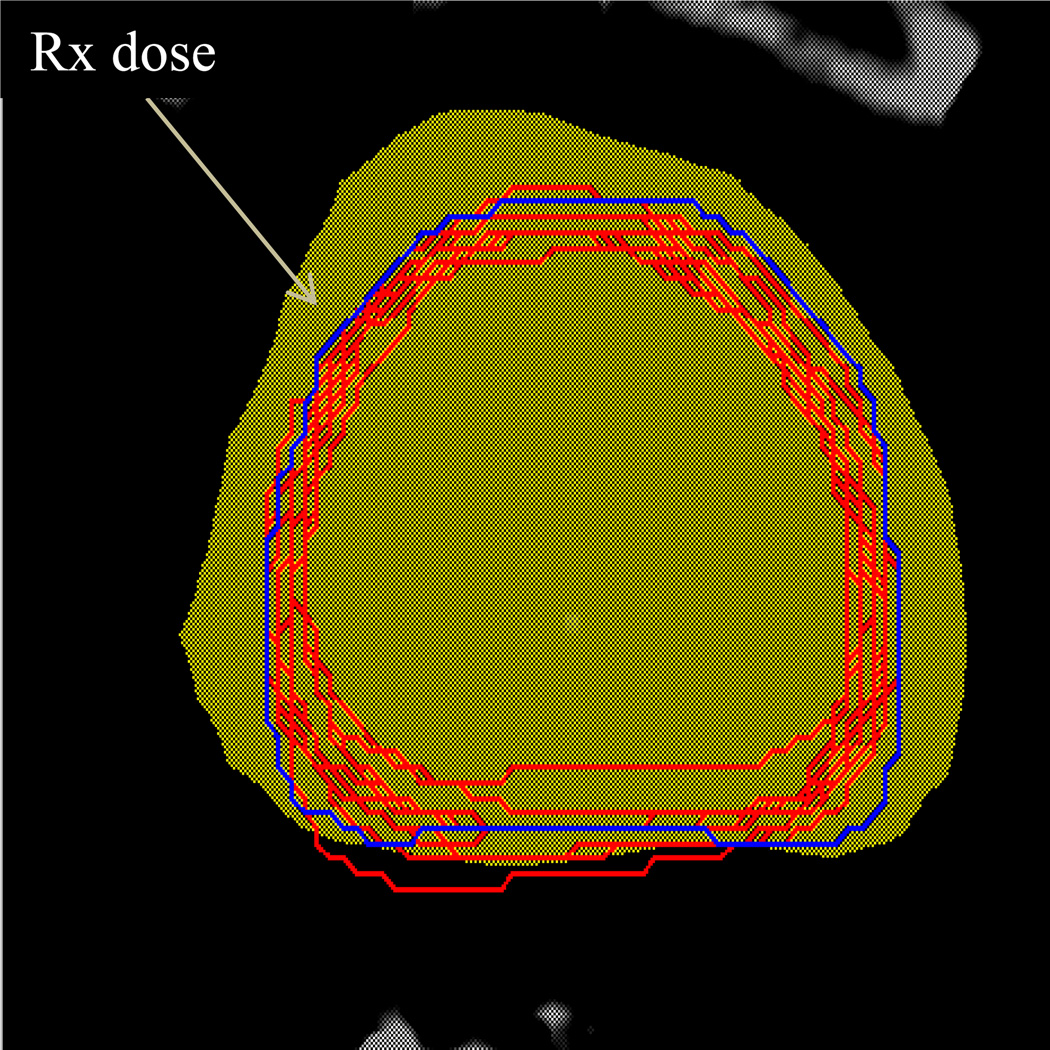
For prostate cancer patients, online image-guided (IG) radiotherapy has been widely used in clinic to correct the translational inter-fractional motion at each treatment fraction. For uncertainties that cannot be corrected online, such as rotation and deformation of the target volume, margins are still required to be added to the clinical target volume (CTV) for the treatment planning. Offline adaptive radiotherapy has been implemented to optimize the treatment for each individual patient based on the measurements at early stages of treatment process. It has been shown that offline adaptive radiotherapy can effectively reduce the required margin. Recently a hybrid strategy of offline adaptive replanning and online IG was proposed and the geometric evaluation was performed. It was found that the planning margins can further be reduced by 1-2 mm compared to online IG only strategy. The purpose of this study was to investigate the dosimetric benefits of such a hybrid strategy on the target and organs at risk. A total of 420 repeated helical computed tomography scans from 28 patients were included in the study. Both low-risk patients (LRP, CTV = prostate) and intermediate-risk patients (IRP, CTV = prostate + seminal vesicles, SV) were included in the simulation. Two registration methods, based on center-of-mass shift of prostate only and prostate plus SV, were performed for IRP. The intensity-modulated radiotherapy was used in the simulation. Criteria on both cumulative and fractional doses were evaluated. Furthermore, the geometric evaluation was extended to investigate the optimal number of fractions necessary to construct the internal target volume (ITV) for the hybrid strategy. The dosimetric margin improvement was smaller than its geometric counterpart and was in the range of 0-1 mm. The optimal number of fractions necessary for the ITV construction is 2 for LRPs and 3-4 for IRPs in a hypofractionation protocol. A new cumulative index of target volume was proposed for the evaluation of adaptive radiotherapy strategies, and it was found that it had the advantages over other indices in evaluating different adaptive radiotherapy strategies.
Figures




References
-
- Amer AM, Mackay RI, Roberts SA, Hendry JH, Williams PC. The required number of treatment imaging days for an effective off-line correction of systematic errors in conformal radiotherapy of prostate cancer--a radiobiological analysis. Radiother Oncol. 2001;61:143–150. - PubMed
-
- Balter JM, Lam KL, Sandler HM, Littles JF, Bree RL, Ten Haken RK. Automated localization of the prostate at the time of treatment using implanted radiopaque markers: technical feasibility. Int J Radiat Oncol Biol Phys. 1995;33:1281–1286. - PubMed
-
- Bel A, Vos PH, Rodrigus PT, Creutzberg CL, Visser AG, Stroom JC, Lebesque JV. High-precision prostate cancer irradiation by clinical application of an offline patient setup verification procedure, using portal imaging. Int J Radiat Oncol Biol Phys. 1996;35:321–332. - PubMed
-
- Bortfeld T, van Herk M, Jiang S. When should systematic patient positioning errors in radiotherapy be corrected? Phys Med Biol. 2002;47:N297–N302. - PubMed
Publication types
MeSH terms
Grants and funding
LinkOut - more resources
Full Text Sources
Medical
Miscellaneous