


Review
doi: 10.1038/bjc.2011.240.
Epub 2011 Jul 19.
Guidelines for preclinical and early phase clinical assessment of novel radiosensitisers
Affiliations
- PMID: 21772330
- PMCID: PMC3188925
- DOI: 10.1038/bjc.2011.240
Item in Clipboard
Review
Guidelines for preclinical and early phase clinical assessment of novel radiosensitisers
Br J Cancer.
.
No abstract available
Figures
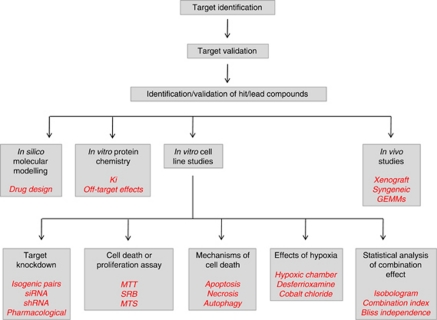
Summary of the components of a robust preclinical evaluation package for a putative targeted radiosensitiser. Abbreviations: Ki=dissociation constant; GEMMs=genetically engineered mouse models; siRNA=small interfering ribonucleic acid; shRNA=short hairpin ribonucleic acid; MTT=(dimethylthiazol-2-yl)-2,5diphenyltetrazolium bromide; SRB=sulforhodamine B; MTS=3-(4,5-dimethylthiazol-2-yl)-5-(3-carboxymethoxyphenyl)-2-(4-sulfophenyl)-2H-tetrazolium.
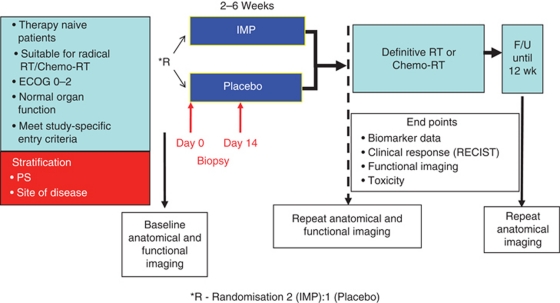
Typical phase 0/window of opportunity clinical trial design. Patients are randomised between the investigational medicinal product (IMP) and an inactive placebo for a variable time period (depending on the clinical situation governing management of the primary tumour). These studies have the potential to provide toxicity, response and biomarker (tissue and radiological) end points.
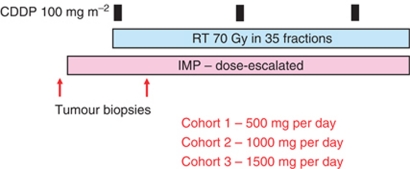
Drug dose escalation phase I trial design based on a clinical protocol in which lapatinib was added to standard chemoradiation in patients with stage III/IV head and neck cancer (Harrington et al, 2009). Patients were recruited in cohorts of three to each dose level. In the event of the occurrence of a predefined dose-limiting toxicity, an additional three patients were recruited to that dose cohort (classical 3+3 design). Subsequent dose escalation was only permitted if none of the additional three patients suffered a DLT. Optional tumour biopsies may be incorporated into these study designs to provide biomarker data.
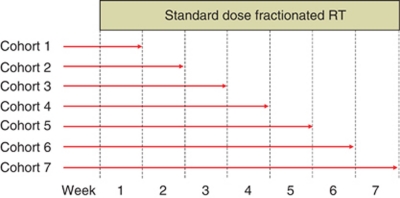
Drug duration escalation study. Successive patient cohorts are exposed to a predetermined dose of the study drug for an increasing number of radiation fractions.
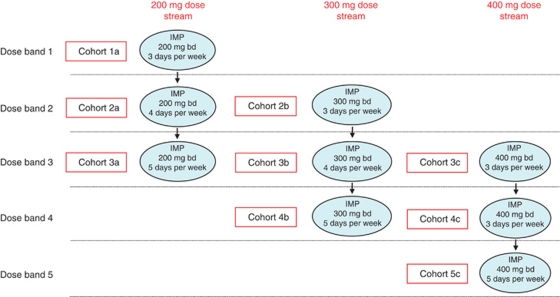
An example of a study involving continuous reassessment methodology. Patients receive standard radical RT (e.g., 70 Gy in 35 fractions) and receive the IMP according to predefined dose streams and within dose bands. This design allows for simultaneous evaluation of different doses and durations of exposure to the IMP.
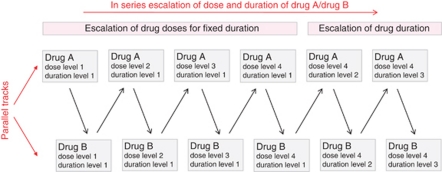
Flip-flop study design. Patients are recruited to two parallel streams in which different novels agents (Drug A and Drug B) are combined with radiation. Closure of a cohort in the Drug A study track triggers opening of recruitment to the Drug B study track (and vice versa). This design avoids gaps in patient recruitment by ensuring that recruitment to either track is always open.
References
-
- Adkins DR, DiPersio JF (2008) Total body irradiation before an allogeneic stem cell transplantation: is there a magic dose? Curr Opin Hematol 15: 555–560 - PubMed
-
- Agarawal JP, Swangsilpa T, van der Linden Y, Rades D, Jeremic B, Hoskin PJ (2006) The role of external beam radiotherapy in the management of bone metastases. Clin Oncol (R Coll Radiol) 18: 747–760 - PubMed
-
- Auperin A, Le Pechoux C, Pignon JP, Koning C, Jeremic B, Clamon G, Einhorn L, Ball D, Trovo MG, Groen HJ, Bonner JA, Le Chevalier T, Arriagada R (2006) Concomitant radio-chemotherapy based on platin compounds in patients with locally advanced non-small cell lung cancer (NSCLC): a meta-analysis of individual data from 1764 patients. Ann Oncol 17: 473–483 - PubMed
-
- Bashir FA, Parry JM, Windsor PM (2008) Use of a modified hemi-body irradiation technique for metastatic carcinoma of the prostate: report of a 10-year experience. Clin Oncol (R Coll Radiol) 20: 591–598 - PubMed
-
- Baumann M, DuBois W, Pu A, Freeman J, Suit HD (1992) Response of xenografts of human malignant gliomas and squamous cell carcinomas to fractionated irradiation. Int J Radiat Oncol Biol Phys 23: 803–809 - PubMed
Publication types
MeSH terms
Substances
Grants and funding
LinkOut - more resources
Full Text Sources
Other Literature Sources
Medical
