The impact of acute organ dysfunction on patients' mortality with severe sepsis
- PMID: 21772676
- PMCID: PMC3127295
- DOI: 10.4103/0970-9185.81816
The impact of acute organ dysfunction on patients' mortality with severe sepsis
Abstract
Background: Severe sepsis leads to organ failure and results in high mortality. Organ dysfunction is an independent prognostic factor for intensive care unit (ICU) mortality. The objective of the present study was to determine the effect of acute organ dysfunction for ICU mortality in patients with severe sepsis using administrative data.
Materials and methods: A multicenter cross-sectional study was performed in 2008. The study was conducted in 112 teaching hospitals in Japan. All cases with severe sepsis in ICU were identified from administrative data.
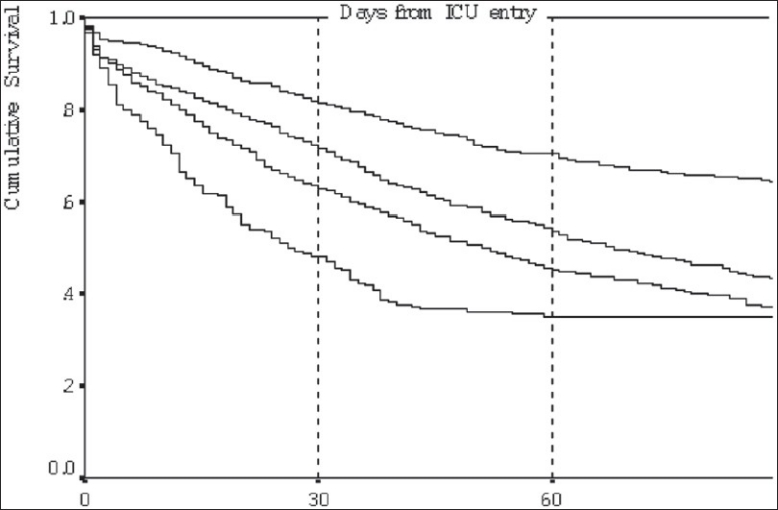
Results: Administrative data acquired for 4196 severe septic cases of 75,069 cases entered in the ICU were used to assess patient outcomes. Cardiovascular dysfunction was identified as the most major organ dysfunction (73.0%), and the followings were respiratory dysfunction (69.4%) and renal dysfunction (39.0%), respectively. The ICU mortality and 28-day means 28-day from ICU entry. were 18.8% and 27.7%, respectively. After adjustment for age, gender, and severity of illness, the hazard ratio of 2, 3, and ≥4, the organ dysfunctions for one organ failure on ICU mortality was 1.6, 2.0, and 2.7, respectively.
Conclusions: We showed that the number of organ dysfunction was a useful indicator for ICU mortality on administrative data. The hepatic dysfunction was the highest mortality among organ dysfunctions. The hazard ratio of ICU death in severe septic patients with multiple organ dysfunctions was average 2.2 times higher than severe septic patients with single organ dysfunction.
Keywords: Intensive care units; mortality; multicenter study; multiple organ failure; sepsis.
Conflict of interest statement
Figures
References
-
- Levy MM, Dellinger RP, Townsend SR, Linde-Zwirble WT, Marshall JC, Bion J, et al. The surviving sepsis campaign: Results of an international guideline-based performance improvement program targeting severe sepsis. Crit Care Med. 2010;38:367–74. - PubMed
-
- Vincent JL, Sakr Y, Sprung CL, Ranieri VM, Reinhart K, Gerlach H, et al. Sepsis in European intensive care units: Results of the SOAP study. Crit Care Med. 2006;34:344–53. - PubMed
-
- Ingraham AM, Xiong W, Hemmila MR, Shafi S, Goble S, Neal ML, et al. The attributable mortality and length of stay of trauma-related complications: A matched cohort study. Ann Surg. 2010;252:358–62. - PubMed
-
- Nfor TK, Walsh TS, Prescott RJ. The impact of organ failures and their relationship with outcome in intensive care: Analysis of a prospective multicentre database of adult admissions. Anaesthesia. 2006;61:731–8. - PubMed
-
- Martin GS, Mannino DM, Eaton S, Moss M. The epidemiology of sepsis in the United States from 1979 through 2000. N Engl J Med. 2003;348:1546–54. - PubMed