


Magnesium sulfate as a second-line tocolytic agent for preterm labor: a randomized controlled trial in Kyushu Island
- PMID: 21773032
- PMCID: PMC3135123
- DOI: 10.1155/2011/965060
Magnesium sulfate as a second-line tocolytic agent for preterm labor: a randomized controlled trial in Kyushu Island
Abstract
Objectives: We evaluated the efficacy of magnesium sulfate as a second-line tocolysis for 48 hours.
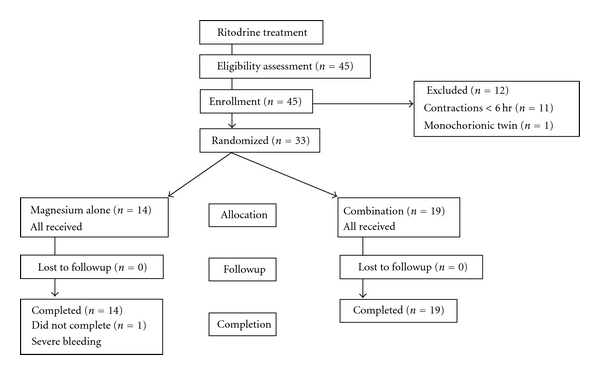
Materials and methods: A multi-institutional, simple 2-arm randomized controlled trial was performed. Forty-five women at 22 to 34 weeks of gestation were eligible, whose ritodrine did not sufficiently inhibit uterine contractions. After excluding 12 women, 33 were randomly assigned to either magnesium alone or combination (ritodrine and magnesium). The treatment was determined as effective if the frequency of uterine contraction was reduced by 30% at 48 hours of the treatment.
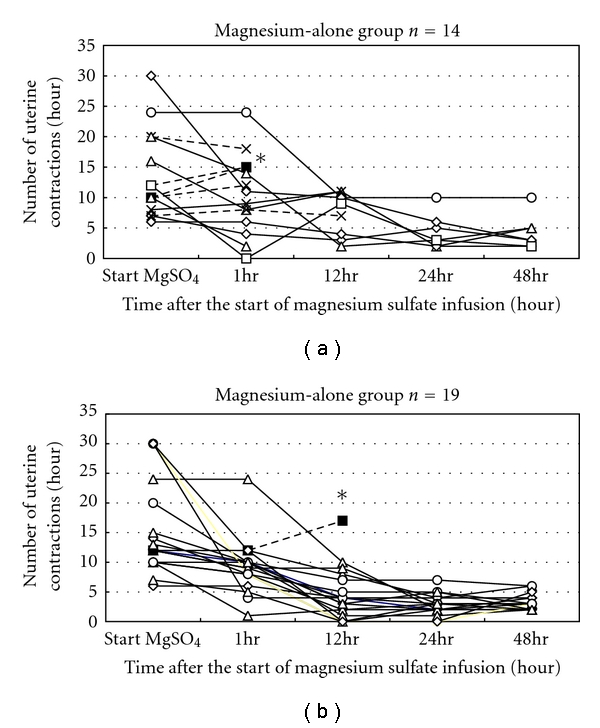
Results: After magnesium sulfate infusion, 90% prolonged their pregnancy for >48 hours. Combination therapy was effective in 95% (18/19), which was significantly higher than 50% (7/14) for magnesium alone.
Conclusion: This randomized trial revealed that combination therapy significantly reduced uterine contractions, suggesting that adjuvant magnesium with ritodrine is recommended, rather than changing into magnesium alone, when uterine contractions are intractable with ritodrine infusion.
Figures
References
-
- Crowther CA, Hiller JE, Doyle LW. Magnesium sulphate for preventing preterm birth in threatened preterm labour. Cochrane Database of Systematic Reviews. 2002;(4, article CD001060) - PubMed
-
- Mercer BM, Merlino AA. Magnesium sulfate for preterm labor and preterm birth. Obstetrics and Gynecology. 2009;114(3):650–668. - PubMed
-
- Ikenoue T, Matsuda Y, Kamitomo M, Hokanishi H. Combination therapy of intravenous ritodrine and magnesium sulfate to inhibit premature labor. The Journal of Obstetrics and Gynaecology Research. 1989;41(12):1972–1978. - PubMed
-
- Coleman FH. Safety and efficacy of combined ritodrine and magnesium sulfate for preterm labor: a method for reduction of complications. American Journal of Perinatology. 1990;7(4):366–369. - PubMed
-
- Kosasa TS, Busse R, Wahl N, Hirata G, Nakayama RT, Hale RW. Long-term tocolysis with combined intravenous terbutaline and magnesium sulfate: a 10-year study of 1000 patients. Obstetrics and Gynecology. 1994;84(3):369–373. - PubMed
Publication types
MeSH terms
Substances
LinkOut - more resources
Full Text Sources
Medical
