. 2011 Sep;32(3):257-64.
doi: 10.1007/s10059-011-1047-x. Epub 2011 Jul 15.

Engineering of 2-Cys peroxiredoxin for enhanced stress-tolerance

Affiliations

Engineering of 2-Cys peroxiredoxin for enhanced stress-tolerance

Byung Chull An et al. Mol Cells. 2011 Sep.

Abstract

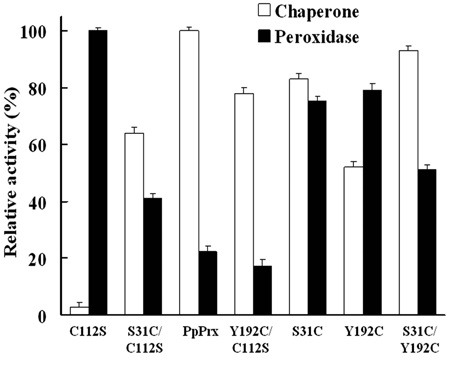
A typical 2-cysteine peroxiredoxin (2-Cys Prx)-like protein (PpPrx) that alternatively acts as a peroxidase or a molecular chaperone in Pseudomonas putida KT2440 was previously characterized. The dual functions of PpPrx are regulated by the existence of an additional Cys(112) between the active Cys(51) and Cys(171) residues. In the present study, additional Cys residues (Cys(31), Cys(112), and Cys(192)) were added to PpPrx variants to improve their enzymatic function. The optimal position of the additional Cys residues for the dual functionality was assessed. The peroxidase activities of the S31C and Y192C mutants were increased 3- to 4-fold compared to the wild-type, while the chaperone activity was maintained at > 66% of PpPrx. To investigate whether optimization of the dual functions could enhance stress-tolerance in vivo, a complementation study was performed. The S31C and Y192C mutants showed a much greater tolerance than other variants under a complex condition of heat and oxidative stresses. The optimized dual functions of PpPrx could be adapted for use in bioengineering systems and industries, such as to develop organisms that are more resistant to extreme environments.


Figures
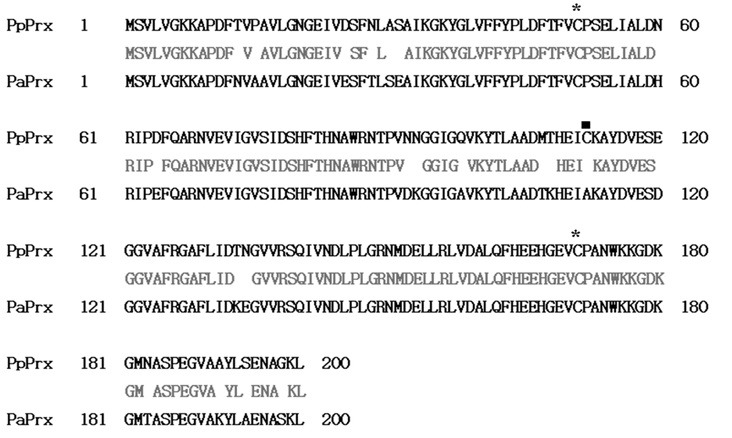
Fig. 1.
Fig. 1.. Amino acid sequence alignment of PpPrx and PaPrx. (A) Alignment of the amino acid sequences of P. putida PpPrx (2-Cys Prx) with homologous PaPrx from P. aruginosa. Gray indicates identical amino acids in all sequences. Empty spaces indicate mismatch sequences. Asterisk indicates the highly conserved tripeptide (VCP) that is related to the catalytic function. The additional Cys (Cys112) is designated by a square. GenBank accession numbers of the proteins are as follows: PpPrx (AAN66709) and PaPrx (AAG06917).
Fig. 2.
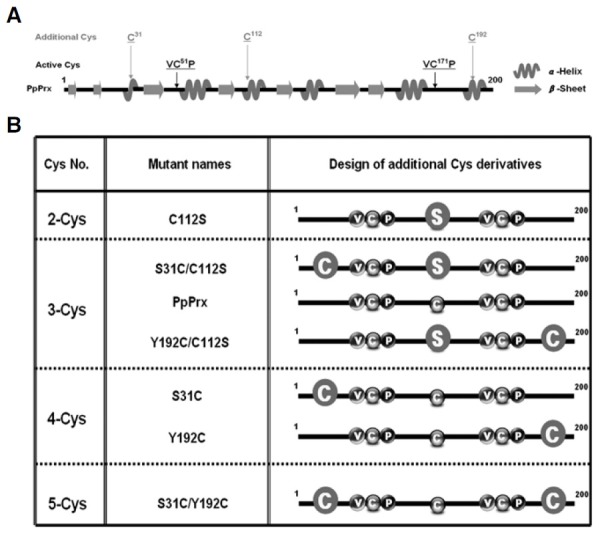
Fig. 2.. Secondary structure prediction and various additional Cys derivatives of PpPrx. (A) The PpPrx secondary structure was predicted using a bioinformatics tool (http://npsa-pbil.ibcp.fr/). Spirals and arrows represent the α-helix and β-sheet motifs of PpPrx, respectively. Positions of the additional Cys residues (Cys31, Cys112 and Cys192) and active Cys residues (Cys51 as peroxidatic Cys, Cys171 as resolving Cys) are indicated by gray and black arrows, respectively, on the PpPrx secondary structure. (B) Schematic representation of 7 PpPrx derivatives with excluded or included additional Cys. Substituted Cys and Ser are indicated by embossed circles.
Fig. 3.
Fig. 3.. Additional Cys-mediated functional change of PpPrx. Comparison of additional Cys-mediated changes in enzymatic efficiency (peroxidase and chaperone activities). The relative activities of PpPrx derivative proteins were compared to those of the respective dominant activities. Chaperone activity of PpPrx and peroxidase activity of C112S-PpPrx were each set to 100%. Data shown are the means of at least three independent experiments.
Fig. 4.
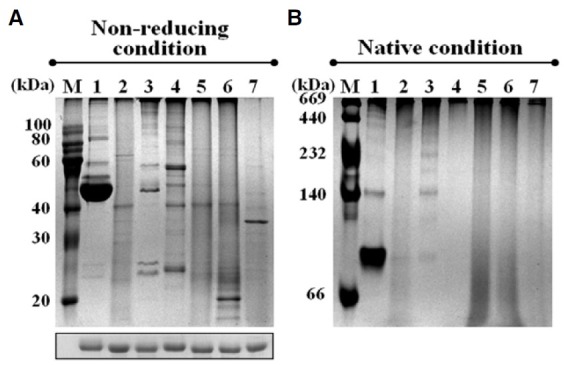
Fig. 4.. Additional Cys-mediated structure change of PpPrx derivatives. (A) PpPrx derivative proteins were separated by 12% nonreducing PAGE (upper image) or 12% reducing PAGE (lower image) and (B) 10% native PAGE. Proteins were stained with Coo-massie Brilliant Blue R-250. Lane M, marker; lane 1, C112S; lane 2, S31C/C112S; lane 3, PpPrx; lane 4, Y192C/C112S; lane 5, S31C; lane 6, Y192C; lane 7, S31C/Y192C.
Fig. 5.
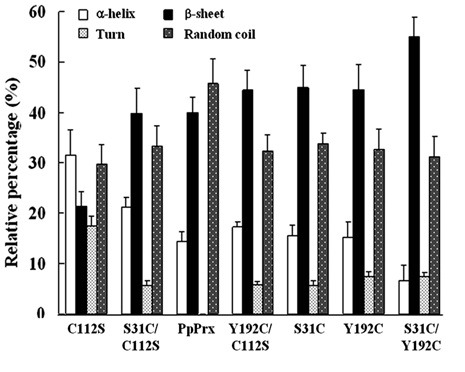
Fig. 5.. Additional Cys-mediated secondary structural change of PpPrx derivatives. The comparison of the secondary structure index values (%) was based on the far UV-CD spectra of the seven PpPrx derivative proteins. Data shown are the means of at least three independent experiments.
Fig. 6.
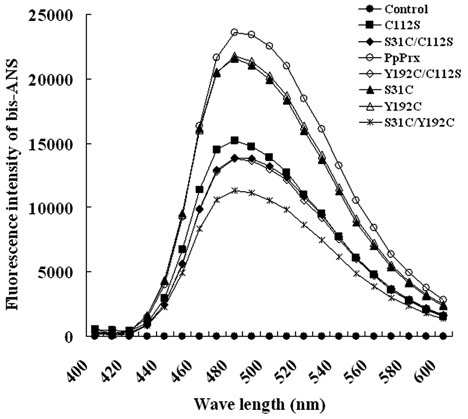
Fig. 6.. Additional Cys-mediated change in the hydrophobicity of the PpPrx derivatives. Changes in the surface hydrophobicities of the PpPrx derivative proteins due to the additional Cys. Fluorescence spectra of bis-ANS bound to 100 μg/ml of each PpPrx derivative protein. Controls were measured in the absence of PpPrx protein. Data shown are the means of at least three independent experiments.
Fig. 7.
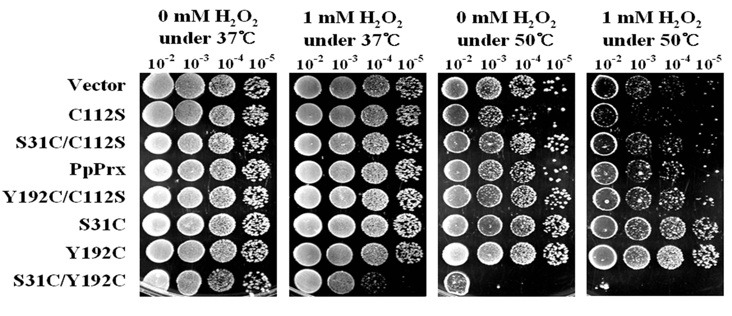
Fig. 7.. In vivo observation of PpPrx mutant phenotypes under extreme stress. Growth temperature (as a heat stress), H2O2 concentration (as an oxidative stress), and the fold dilution are indicated. The growth phenotypes of E. coli transformed with PpPrx derivatives were observed after 1 day under the indicated conditions. After cultivation in liquid LB medium at 37℃, the cells were resuspended at a density of 1.0 at 600 nm. The cells were serially diluted from 10-1 to 10-4. Diluted cells were incubated on an LB plate with 1.6 mM H2O2 at 37℃ (for oxidative stress), on an LB plate without H2O2 at 50℃ (for heat stress), or on LB plate with 1.6 mM H2O2 at 50℃ (for extreme stress).

References

    1. An B.C., Lee S.S., Lee E.M., Lee J.T., Wi S.G., Jung H.S., Park W., Chung B.Y. A new antioxidant with dual functions as a peroxidase and chaperone in Pseudomonas aeruginosa. Mol. Cells. (2010);29:145–151. - PubMed
    1. An B.C., Lee S.S., Lee E.M., Lee J.T., Wi S.G., Jung H.S., Park W., Chung B.Y. Functional switching of a novel prokaryotic 2-Cys peroxiredoxin (PpPrx) under oxidative stress. Cell Stress Chaperones. (2011);16:317–328. - PMC - PubMed
    1. Baier M., Dietz K.J. Alkyl hydroperoxide reductase: the way out of the oxidative breakdown of lipids in chloroplast. Trends Plant Sci. (1999);4:166–168. - PubMed
    1. Bradford M.M. A rapid and sensitive method for the quantitation of microgram quantities of protein utilizing the principle of protein-dye binding. Anal. Biochem. (1976);72:248–254. - PubMed
    1. Chae H.Z., Robison K., Poole L.B., Church G., Storz G., Rhee S.G. Cloning and sequencing of thiol-specific antioxidant from mammalian brain: alkyl hydroperoxide reductase and thiol-specific antioxidant define a large family of antioxidant enzymes. Proc. Natl. Acad. Sci. USA. (1994);91:7017–7021. - PMC - PubMed

Publication types

MeSH terms