


The effect of long-term alendronate treatment on cortical thickness of the proximal femur
- PMID: 21773861
- PMCID: PMC3237985
- DOI: 10.1007/s11999-011-1985-9
The effect of long-term alendronate treatment on cortical thickness of the proximal femur
Abstract
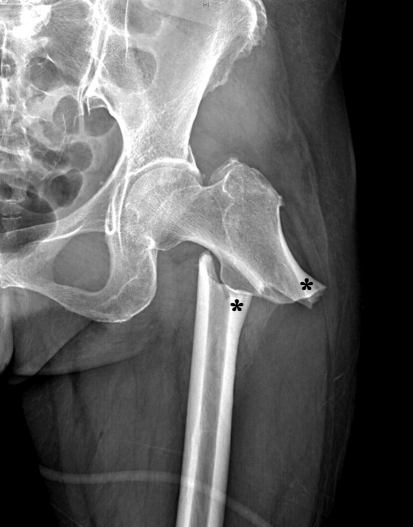
Background: One of the radiographic hallmarks in patients with atypical femoral insufficiency fractures after prolonged bisphosphonate treatment is generalized cortical hypertrophy. Whether cortical thickening in the proximal femur is caused by long-term alendronate therapy, however, remains unknown.
Questions/purposes: We asked whether long-term alendronate use of 5 years or more results in progressive thickening of the subtrochanteric femoral cortices.
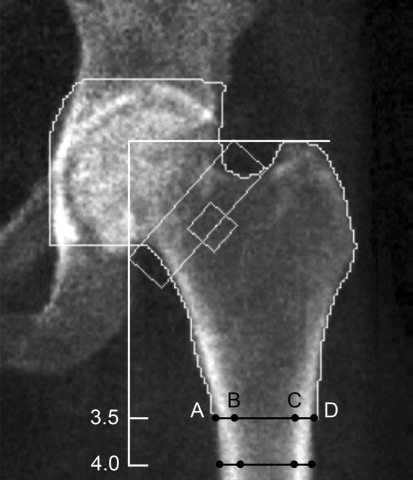
Patients and methods: We retrospectively evaluated changes in cortical thickness and cortical thickness ratio (ratio of cortical to femoral shaft diameter) at the subtrochanteric region of the proximal femur in baseline and latest hip dual-energy xray absorptiometry (DXA) scans of 131 patients. The mean followup was 7.3 years. Patients were divided into two groups: control (no history of alendronate, 45 patients) and alendronate (history of alendronate ≥ 5 years, 86 patients). We determined cortical thickness and cortical thickness ratio at 3.5 and 4.0 cm below the tip of the greater trochanter, representing the subtrochanteric region.
Results: After a minimum of 5 years followup, mean cortical thickness decreased approximately 3% in the alendronate and control groups. The cortical thickness at the subtrochanteric femoral region changed less than 1 mm in greater than 90% of the patients with long-term alendronate treatment. We observed no differences in mean changes of cortical thickness and percent changes of cortical thickness between the two groups.
Conclusions: Long-term alendronate treatment did not appear to cause thickened femoral cortices within the detection limits of our method. This finding contrasts with the notion that long-term alendronate treatment leads to generalized cortical thickening.
Figures
Comment in
-
Letter to the editor: the effect of long-term alendronate treatment on cortical thickness of the proximal femur.Clin Orthop Relat Res. 2011 Dec;469(12):3509-10; author reply 3511-12. doi: 10.1007/s11999-011-2129-y. Clin Orthop Relat Res. 2011. PMID: 21997786 Free PMC article. No abstract available.
References
-
- Black DM, Cummings SR, Karpf DB, Cauley JA, Thompson DE, Nevitt MC, Bauer DC, Genant HK, Haskell WL, Marcus R, Ott SM, Torner JC, Quandt SA, Reiss TF, Ensrud KE. Randomised trial of effect of alendronate on risk of fracture in women with existing vertebral fractures: Fracture Intervention Trial Research Group. Lancet. 1996;348:1535–1541. doi: 10.1016/S0140-6736(96)07088-2. - DOI - PubMed
-
- Bone HG, Hosking D, Devogelaer JP, Tucci JR, Emkey RD, Tonino RP, Rodriguez-Portales JA, Downs RW, Gupta J, Santora AC. Liberman UA; Alendronate Phase III Osteoporosis Treatment Study Group. Ten years’ experience with alendronate for osteoporosis in postmenopausal women. N Engl J Med. 2004;350:1189–1199. - PubMed
-
- Burghardt AJ, Kazakia GJ, Sode M, Papp AE, Link TM, Majumdar S. A longitudinal HR-pQCT study of alendronate treatment in postmenopausal women with low bone density: relations among density, cortical and trabecular microarchitecture, biomechanics, and bone turnover. J Bone Miner Res. 2010;25:2558–2571. doi: 10.1002/jbmr.157. - DOI - PMC - PubMed
Publication types
MeSH terms
Substances
LinkOut - more resources
Full Text Sources
