Case Reports
. 2012 Mar;6(1):135-9.
doi: 10.1007/s12105-011-0283-x. Epub 2011 Jul 20.

Mammary analogue secretory carcinoma: the first submandibular case reported including findings on fine needle aspiration cytology

Affiliations
Case Reports

Mammary analogue secretory carcinoma: the first submandibular case reported including findings on fine needle aspiration cytology

Fredrik Petersson et al. Head Neck Pathol. 2012 Mar.

Abstract

We present the first case (male, 35 years old) of a mammary analogue secretory carcinoma occurring in a submandibular gland and document findings on fine needle aspiration cytology. On histology, the tumor displayed characteristic features: circumscribed nodules composed of bland, pink to light red neoplastic cells with low proliferative/mitotic activity arranged in tubular, vaguely cribriform, and microcystic structures containing Periodic acid Schiff-positive, diastase-resistant secretory material. Immunohistochemistry showed strong and diffuse positivity for cytokeratin 7, S100 protein, and vimentin, as well as moderate to strong immunoreactivity for c-kit in the majority of tumor cells. A rearrangement of the ETV6 gene on fluorescence in situ hybridization was documented. The patient underwent an ipsilateral selective (levels I-IV) neck dissection which showed metastasis in 3 out of 36 lymph nodes (levels 1-3). Adjuvant radiotherapy was administered. No local recurrence or metastatic disease has been detected during a follow up period of 28 months.


Figures
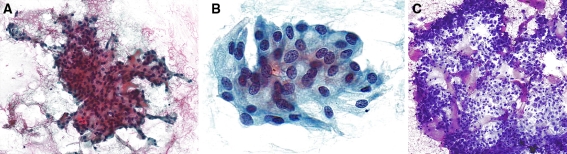
Fig. 1
Fig. 1
a FNA smear shows small loosely cohesive sheets of neoplastic cells forming vague acinar structures in the periphery (a; Papanicolau). On high power, the tumor cells display smooth contours with only focal nuclear membrane irregularities and finely dispersed chromatin with occasional minute nucleoli and vaguely bubbly cytoplasm (b; Papanicolau). Round to irregular elongated secretory (“colloid”-like) material with a variable staining intensity is intimately admixed with the tumor cells (c; Giemsa)
Fig. 2
Fig. 2
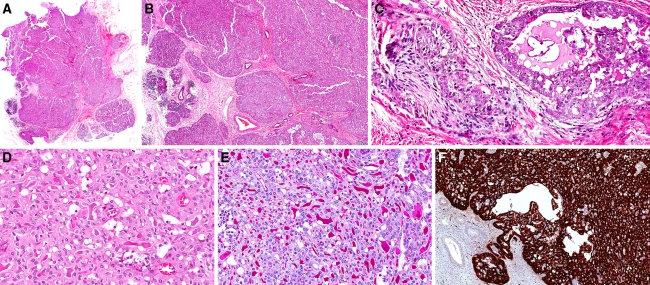
A multinodular, unencapsulated tumor with an “eosinophilic” appearance (a). The tumor is composed of nodules of varying sizes featuring infiltrative growth into the surrounding salivary gland parenchyma (b; left) and focal perineural growth (c; left). The neoplastic cells are medium sized with round to ovoid isomorphic nuclei harbouring fine—pale chromatin and inconspicuous to small nucleoli (d). The secretory material was faintly basophilic or variably eosinophilic, and PAS-positive, diastase resistant (e). The tumor is strongly positive for S100-protein on immunohistochemistry (f)
Fig. 3
Fig. 3
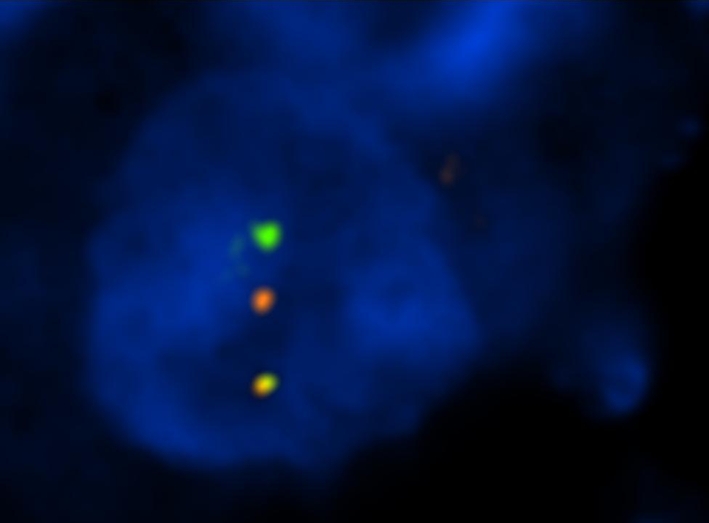
FISH using LSI ETV6 (TEL) (12p13) Dual Color, Break Apart Rearrangement Probe shows green and red split signals indicating break of the ETV6 gene

References

    1. Skalova A, Vanecek T, Sima R, et al. Mammary analogue secretory carcinoma of salivary glands, containing the ETV6-NTRK3 fusion gene: a hitherto undescribed salivary gland tumor entity. Am J Surg Pathol. 2010;34:599–608. - PubMed
    1. Lae M, Freneaux P, Sastre-Garau X, et al. Secretory breast carcinomas with ETV6-NTRK3 fusion gene belong to the basal-like carcinoma spectrum. Mod Pathol. 2009;22:291–298. doi: 10.1038/modpathol.2008.184. - DOI - PubMed
    1. Makretsov N, He M, Hayes M, et al. A fluorescence in situ hybridization study of ETV6-NTRK3 fusion gene in secretory breast carcinoma. Genes Chromosomes Cancer. 2004;40:152–157. doi: 10.1002/gcc.20028. - DOI - PubMed
    1. Reis-Filho JS, Natrajan R, Vatcheva R, et al. Is acinic cell carcinoma a variant of secretory carcinoma? A FISH study using ETV6’split apart’ probes. Histopathology. 2008;52:840–846. doi: 10.1111/j.1365-2559.2008.03046.x. - DOI - PubMed
    1. Tognon C, Knezevich SR, Huntsman D, et al. Expression of the ETV6-NTRK3 gene fusion as a primary event in human secretory breast carcinoma. Cancer Cell. 2002;2:367–376. doi: 10.1016/S1535-6108(02)00180-0. - DOI - PubMed

Publication types

MeSH terms

Supplementary concepts