


Working, declarative and procedural memory in specific language impairment
- PMID: 21774923
- PMCID: PMC3664921
- DOI: 10.1016/j.cortex.2011.06.001
Working, declarative and procedural memory in specific language impairment
Abstract
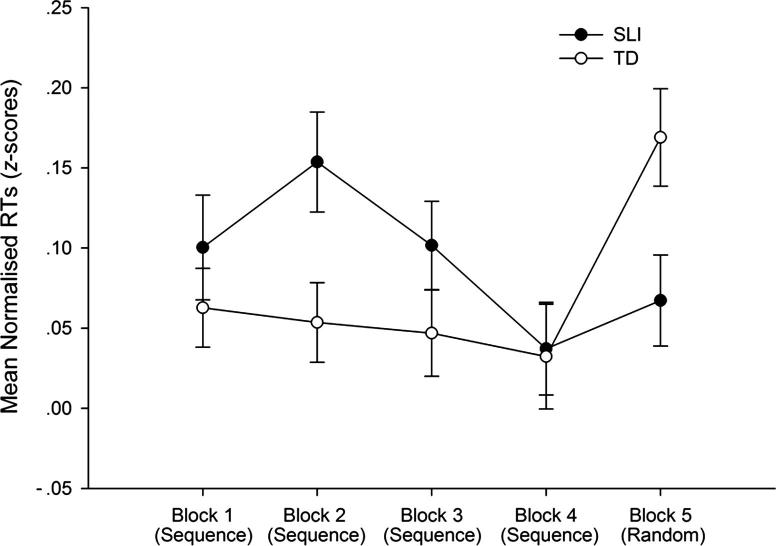
According to the Procedural Deficit Hypothesis (PDH), abnormalities of brain structures underlying procedural memory largely explain the language deficits in children with specific language impairment (SLI). These abnormalities are posited to result in core deficits of procedural memory, which in turn explain the grammar problems in the disorder. The abnormalities are also likely to lead to problems with other, non-procedural functions, such as working memory, that rely at least partly on the affected brain structures. In contrast, declarative memory is expected to remain largely intact, and should play an important compensatory role for grammar. These claims were tested by examining measures of working, declarative and procedural memory in 51 children with SLI and 51 matched typically-developing (TD) children (mean age 10). Working memory was assessed with the Working Memory Test Battery for Children, declarative memory with the Children's Memory Scale, and procedural memory with a visuo-spatial Serial Reaction Time task. As compared to the TD children, the children with SLI were impaired at procedural memory, even when holding working memory constant. In contrast, they were spared at declarative memory for visual information, and at declarative memory in the verbal domain after controlling for working memory and language. Visuo-spatial short-term memory was intact, whereas verbal working memory was impaired, even when language deficits were held constant. Correlation analyses showed neither visuo-spatial nor verbal working memory was associated with either lexical or grammatical abilities in either the SLI or TD children. Declarative memory correlated with lexical abilities in both groups of children. Finally, grammatical abilities were associated with procedural memory in the TD children, but with declarative memory in the children with SLI. These findings replicate and extend previous studies of working, declarative and procedural memory in SLI. Overall, we suggest that the evidence largely supports the predictions of the PDH.
Copyright © 2011 Elsevier Srl. All rights reserved.
Figures
References
-
- Alloway T.P., Rajendran G., Archibald L.M.D. Working memory in children with developmental disorders. Journal of Learning Disabilities. 2009;42(4):372–382. - PubMed
-
- American Psychiatric Association . American Psychiatric Association; Washington, DC: 2000. Diagnostic and Statistical Manual of Mental Disorders: DSM-IV-TR.
-
- Archibald L.M., Gathercole S.E. Short-term and working memory in specific language impairment. International Journal of Language & Communication Disorders. 2006;41(6):675–693. - PubMed
-
- Archibald L.M., Gathercole S.E. Visuospatial immediate memory on specific language impairment. Journal of Speech, Language and Hearing Research. 2006;49(2):265–277. - PubMed
Publication types
MeSH terms
Grants and funding
LinkOut - more resources
Full Text Sources
Medical
Research Materials
