. 2011 Nov;92(Pt 11):2534-2541.
doi: 10.1099/vir.0.034611-0. Epub 2011 Jul 20.

Viruses in diarrhoeic dogs include novel kobuviruses and sapoviruses

Affiliations

Viruses in diarrhoeic dogs include novel kobuviruses and sapoviruses

Linlin Li et al. J Gen Virol. 2011 Nov.

Abstract

The close interactions of dogs with humans and surrounding wildlife provide frequent opportunities for cross-species virus transmissions. In order to initiate an unbiased characterization of the eukaryotic viruses in the gut of dogs, this study used deep sequencing of partially purified viral capsid-protected nucleic acids from the faeces of 18 diarrhoeic dogs. Known canine parvoviruses, coronaviruses and rotaviruses were identified, and the genomes of the first reported canine kobuvirus and sapovirus were characterized. Canine kobuvirus, the first sequenced canine picornavirus and the closest genetic relative of the diarrhoea-causing human Aichi virus, was detected at high frequency in the faeces of both healthy and diarrhoeic dogs. Canine sapovirus constituted a novel genogroup within the genus Sapovirus, a group of viruses also associated with human and animal diarrhoea. These results highlight the high frequency of new virus detection possible even in extensively studied animal species using metagenomics approaches, and provide viral genomes for further disease-association studies.


Figures
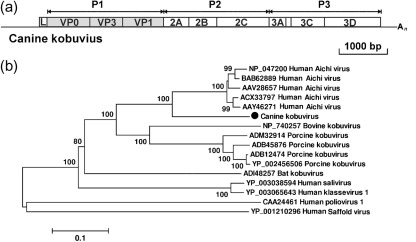
Fig. 1.
Fig. 1.
(a) Genome organization of canine kobuvirus (CaKoV). The P1 region (shaded) was used to construct the phylogenetic tree. (b) Phylogenetic analysis of CaKoV, known kobuviruses and kobu-like viruses based on the complete amino acid sequence of the P1 region using the neighbour-joining method with p-distances and 1000 bootstrap replicates. GenBank accession numbers are shown. Bar, 10 % estimated phylogenetic divergence.
Fig. 2.
Fig. 2.
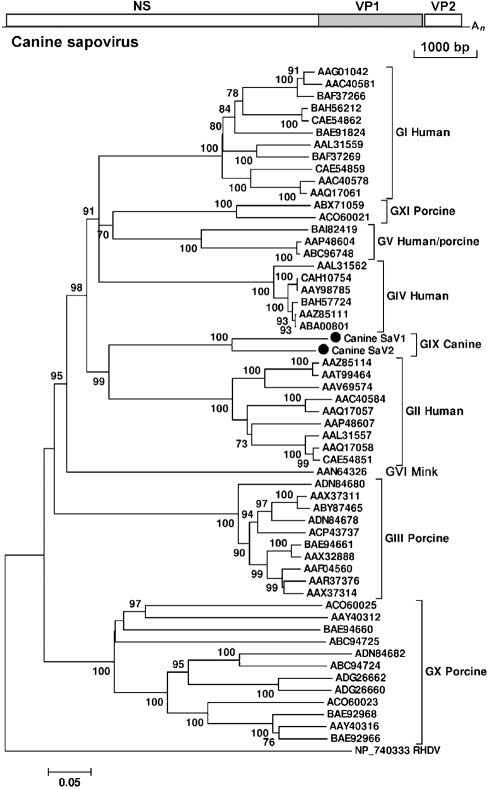
(a) Genome organization of canine sapovirus. The VP1 region (shaded) was used to construct the phylogenetic tree. (b) Phylogenetic analysis of canine sapovirus and representative sapovirus strains with a complete VP1 region selected from GenBank, based on the complete amino acid sequence of the VP1 region using the neighbour-joining method with p-distances and 1000 bootstrap replicates. GenBank accession numbers are shown. Bar, 5 % estimated phylogenetic divergence. Rabbit haemorrhagic disease virus (RHDV) from the genus Lagovirus in the family Caliciviridae was used as the outgroup. CaSaV1 and -2 were grouped as a distinct clade named genogroup IX (GIX); the traditional genogroups I–V are indicated, and mink sapovirus was named as GVI; two new porcine sapovirus genogroups have been named as GX and GXI (pending an ICTV review; GVII and GVIII are already taken based on RdRp-based classification).
Fig. 3.
Fig. 3.
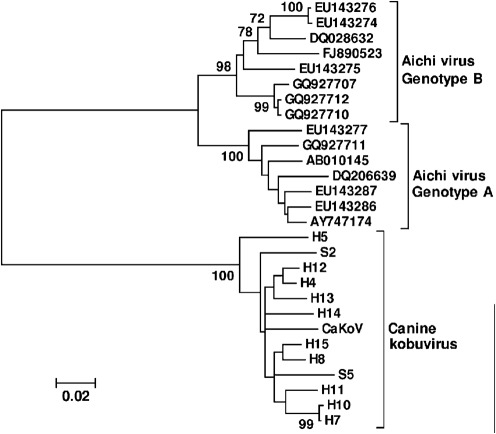
Phylogenetic analyses of CaKoV strains and Aichi virus strains based on the nucleotide sequence of the partial VP1 region using the neighbour-joining method with p-distances and 1000 bootstrap replicates. CaKoV was isolated from diarrhoeic dog AN211d. H, Virus from a healthy dog faecal sample; S, virus from a diarrhoeic dog faecal sample. Bar, 2 % estimated phylogenetic divergence.

References

    1. Allander T., Emerson S. U., Engle R. E., Purcell R. H., Bukh J. (2001). A virus discovery method incorporating DNase treatment and its application to the identification of two bovine parvovirus species. Proc Natl Acad Sci U S A 98, 11609–11614 10.1073/pnas.211424698 - DOI - PMC - PubMed
    1. Barry A. F., Alfieri A. F., Alfieri A. A. (2008). High genetic diversity in RdRp gene of Brazilian porcine sapovirus strains. Vet Microbiol 131, 185–191 10.1016/j.vetmic.2008.02.021 - DOI - PubMed
    1. Buonavoglia C., Martella V. (2007). Canine respiratory viruses. Vet Res 38, 355–373 10.1051/vetres:2006058 - DOI - PubMed
    1. Chevreux, B. (2005). mira: an automated genome and EST assembler. PhD thesis, Ruprecht-Karls University, Heidelberg, Germany.
    1. Chiba S., Sakuma Y., Kogasaka R., Akihara M., Horino K., Nakao T., Fukui S. (1979). An outbreak of gastroenteritis associated with calicivirus in an infant home. J Med Virol 4, 249–254 10.1002/jmv.1890040402 - DOI - PubMed

Publication types

MeSH terms

Associated data