


CYP9Q-mediated detoxification of acaricides in the honey bee (Apis mellifera)
- PMID: 21775671
- PMCID: PMC3150950
- DOI: 10.1073/pnas.1109535108
CYP9Q-mediated detoxification of acaricides in the honey bee (Apis mellifera)
Abstract
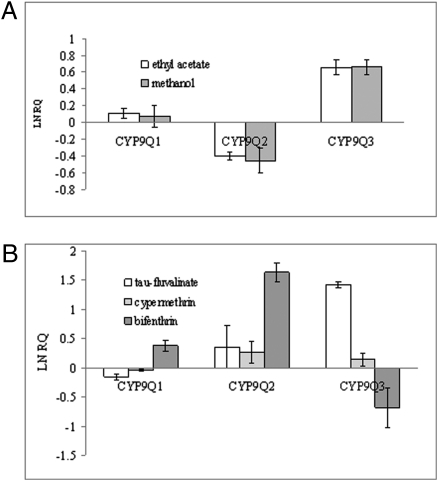
Although Apis mellifera, the western honey bee, has long encountered pesticides when foraging in agricultural fields, for two decades it has encountered pesticides in-hive in the form of acaricides to control Varroa destructor, a devastating parasitic mite. The pyrethroid tau-fluvalinate and the organophosphate coumaphos have been used for Varroa control, with little knowledge of honey bee detoxification mechanisms. Cytochrome P450-mediated detoxification contributes to pyrethroid tolerance in many insects, but specific P450s responsible for pesticide detoxification in honey bees (indeed, in any hymenopteran pollinator) have not been defined. We expressed and assayed CYP3 clan midgut P450s and demonstrated that CYP9Q1, CYP9Q2, and CYP9Q3 metabolize tau-fluvalinate to a form suitable for further cleavage by the carboxylesterases that also contribute to tau-fluvalinate tolerance. These in vitro assays indicated that all of the three CYP9Q enzymes also detoxify coumaphos. Molecular models demonstrate that coumaphos and tau-fluvalinate fit into the same catalytic pocket, providing a possible explanation for the synergism observed between these two compounds. Induction of CYP9Q2 and CYP9Q3 transcripts by honey extracts suggested that diet-derived phytochemicals may be natural substrates and heterologous expression of CYP9Q3 confirmed activity against quercetin, a flavonoid ubiquitous in honey. Up-regulation by honey constituents suggests that diet may influence the ability of honey bees to detoxify pesticides. Quantitative RT-PCR assays demonstrated that tau-fluvalinate enhances CYP9Q3 transcripts, whereas the pyrethroid bifenthrin enhances CYP9Q1 and CYP9Q2 transcripts and represses CYP9Q3 transcripts. The independent regulation of these P450s can be useful for monitoring and differentiating between pesticide exposures in-hive and in agricultural fields.
Conflict of interest statement
The authors declare no conflict of interest.
Figures
References
-
- Mao W, et al. Quercetin-metabolizing CYP6AS enzymes of the pollinator Apis mellifera (Hymenoptera: Apidae) Comp Biochem Physiol B Biochem Mol Biol. 2009;154:427–434. - PubMed
-
- Schmidt JO, Johnson BE. Pollen feeding preference of Apis mellifera (Hymenoptera: Apidae), a polylectic bee. Southwest Entomologist. 1984;9:41–47.
-
- Adler LS. The ecological significance of toxic nectar. Oikos. 2000;91:409–420.
-
- Campos M, Markham KR, Mitchell KA, da Cunha AP. An approach to the characterization of bee pollens via their flavonoid/phenolic profiles. Phytochem Ann. 1997;8:181–185.
-
- Detzel A, Wink M. Attraction, deterrence or intoxication of bees Apis mellifera by plant allelochemicals. Chemoecology. 1993;4:8–18.
Publication types
MeSH terms
Substances
LinkOut - more resources
Full Text Sources
Other Literature Sources
