. 2011 Jul 20;475(7356):381-5.
doi: 10.1038/nature10229.

Postnatal loss of Dlk1 imprinting in stem cells and niche astrocytes regulates neurogenesis

Affiliations

Postnatal loss of Dlk1 imprinting in stem cells and niche astrocytes regulates neurogenesis

Sacri R Ferrón et al. Nature. .

Abstract

The gene for the atypical NOTCH ligand delta-like homologue 1 (Dlk1) encodes membrane-bound and secreted isoforms that function in several developmental processes in vitro and in vivo. Dlk1, a member of a cluster of imprinted genes, is expressed from the paternally inherited chromosome. Here we show that mice that are deficient in Dlk1 have defects in postnatal neurogenesis in the subventricular zone: a developmental continuum that results in depletion of mature neurons in the olfactory bulb. We show that DLK1 is secreted by niche astrocytes, whereas its membrane-bound isoform is present in neural stem cells (NSCs) and is required for the inductive effect of secreted DLK1 on self-renewal. Notably, we find that there is a requirement for Dlk1 to be expressed from both maternally and paternally inherited chromosomes. Selective absence of Dlk1 imprinting in both NSCs and niche astrocytes is associated with postnatal acquisition of DNA methylation at the germ-line-derived imprinting control region. The results emphasize molecular relationships between NSCs and the niche astrocyte cells of the microenvironment, identifying a signalling system encoded by a single gene that functions coordinately in both cell types. The modulation of genomic imprinting in a stem-cell environment adds a new level of epigenetic regulation to the establishment and maintenance of the niche, raising wider questions about the adaptability, function and evolution of imprinting in specific developmental contexts.


Figures
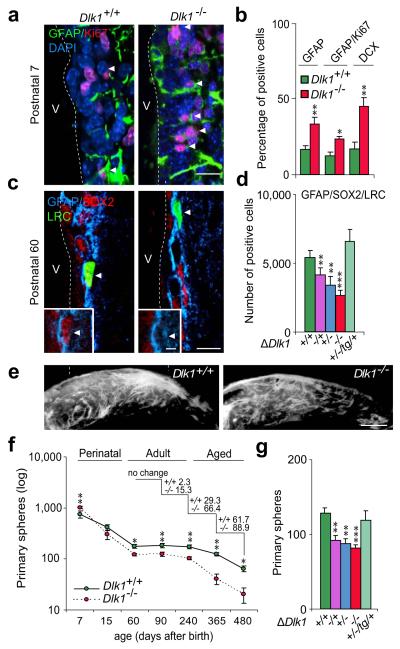
Figure 1
Figure 1. DLK1 regulates postnatal neurogenesis
(a) Immunohistochemistry for GFAP (green) and Ki67 (red) within the postnatal 7 (P7) SVZ of wild-type and Dlk1−/− mice. (b) Percentage of cell-types in the P7 SVZ from wild-type and Dlk1−/− mice. (c) Immunohistochemistry for GFAP (blue), SOX2 (red) and BrdU (green) within the adult SVZ of wild-type and Dlk1−/− mice. (d) Number of GFAP+/SOX2+/BrdU-label retaining cells (LRC)+ in the SVZ of mice with deletions of maternally-inherited (Dlk1−/+), paternally-inherited (Dlk1+/−), or both alleles (Dlk1−/−). Light-green bar represents paternal transmission mutant mice in a Dlk1 transgenic background (Dlk1+/−/Dlk1tg/+). (e) Whole-mount for DCX+ migrating neuroblasts within the SVZ. (f) Primary spheres from wild-type and Dlk1 mutant SVZs at different developmental stages. (g) Primary spheres from adult SVZ of different Dlk1 mutants. *p<0.05, **p<0.01, ***p<0.001. Error bars, s.e.m. of five experiments (n=4 cultures per genotype). V, ventricle. Scale bars; in a, c, 20 μm (inset 10 μm).
Figure 2
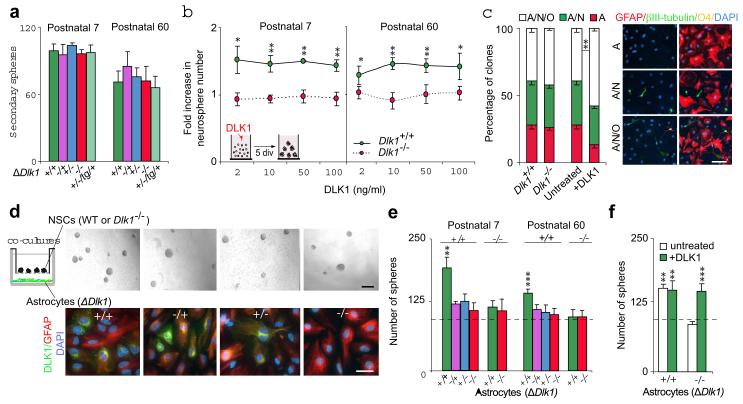
Figure 2. DLK1 is secreted by postnatal SVZ niche-astrocytes
(a) Secondary spheres formed from wild-type and Dlk1−/− primary neurospheres at P7 and P60. (b) Primary spheres from Dlk1+/+ and Dlk1−/− SVZ, after DLK1 treatment. (c) Quantification of unipotent (astrocytes), bipotent (astrocytes/neurons) and tripotent (astrocytes/ neurons/oligondendrocytes) clones derived from Dlk1+/+ and Dlk1−/− neurospheres grown in the presence or absence of DLK1 (left panel). Immunocytochemistry for GFAP (red), βIII-tubulin (green) and O4 (yellow) in differentiated neurospheres (right panel). (d) Primary neurospheres co-cultured with wild-type or Dlk1 mutant niche-astrocytes (upper panels). Immunocytochemistry for GFAP (red) and DLK1 (green) in niche-astrocyte cultures (lower panels). (e) Quantification of P7 and P60 co-culture experiments shown in d. (f) Primary spheres co-cultured with Dlk1+/+ or Dlk1−/− astrocytes and treated with DLK1. Dashed-lines indicate non co-cultured spheres. *p<0.05, **p<0.01, ***p<0.001. Error bars, s.e.m of triplicate cultures (3-6 samples per genotype). Scale bars: in c, 50 μm; in d (upper panel, 100 μm; lower panel, 30 μm).
Figure 3
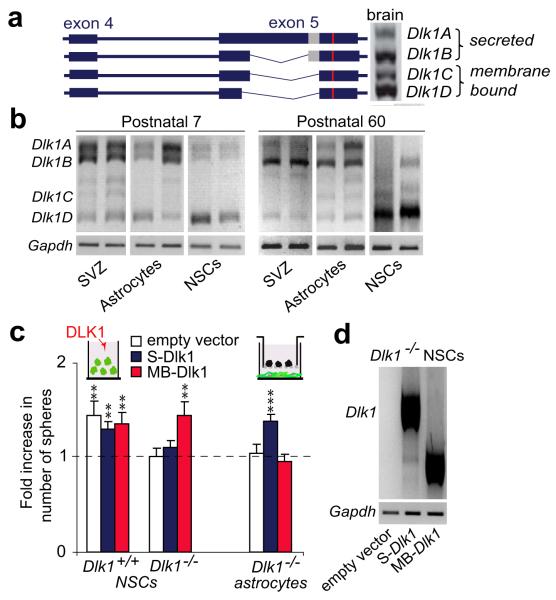
Figure 3. NSCs require membrane-bound DLK1 to respond to niche-secreted DLK1
(a) Dlk1 transcripts in whole brain. Proteolytic cleavage domain (grey box) is shown. (b) Semi-quantitative PCR of Dlk1 isoforms in SVZ, NSCs and niche-astrocytes at postnatal 7 and 60. (c) Neurospheres generated from Dlk1−/− or Dlk1+/+ cultures nucleofected with pIRES-GFP, pIRES-GFP-S-Dlk1 (secreted isoform) or pIRES-GFP-MB-Dlk1 (membrane-bound isoform) after DLK1 treatment or from wild-type NSCs co-cultured with transduced Dlk1−/− astrocytes. (d) Semi-quantitative PCR of Dlk1 isoforms in nucleofected NSCs. **p<0.01, ***p<0.001. Error bars: s.e.m; triplicate cultures (n=6 animals per genotype).
Figure 4
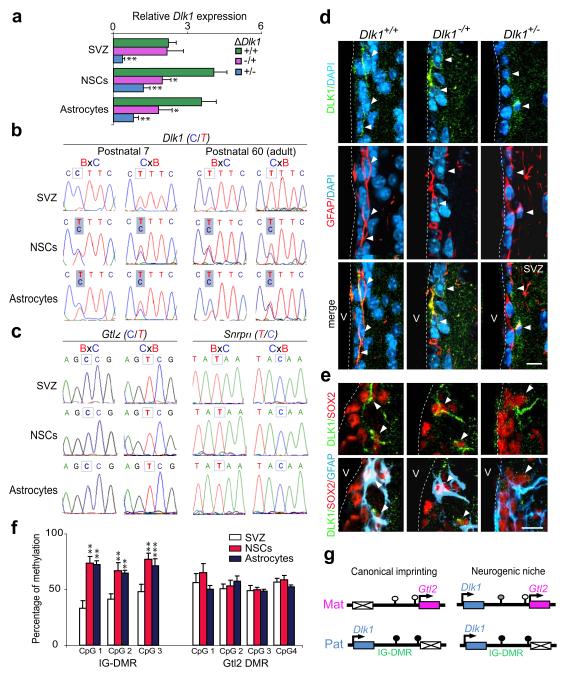
Figure 4. NSCs and niche-astrocytes selectively lose Dlk1 imprinting postnatally
(a) Quantitative PCR of Dlk1 expression in SVZ, NSCs and niche-astrocytes derived from Dlk1+/+, Dlk1−/+ and Dlk1+/− mice. (b) Dlk1 allele-specific expression of postnatal 7 and 60 SVZ, NSCs, and niche-astrocytes derived from reciprocal F1 hybrid offspring from Mus musculus domesticus (BL6) and Mus musculus castaneus (Cast). (c) Gtl2 and Snrpn allele-specific expression. (d) Immunohistochemistry for GFAP (red) and DLK1 (green) in the SVZ of Dlk1+/+, Dlk1−/+ and Dlk+/− mice. (e) Immunohistochemistry for GFAP (blue), SOX2 (red), and DLK1 (green) in the SVZ of Dlk1 mutant mice. Arrowheads indicate positive cells. (f) Methylation at the IG-DMR and Gtl2 promoter DMR. (g) Schematic representation of the Dlk1-Gtl2 domain in the neurogenic niche. Open and closed circles represent unmethylated and hypermethylated CpGs respectively. *p<0.05, **p<0.01. Error bars: s.e.m; n=10 per group and three bisulfite conversions. Scale bars: in c, 10 μm; in d, 7 μm.

Comment in

References

METHODS REFERENCES

    1. Mirzadeh Z, et al. The subventricular zone en-face: wholemount staining and ependymal flow. J Vis Exp. 2010;39 pii: 1938. doi: 10.3791/1938. - PMC - PubMed
    1. Lie DC, et al. Wnt signalling regulates adult hippocampal neurogenesis. Nature. 2005;437(7063):1370–1375. - PubMed
    1. García-Marqués J, De Carlos JA, Greer CA, López-Mascaraque L. Different astroglia permissivity controls the migration of olfactory bulb interneuron precursors. Glia. 2010;58(2):218–230. - PMC - PubMed
    1. Hsieh JJ, et al. Truncated mammalian Notch1 activates CBF1/RBPJk-repressed genes by a mechanism resembling that of Epstein-Barr virus EBNA2. Mol Cell Biol. 1996;16(3):952–959. - PMC - PubMed

References

    1. Schmidt JV, Matteson PG, Jones BK, Guan XJ, Tilghman SM. The Dlk1 and Gtl2 genes are linked and reciprocally imprinted. Genes Dev. 2000;14(16):1997–2002. - PMC - PubMed
    1. Takada S, et al. Delta-like and Gtl2 are reciprocally expressed, differentially methylated linked imprinted genes on mouse chromosome 12. Curr Biol. 2000;10(18):1135–1138. - PubMed
    1. Riquelme PA, Drapeau E, Doetsch F. Brain micro-ecologies: neural stem cell niches in the adult mammalian brain. Philos Trans R Soc Lond B Biol Sci. 2008;363(1489):123–137. - PMC - PubMed
    1. Ma DK, Bonaguidi MA, Ming GL, Song H. Adult neural stem cells in the mammalian central nervous system. Cell Res. 2009;19(6):672–682. - PMC - PubMed
    1. Lledo PM, Merkle FT, Alvarez-Buylla Origin and function of olfactory bulb interneuron diversity. Trends Neurosci. 2008;31(8):392–400. - PMC - PubMed

Publication types

MeSH terms

Substances