


Signal transducer and activator of transcription-3 and breast cancer prognosis
- PMID: 21776434
- PMCID: PMC3138712
Signal transducer and activator of transcription-3 and breast cancer prognosis
Abstract
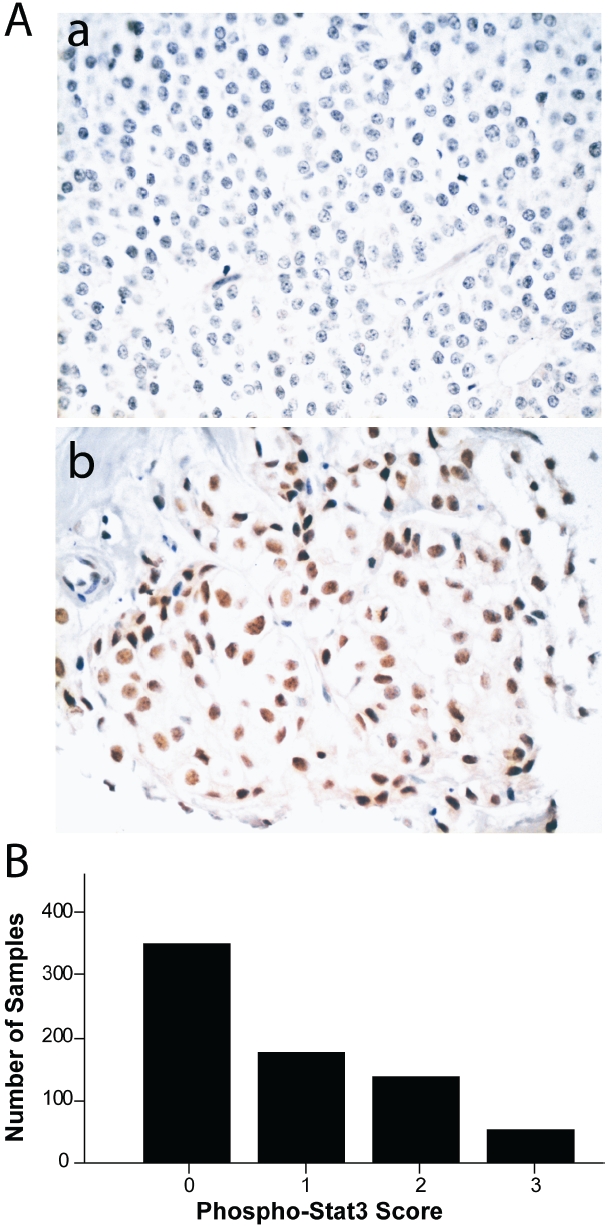
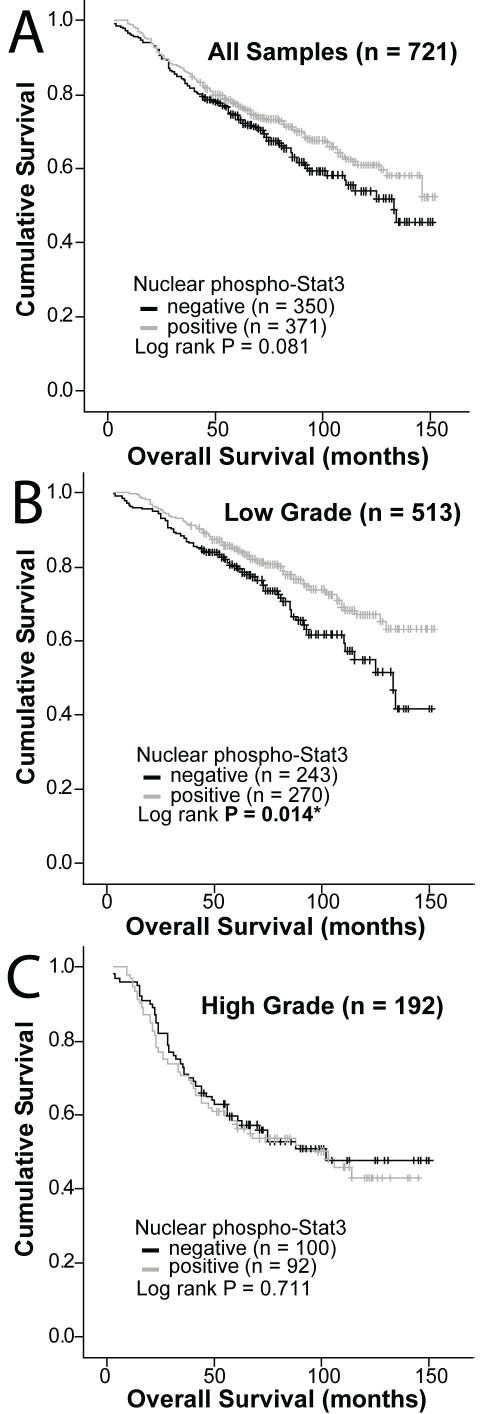
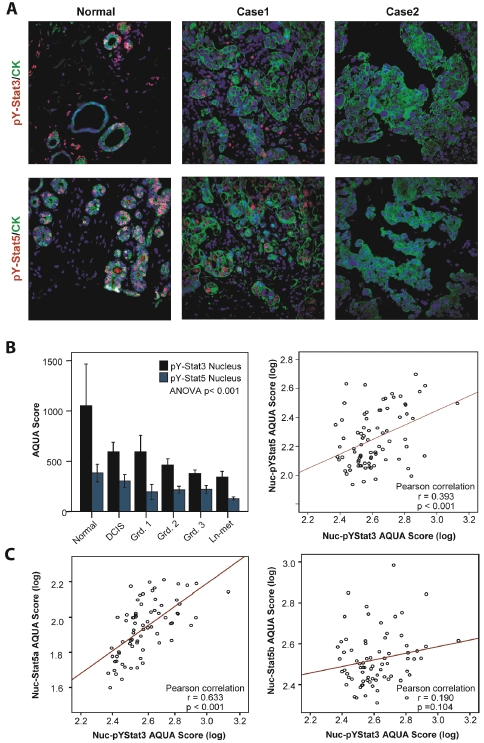
Signal transducer and activator of transcription-3 (Stat3) is frequently activated in breast cancer and multiple lines of evidence suggest that Stat3 promotes tumor progression. However, the prognostic value of Stat3 in human breast cancer remains controversial and associations range from favorable to unfavorable based on four outcome studies of 62, 102, 255 and 517 patients. Cellular Stat3 protein expression was measured in three studies whereas nuclear localized, tyrosine phosphorylated Stat3 (Nuc-pYStat3) was used as the readout in only one study. We therefore retrospectively analyzed the prognostic value of Nuc-pYStat3 in a larger material of 721 breast cancer specimens. Overall, patients whose tumors were positive for Nuc-pYStat3 tended to have improved survival, but the trend did not reach statistical significance (P=0.08). When specimens were stratified by tumor grade, patients with low grade but not high grade tumors that were positive for Nuc-pYStat3 had significantly prolonged overall survival in univariate analysis (P=0.014) but not in multivariate analyses. Unexpectedly, quantitative immunofluoresence detection revealed highest levels of Nuc-pYStat3 in normal breast epithelia and gradual loss of Nuc-pYStat3 during progression from DCIS, invasive ductal carcinoma, and lymph node metastases. Levels of Nuc-pYStat3 correlated positively with levels of Nuc-pYStat5, a favorable prognostic marker, in invasive ductal carcinomas. Furthermore, NucpYStat3 levels correlated strongly with protein levels of nuclear localized Stat5a (r=0.633, P<0.001) but not Stat5b. Our data does not support the notion that Nuc-pYStat3 is an independent marker of prognosis in breast cancer, although future studies may reveal prognostic utility within molecularly characterized subtypes of breast cancer.
Keywords: Stat3; biomarker; breast cancer; immunohistochemistry; prognosis; survival.
Figures
References
-
- Zhong Z, Wen Z, Darnell JE., Jr Stat3: a STAT family member activated by tyrosine phosphorylation in response to epidermal growth factor and interleukin-6. Science. 1994;264:95–98. - PubMed
-
- Darnell JE, Jr, Kerr IM, Stark GR. Jak-STAT pathways and transcriptional activation in response to IFNs and other extracellular signaling proteins. Science. 1994;264:1415–1421. - PubMed
-
- Bowman T, Garcia R, Turkson J, Jove R. STATs in oncogenesis. Oncogene. 2000;19:2474–2488. - PubMed
-
- Garcia R, Yu CL, Hudnall A, Catlett R, Nelson KL, Smithgall T, Fujita DJ, Ethier SP, Jove R. Constitutive activation of Stat3 in fibroblasts transformed by diverse oncoproteins and in breast carcinoma cells. Cell Growth Differ. 1997;8:1267–1276. - PubMed
-
- Sartor CI, Dziubinski ML, Yu CL, Jove R, Ethier SP. Role of epidermal growth factor receptor and STAT-3 activation in autonomous proliferation of SUM-102PT human breast cancer cells. Cancer Res. 1997;57:978–987. - PubMed
Grants and funding
LinkOut - more resources
Full Text Sources
Miscellaneous