


A latent class analysis of DSM-IV and Fagerström (FTND) criteria for nicotine dependence
- PMID: 21778154
- PMCID: PMC3179671
- DOI: 10.1093/ntr/ntr105
A latent class analysis of DSM-IV and Fagerström (FTND) criteria for nicotine dependence
Abstract
Background: Nicotine dependence is associated with considerable morbidity and mortality. Two predominant classification systems, the Diagnostic and Statistical Manual (DSM-IV) and Fagerström Test for Nicotine Dependence (FTND), have been used to measure liability to nicotine dependence, yet few studies have attempted to simultaneously examine both sets of criteria.
Methods: Using a sample of 624 regular smoking individuals who are offspring of Vietnam Era Twin fathers ascertained for an offspring of twin study, we applied latent class analysis to the 7 DSM-IV and the 6 FTND criteria to classify individuals by their nicotine dependence symptom profiles. Post-hoc across-class comparisons were conducted using a variety of smoking-related variables and aspects of psychopathology. Whether a single class identified offspring at high genetic and environmental vulnerability was also investigated.
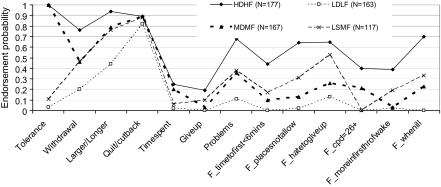
Results: The cross-diagnosis kappa was .30. A 4-class solution fit these data best. The classes included a low DSM-low FTND class and a high DSM-high FTND class; a moderate DSM-moderate FTND class, which was distinguished by moderate levels of smoking and intermediate levels of comorbid psychopathology; and a light smoking-moderate FTND class consisting primarily of lighter smokers with a more recent onset of regular smoking. High genetic and environmental vulnerability to nicotine dependence was noted in all classes with no statistically significant across-class differences.
Conclusions: In general, the DSM-IV and FTND criteria performed similarly to define a continuum of risk for nicotine dependence. The emerging class of light smokers should be further investigated to assess whether they transition to another class or remain as such.
Figures
References
-
- American Psychiatric Association. Diagnostic and statistical manual of mental disorders. 4th ed. Washington, DC: Author; 1994.
-
- American Psychiatric Association. Diagnostic and statistical manual of mental disorder. 3rd ed.revised. Washington, DC: Author; 1987.
-
- Breslau N, Johnson EO. Predicting smoking cessation and major depression in nicotine-dependent smokers. American Journal of Public Health. 2000;90:1122–1127. Retrieved from http://www.ncbi.nlm.nih.gov/pmc/articles/PMC1446294/?tool=pubmed. - PMC - PubMed
-
- Broms U, Silventoinen K, Madden PA, Heath AC, Kaprio J. Genetic architecture of smoking behavior: A study of Finnish adult twins. Twin Research and Human Genetics. 2006;9:64–72. Retrieved from http://www.atypon-link.com/AAP/doi/pdfplus/10.1375/twin.9.1.64. - DOI - PubMed
Publication types
MeSH terms
Grants and funding
- DA019951/DA/NIDA NIH HHS/United States
- DA18660/DA/NIDA NIH HHS/United States
- DA14363/DA/NIDA NIH HHS/United States
- AA11822/AA/NIAAA NIH HHS/United States
- K08 AA017921/AA/NIAAA NIH HHS/United States
- DA020810/DA/NIDA NIH HHS/United States
- AA11998/AA/NIAAA NIH HHS/United States
- R01 DA012854/DA/NIDA NIH HHS/United States
- K08 DA019951/DA/NIDA NIH HHS/United States
- DA18267/DA/NIDA NIH HHS/United States
- DA23668/DA/NIDA NIH HHS/United States
- AA11667/AA/NIAAA NIH HHS/United States
- AA007580/AA/NIAAA NIH HHS/United States
LinkOut - more resources
Full Text Sources
