"Speaking the dialect": understanding public discourse in the aftermath of an HIV vaccine trial shutdown
- PMID: 21778490
- PMCID: PMC3154228
- DOI: 10.2105/AJPH.2011.300208
"Speaking the dialect": understanding public discourse in the aftermath of an HIV vaccine trial shutdown
Abstract
Objectives: We investigated how persons from key populations at higher risk of HIV exposure interpreted the process and outcomes of the Step Study HIV-1 vaccine trial, which was terminated early, and implications for willingness to participate in and community support for HIV vaccine research.
Methods: We used qualitative methods and a community-based approach in 9 focus groups (n = 72) among ethnically and sexually diverse populations and 6 semistructured key informant interviews in Ontario, Canada, in 2007 to 2008.
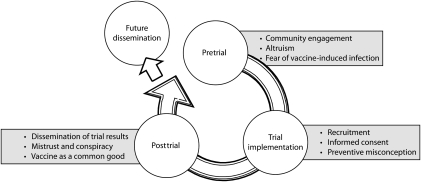
Results: Participants construed social meaning from complex clinical and biomedical phenomena. Social representations and mental models emerged in fears of vaccine-induced infection, conceptualizations of unfair recruitment practices and increased risk behaviors among trial participants, and questioning of informed consent. Narratives of altruism and the common good demonstrated support for future trials.
Conclusions: Public discourse on HIV vaccine trials is a productive means of interpreting complex clinical trial processes and outcomes in the context of existing beliefs and experiences regarding HIV vaccines, medical research, and historical disenfranchisement. Strategic engagement with social representations and mental models may promote meaningful community involvement in biomedical HIV prevention research.
Figures
References
-
- Belshe R, Franchini G, Girard MP, et al. Support for the RV144 HIV vaccine trial. Science. 2004;305(5681):177–180 - PubMed
-
- Burton DR, Desrosiers RC, Doms RW, et al. Public health. A sound rationale needed for phase III HIV-1 vaccine trials. Science. 2004;303(5656):316. - PubMed
-
- Fauci AS, Johnston MI, Dieffenbach CW, et al. HIV vaccine research: the way forward. Science. 2008;321(5888):530–532 - PubMed
-
- Khanlou H, Weinstein M. Enough is enough: instead of continuing to squander hundreds of millions of dollars on a futile quest for an HIV vaccine, focus AIDS spending on prevention, testing and treatment. AIDS Healthcare Foundation; March 23, 2008. Available at: http://www.increaseaidsfunding.ca/docs/baltimoresun_032308.pdf. Accessed February 4, 2011
-
- Leavy O. HIV vaccine results controversy. Nat Rev Immunol. 2009;9(11):755
Publication types
MeSH terms
Substances
LinkOut - more resources
Full Text Sources