


E6 and E7 from beta HPV38 cooperate with ultraviolet light in the development of actinic keratosis-like lesions and squamous cell carcinoma in mice
- PMID: 21779166
- PMCID: PMC3136451
- DOI: 10.1371/journal.ppat.1002125
E6 and E7 from beta HPV38 cooperate with ultraviolet light in the development of actinic keratosis-like lesions and squamous cell carcinoma in mice
Erratum in
-
Correction: E6 and E7 from Beta Hpv38 Cooperate with Ultraviolet Light in the Development of Actinic Keratosis-Like Lesions and Squamous Cell Carcinoma in Mice.PLoS Pathog. 2016 Oct 28;12(10):e1006005. doi: 10.1371/journal.ppat.1006005. eCollection 2016 Oct. PLoS Pathog. 2016. PMID: 27792794 Free PMC article.
Abstract
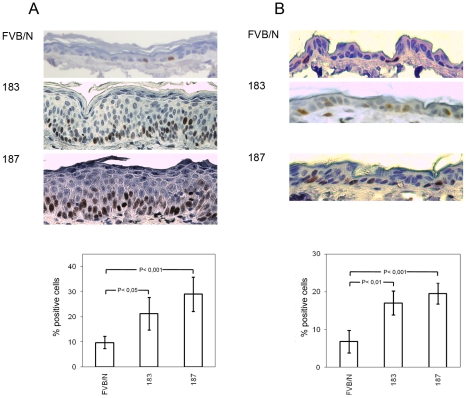
Cutaneous beta human papillomavirus (HPV) types appear to be involved in the development of non-melanoma skin cancer (NMSC); however, it is not entirely clear whether they play a direct role. We have previously shown that E6 and E7 oncoproteins from the beta HPV type 38 display transforming activities in several experimental models. To evaluate the possible contribution of HPV38 in a proliferative tissue compartment during carcinogenesis, we generated a new transgenic mouse model (Tg) where HPV38 E6 and E7 are expressed in the undifferentiated basal layer of epithelia under the control of the Keratin 14 (K14) promoter. Viral oncogene expression led to increased cellular proliferation in the epidermis of the Tg animals in comparison to the wild-type littermates. Although no spontaneous formation of tumours was observed during the lifespan of the K14 HPV38 E6/E7-Tg mice, they were highly susceptible to 7,12-dimethylbenz(a)anthracene (DMBA)/12-0-tetradecanoylphorbol-13-acetate (TPA) two-stage chemical carcinogenesis. In addition, when animals were exposed to ultraviolet light (UV) irradiation, we observed that accumulation of p21(WAF1) and cell-cycle arrest were significantly alleviated in the skin of Tg mice as compared to wild-type controls. Most importantly, chronic UV irradiation of Tg mice induced the development of actinic keratosis-like lesions, which are considered in humans as precursors of squamous cell carcinomas (SCC), and subsequently of SCC in a significant proportion of the animals. In contrast, wild-type animals subjected to identical treatments did not develop any type of skin lesions. Thus, the oncoproteins E6 and E7 from beta HPV38 significantly contribute to SCC development in the skin rendering keratinocytes more susceptible to UV-induced carcinogenesis.
Conflict of interest statement
The authors have declared that no competing interests exist.
Figures




References
-
- Pisani P, Bray F, Parkin DM. Estimates of the world-wide prevalence of cancer for 25 sites in the adult population. Int J Cancer. 2002;97:72–81. - PubMed
-
- Ananthaswamy HN, Loughlin SM, Cox P, Evans RL, Ullrich SE, et al. Sunlight and skin cancer: inhibition of p53 mutations in UV-irradiated mouse skin by sunscreens. Nat Med. 1997;3:510–514. - PubMed
-
- Armstrong BK, Kricker A. The epidemiology of UV induced skin cancer. J Photochem Photobiol B. 2001;63:8–18. - PubMed
-
- Preston DS, Stern RS. Nonmelanoma cancers of the skin. N Engl J Med. 1992;327:1649–1662. - PubMed
-
- Boyle J, MacKie RM, Briggs JD, Junor BJ, Aitchison TC. Cancer, warts, and sunshine in renal transplant patients. A case-control study. Lancet. 1984;1:702–705. - PubMed
Publication types
MeSH terms
Substances
LinkOut - more resources
Full Text Sources
Medical
Molecular Biology Databases
Research Materials
Miscellaneous
