Biomarkers predicting Alzheimer's disease in cognitively normal aging
- PMID: 21779293
- PMCID: PMC3131540
- DOI: 10.3988/jcn.2011.7.2.60
Biomarkers predicting Alzheimer's disease in cognitively normal aging
Abstract
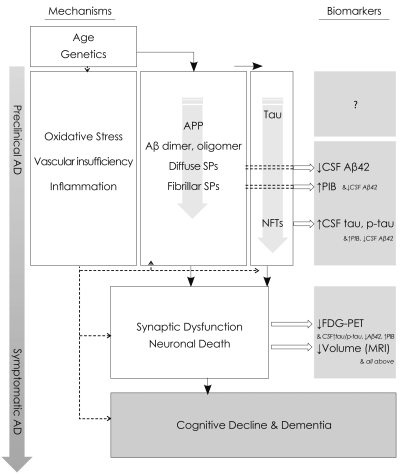
The pathophysiologic process of Alzheimer's disease (AD) begins years before the diagnosis of clinical dementia. This concept of preclinical AD has arisen from the observation of AD pathologic findings such as senile plaques and neurofibrillary tangles in the brains of people who at the time of death had normal cognitive function. Recent advances in biomarker studies now provide the ability to detect the pathologic changes of AD, which are antecedent to symptoms of the illness, in cognitively normal individuals. Functional and structural brain alterations that begin with amyloid-β accumulation already show the patterns of abnormality seen in individuals with dementia due to AD. The presence of preclinical AD provides a critical opportunity for potential interventions with disease-modifying therapy. This review focuses on the studies of antecedent biomarkers for preclinical AD.
Keywords: Alzheimer's disease; biomarker; preclinical.
Conflict of interest statement
The authors have no financial conflicts of interest.
Figures
References
-
- Braak H, Braak E. Neuropathological stageing of Alzheimer-related changes. Acta Neuropathol. 1991;82:239–259. - PubMed
-
- Khachaturian ZS. Diagnosis of Alzheimer's disease. Arch Neurol. 1985;42:1097–1105. - PubMed
-
- Mirra SS, Heyman A, McKeel D, Sumi SM, Crain BJ, Brownlee LM, et al. The Consortium to Establish a Registry for Alzheimer's Disease (CERAD). Part II. Standardization of the neuropathologic assessment of Alzheimer's disease. Neurology. 1991;41:479–486. - PubMed
-
- Hyman BT, Trojanowski JQ. Consensus recommendations for the postmortem diagnosis of Alzheimer disease from the National Institute on Aging and the Reagan Institute Working Group on diagnostic criteria for the neuropathological assessment of Alzheimer disease. J Neuropathol Exp Neurol. 1997;56:1095–1097. - PubMed
-
- Price JL, Morris JC. Tangles and plaques in nondemented aging and "preclinical" Alzheimer's disease. Ann Neurol. 1999;45:358–368. - PubMed
Grants and funding
LinkOut - more resources
Full Text Sources