. 2010 Nov;1(11):1115-8.
doi: 10.1177/1947601911401911.

Newcomers to the WW Domain-Mediated Network of the Hippo Tumor Suppressor Pathway

Affiliations

Newcomers to the WW Domain-Mediated Network of the Hippo Tumor Suppressor Pathway

Marius Sudol. Genes Cancer. 2010 Nov.

Abstract

The Hippo tumor suppressor pathway regulates the size of organs by controlling 2 opposing processes: proliferation and apoptosis. The pathway was originally defined in Drosophila, but it is well conserved in mammals. One of the unique features of Hippo signaling is the unusually wide occurrence of WW domains and its cognate PPxY ligand motifs within components of this pathway. Recently, it was proposed that the prevalence of WW domain-mediated complexes in the Hippo signaling pathway should facilitate its molecular analysis and help in the identification of new components of the Hippo-centered network. Indeed, several new members of the Hippo pathway, which form functional complexes with WW domains of YAP and TAZ effectors, were recently described. We focus here on 2 families of such proteins, angiomotins and SMADs, plus 1 regulatory factor, WBP-2, which together shed new light on the rapidly expanding Hippo network. Since the Hippo pathway acts as a tumor suppressor pathway, the complexes described here, which assemble on WW domains of YAP and TAZ, represent potential targets of cancer therapy.

Keywords: SMADs; WW module; YAP and TAZ oncogenes; angiomotins.


Conflict of interest statement

The author(s) declared no potential conflicts of interest with respect to the authorship and/or publication of this article.

Figures
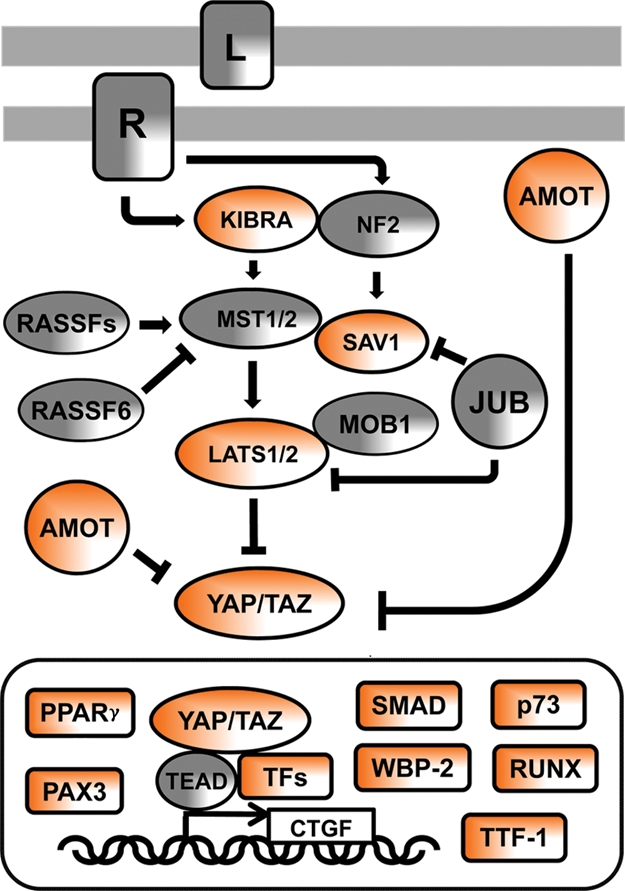
Figure 1.
Figure 1.
The Hippo signaling network in mammals. In the signaling diagram, the proteins that contain WW domains or PPxY ligand motif are in orange. “L” denotes an unknown ligand, and “R” denotes its cognate but still unknown receptor. L and R are engaged by cell-to-cell contacts and activate the pathway. JUB, also known as AJUBA, transduces signals from sites of cell adhesion. JUB has an inhibitory function on SAV1 (SALVADOR 1) adapter protein and LATS kinases. RASSF is a family of Ras association domain–containing proteins that stimulate or inhibit MST kinases. MOB1 is the Mps One Binder kinase activator-like 1B protein, whose binding to LATS activates its kinase activity. TFs = transcription factors, examples of which are as follows: TEAD = TEA domain proteins that have a conserved DNA binding domain and can function as repressors or activators of gene transcription; PPARγ = peroxisome proliferator-activated receptor γ; PAX3 = paired box 3 protein; p73 = a member of the p53 family of proteins implicated in apoptotic signaling; RUNX = runt-related transcription factor; TTF-1 = transcription termination factor-1; CTGF = connective tissue growth factor, one of the genes induced by YAP/TEAD nuclear signaling. Other abbreviations are described in the text.
Figure 2.
Figure 2.
Modes of signaling by the WW domain. The WW domain recognizes PPxY-containing ligand (A), with the Y in a nonphospho state. Phosphorylation of the signature Y in PPxY abrogates the complex (B). In some instances, 2 WW domains mediate interaction with a single PPxY-containing ligand (C), as discussed in the text for the YAP (isoform 2) and SMAD1 complex. WW domains were also shown to homodimerize (D) and heterodimerize (E). In one instance, an additional β strand at the carboxy-terminal region of the WW domain was required for dimer formation (F). See the text for references.
Figure 3.
Figure 3.
Schematic of nuclear signaling by the YAP/TAZ and estrogen receptor complex. YAP and its ligand, WBP-2, were shown to be a part of the E6-AP and ER-E (estrogen receptor - estrogen) complex and are required for estrogen-mediated gene expression. The nuclear signaling of this multicomponent complex may identify targets for the development of cancer drugs. Other abbreviations are described in the text.

References

    1. Harvey K, Tapon N. The Salvador-Warts-Hippo pathway: an emerging tumour-suppressor network. Nat Rev Cancer. 2007;7:182-91 - PubMed
    1. Pan D. The Hippo signaling pathway in development and cancer. Dev Cell. 2010;19:491-505 - PMC - PubMed
    1. Sudol M, Bork P, Einbond A, et al. Characterization of the mammalian YAP (Yes-associated protein) gene and its role in defining a novel protein module, the WW domain. J Biol Chem. 1995;270:14733-41 - PubMed
    1. Huang J, Wu S, Barrera J, Matthews K, Pan D. The Hippo signaling pathway coordinately regulates cell proliferation and apoptosis by inactivating Yorkie, the Drosophila homolog of YAP. Cell. 2005;122:421-34 - PubMed
    1. Kanai F, Marignani PA, Sarbassova D, et al. TAZ: a novel transcriptional co-activator regulated by interactions with 14-3-3 and PDZ domain proteins. EMBO J. 2000;19:6778-91 - PMC - PubMed

LinkOut - more resources