


Tyrosine Kinase Receptor Flt/VEGFR Family: Its Characterization Related to Angiogenesis and Cancer
- PMID: 21779435
- PMCID: PMC3092272
- DOI: 10.1177/1947601910392987
Tyrosine Kinase Receptor Flt/VEGFR Family: Its Characterization Related to Angiogenesis and Cancer
Abstract
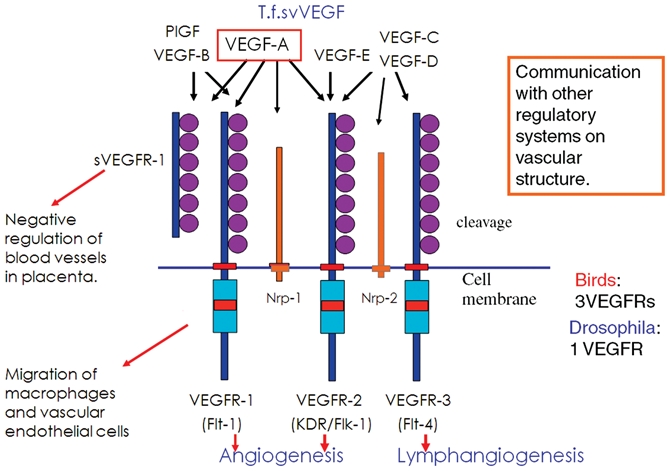
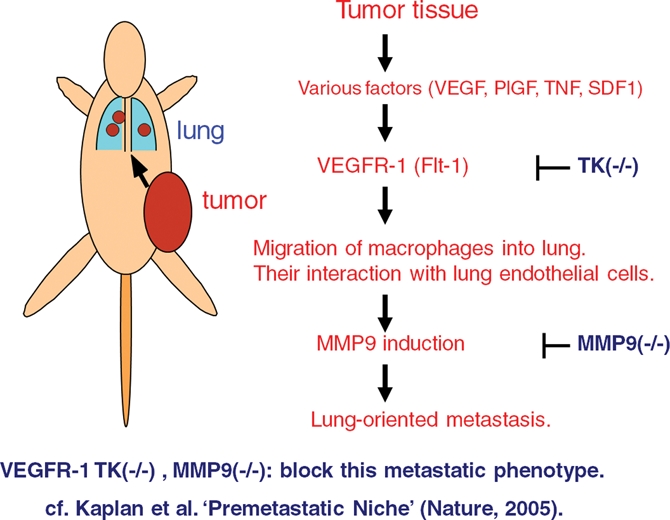
Ligands and their tyrosine kinase (TK) receptors regulate a variety of biological systems in animals. Vascular endothelial growth factor (VEGF) and its receptor (Flt/VEGFR family) system play a crucial role not only in physiological but also in most parts of pathological angiogenesis including cancer. Flt-1/VEGFR-1 and KDR/VEGFR-2 bind VEGF-A but have different functions on angiogenesis at early embryogenesis: Flt-1 has a negative role by trapping ligands, whereas KDR (Flk1 in mice) exerts a strong positive signal, resulting in a balance in blood vessel formation. At adult stages, however, both VEGFRs contribute to pathological angiogenesis either directly or through stimulation of migration/activation of macrophage lineage cells and stimulate tumor growth, metastasis, and inflammation. VEGFRs activate downstream signaling of the phospholipase Cγ-protein kinase C-MAP kinase pathway but not Ras pathway for cell proliferation. The VEGF-C/D and Flt-4/VEGFR-3 system regulates lymphangiogenesis. Thus, VEGFs as well as these receptor TKs are attractive targets for suppressing pathological angiogenesis.
Keywords: phospholipase C; tumor angiogenesis; tyrosine kinase receptor; vascular endothelial growth factor.
Conflict of interest statement
The author declared no potential conflicts of interest with respect to the authorship and/or publication of this article.
Figures
References
-
- Jove R, Hanafusa H. Cell transformation by the viral src oncogene. Annu Rev Cell Biol. 1987;3:31-56 - PubMed
-
- Matsushime H, Yoshida MC, Sasaki M, Shibuya M. A possible new member of tyrosine kinase family, human frt sequence is highly conserved in vertebrates and located on human chromosome 13. Jpn J Cancer Res (Gann). 1987;78:655-61 - PubMed
-
- Shibuya M, Yamaguchi S, Yamane A, et al. Nucleotide sequence and expression of a novel human receptor-type tyrosine kinase gene (flt) closely related to the fms family. Oncogene. 1990;5:519-24 - PubMed
-
- De Vries C, Escobedo JA, Ueno H, Houck K, Ferrara N, Williams LT. The fms-like tyrosine kinase, a receptor for vascular endothelial growth factor. Science. 1992;255:989-91 - PubMed
LinkOut - more resources
Full Text Sources
Other Literature Sources
Molecular Biology Databases
Miscellaneous