


TP53-Associated Pediatric Malignancies
- PMID: 21779516
- PMCID: PMC3135643
- DOI: 10.1177/1947601911409745
TP53-Associated Pediatric Malignancies
Abstract
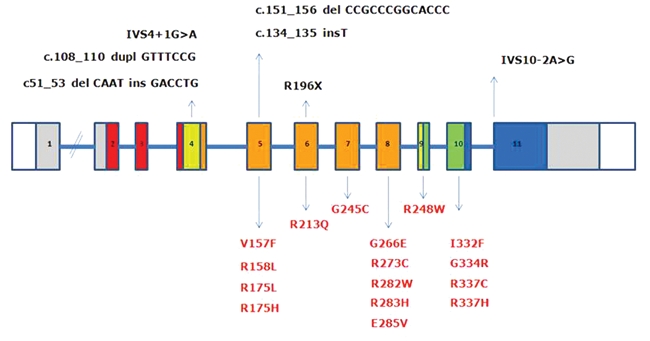
Although the majority of pediatric malignancies express wild-type p53, it is well established that germline TP53 mutations or functional inactivation of this pathway by other means contribute to childhood cancer. Epidemiology studies have revealed the existence of diverse inherited mutant TP53 alleles that display different levels of tumor suppressor activity, which correlate with cancer risk in terms of penetrance, age of onset, and tumor types. In this monograph, the authors describe those childhood cancers associated with functional inactivation of TP53 focusing on adrenocortical carcinoma as a model for tissues that are highly sensitive to loss of p53 activity.
Keywords: Arg337His; adrenocortical tumors; p53 mutation.
Conflict of interest statement
The author(s) declared no potential conflicts of interest with respect to the research, authorship, and/or publication of this article.
Figures
References
-
- Altekruse SF, Kosary CL, Krapcho M, et al., editors. SEER Cancer Statistics Review, 1975-2007, based on November 2009 SEER data submission, posted to the SEER web site, 2010. Bethesda, MD: National Cancer Institute; http://seer.cancer.gov/csr/1975_2007/
-
- Strong LC, Williams WR, Tainsky MA. The Li-Fraumeni syndrome: from clinical epidemiology to molecular genetics. Am J Epidemiol. 1992;135:190-9 - PubMed
-
- Birch JM, Blair V, Kelsey AM, et al. Cancer phenotype correlates with constitutional TP53 genotype in families with the Li-Fraumeni syndrome. Oncogene. 1998;17:1061-8 - PubMed
-
- Bennett WP, Hussain SP, Vahakangas KH, Khan MA, Shields PG, Harris CC. Molecular epidemiology of human cancer risk: gene-environment interactions and p53 mutation spectrum in human lung cancer. J Pathol. 1999;187:8-18 - PubMed
-
- Vousden KH, Lane DP. p53 in health and disease. Nat Rev Mol Cell Biol. 2007;8:275-83 - PubMed
Grants and funding
LinkOut - more resources
Full Text Sources
Other Literature Sources
Research Materials
Miscellaneous