. 2011 Jul 24:11:78.
doi: 10.1186/1472-6750-11-78.

Sustained productivity in recombinant Chinese hamster ovary (CHO) cell lines: proteome analysis of the molecular basis for a process-related phenotype

Affiliations

Sustained productivity in recombinant Chinese hamster ovary (CHO) cell lines: proteome analysis of the molecular basis for a process-related phenotype

Paula Meleady et al. BMC Biotechnol. .

Abstract

Background: The ability of mammalian cell lines to sustain cell specific productivity (Qp) over the full duration of bioprocess culture is a highly desirable phenotype, but the molecular basis for sustainable productivity has not been previously investigated in detail. In order to identify proteins that may be associated with a sustained productivity phenotype, we have conducted a proteomic profiling analysis of two matched pairs of monoclonal antibody-producing Chinese hamster ovary (CHO) cell lines that differ in their ability to sustain productivity over a 10 day fed-batch culture.

Results: Proteomic profiling of inherent differences between the two sets of comparators using 2D-DIGE (Difference Gel Electrophoresis) and LC-MS/MS resulted in the identification of 89 distinct differentially expressed proteins. Overlap comparisons between the two sets of cell line pairs identified 12 proteins (AKRIB8, ANXA1, ANXA4, EIF3I, G6PD, HSPA8, HSP90B1, HSPD1, NUDC, PGAM1, RUVBL1 and CNN3) that were differentially expressed in the same direction.

Conclusion: These proteins may have an important role in sustaining high productivity of recombinant protein over the duration of a fed-batch bioprocess culture. It is possible that many of these proteins could be useful for future approaches to successfully manipulate or engineer CHO cells in order to sustain productivity of recombinant protein.


Figures
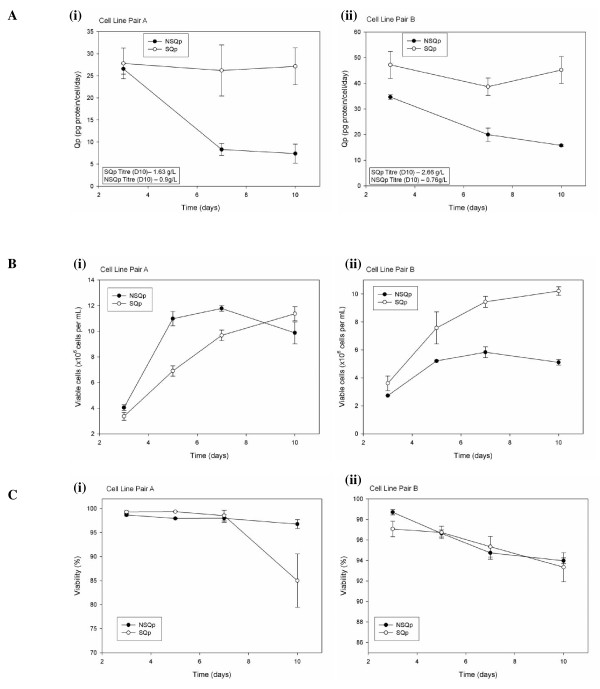
Figure 1
Figure 1
Qp measurements for each of cell line pairs A and B with associated viable cell densities. A. Qp measurements over time in culture for cell line pairs A and B. Qp measurements taken at days 3, 7 and 10. (i) Cell Line Pair A; (ii) - Cell Line Pair B. Final product titres measured at Day 10 (D10) are also included with the graphs. B. Growth and C. % viability of each culture for cell line pairs A and B. Viable cell densities were taken at days 3, 5, 7 and 10; (i) - Cell Line Pair A; (ii) - Cell Line Pair B.
Figure 2
Figure 2
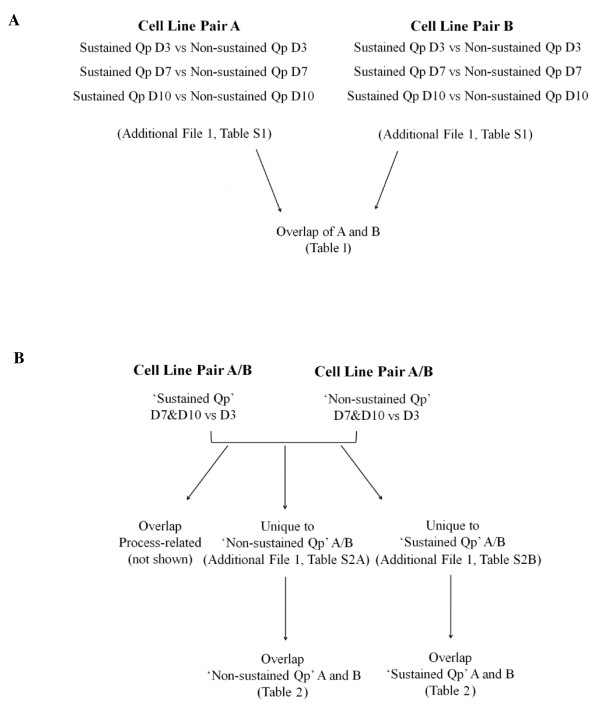
Experimental design for proteomic analysis. Outline of the two approaches (A and B) used to generate lists of proteins that are differentially expressed that may be associated with sustaining high productivity over a 10 day bioprocess culture.
Figure 3
Figure 3
Altered expression of Glucose 6 phosphate-1 dehydrogenase (G6PD). Graphical representation and zoomed in regions of 2D-DIGE gel images to demonstrate altered expression of one of the differentially expressed proteins common to cell line pairs A and B, i.e. Glucose 6 phosphate-1 dehydrogenase (G6PD), decreased in both 'SQp' cell lines compared to 'NSQp' cell lines at all time points over 10 days of culture. G6PD expression in (A) Cell Line Pair A and (B) Cell Line Pair B. (i) Left panel, zoomed in regions of 2D-DIGE gel images of G6PD at days 3, 7 and 10; (ii) Right panel, graphical representation from DeCyder 6.5 software analysis of the standardized log abundance of the spot intensities of G6PD at days 3, 7 and 10. (Blue data points - 'SQp' samples; red data points - 'NSQp' samples).
Figure 4
Figure 4
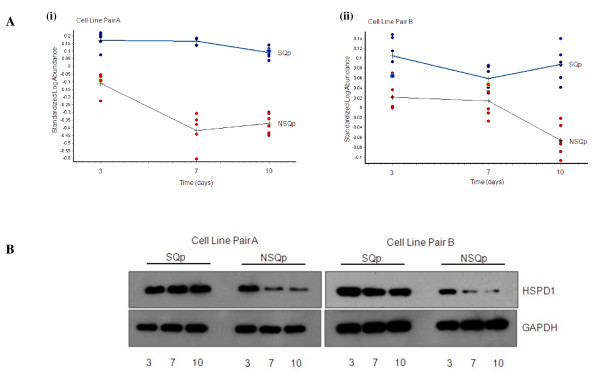
Expression of HSPD1 'tracking' the sustained productivity phenotype: 2D-DIGE and western blot analysis to demonstrate HSPD1 protein expression 'tracking' the sustained productivity phenotype in the SQp and NSQp cell lines from Cell Line Pairs A and B. A. Graphical representation of 2D-DIGE gel protein spots showing the standardized log abundance of spot intensities at days 3, 7 and 10 from DeCyder analysis of (i) Cell Line Pair A and (ii) Cell Line Pair B. Blue data points - 'SQp' samples; red data points - 'NSQp' samples. B. Western blot analysis of HSPD1 protein expression in the two cell line pairs, A and B. GAPDH was used to demonstrate equal loading between samples.

References

    1. Chu L, Robinson DK. Industrial choices for protein production by large-scale cell culture. Curr Opin Biotechnol. 2001;12:180–187. doi: 10.1016/S0958-1669(00)00197-X. - DOI - PubMed
    1. Altamirano C, Paredes C, Cairó JJ, Gòdia F. Improvement of CHO cell culture medium formulation: simultaneous substitution of glucose and glutamine. Biotechnol Prog. 2000;16:69–75. - PubMed
    1. Prentice HL, Ehrenfels BN, Sisk WP. Improving performance of mammalian cells in fed-batch processes through "bioreactor evolution". Biotechnol Prog. 2007;23:458–464. doi: 10.1021/bp060296y. - DOI - PubMed
    1. Meleady P. Proteomic profiling of recombinant cells from large-scale mammalian cell culture processes. Cytotechnology. 2007;53:23–31. doi: 10.1007/s10616-007-9052-9. - DOI - PMC - PubMed
    1. O'Callaghan PM, James DC. Systems biotechnology of mammalian cell factories. Brief Funct Genomic Proteomic. 2008;7:95–110. doi: 10.1093/bfgp/eln012. - DOI - PubMed

Publication types