


Review
doi: 10.1016/j.mce.2011.07.012.
Epub 2011 Jul 12.
Isolated GnRH deficiency: a disease model serving as a unique prism into the systems biology of the GnRH neuronal network
Affiliations
- PMID: 21782888
- PMCID: PMC3226734
- DOI: 10.1016/j.mce.2011.07.012
Item in Clipboard
Review
Isolated GnRH deficiency: a disease model serving as a unique prism into the systems biology of the GnRH neuronal network
Mol Cell Endocrinol.
.
No abstract available
Figures
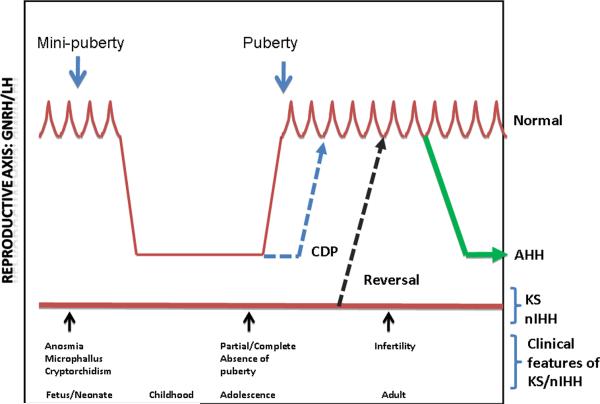
Pulsatile GnRH secretion is initiated during the late fetal/early neonatal period (“mini-puberty”), followed by quiescence during childhood and reawakening of the pulsatile secretion in mid-childhood. Presence of anosmia signals a developmental defect in GnRH neuronal migration while, microphallus or cryptorchidism signal fetal/neonatal lack of GnRH secretion. Constitutional delay of puberty (CDP) represents a late activation of the HPG axis while KS and nIHH represent partial or complete failure of pulsatile GnRH secretion. Recovery of pulsatile GnRH secretion in KS/nIHH subjects in adulthood is termed “Reversal”, while, AHH (adult-onset hypogonadotropic hypogonadism) refers to the onset of isolated GnRH deficiency during adulthood following a normal mini-puberty and puberty.
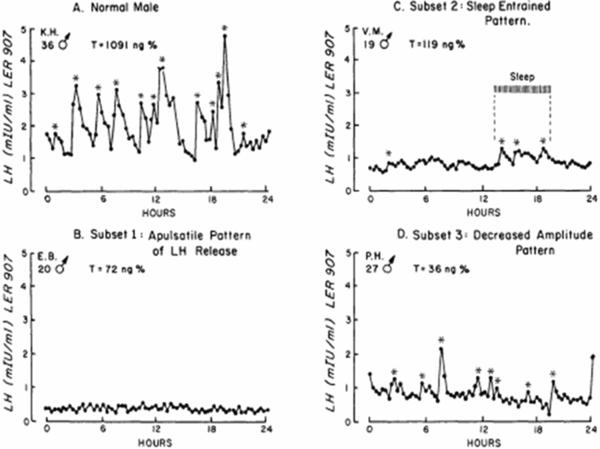
A. Normal adult male pattern of LH secretion: High amplitude LH pulses at ¬2h interval intervals with normal testosterone levels. B. Apulsatile pattern of LH secretion in a GnRH deficient male subject with frank hypogonadal T levels. C. Developmental arrest or sleep entrained (hatched bar) pattern of LH secretion in a GnRH deficient male. D. Normal frequency but low amplitude pattern of LH secretion in a GnRH deficient male subject.
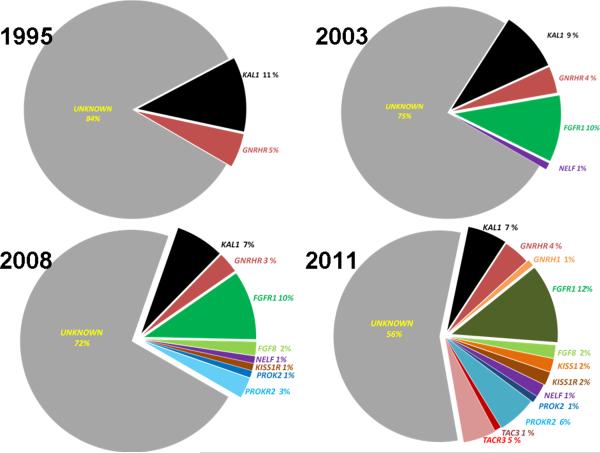
Genetic etiology of isolated GnRH deficiency with relative percentage contribution from each identified gene to the heritability of the syndrome from 1995 – 2011. From only 2 genes that were known in 1995, the number of genes discovered in subjects with isolated GnRH deficiency has steadily increased through 1995–2011. In 2011, the genetic cause of a nearly half of the subjects is known while in the remaining half, the genes are yet to be identified.
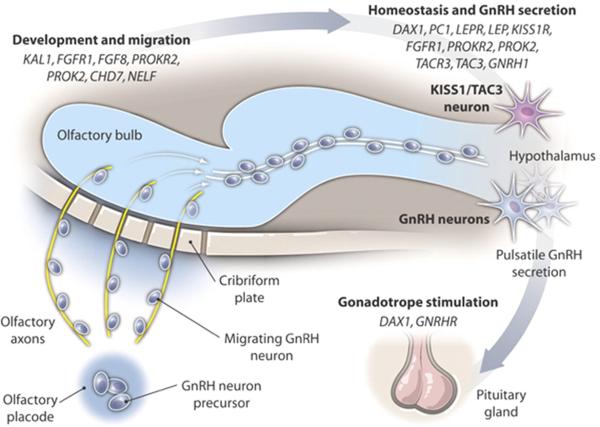
Specific gene mutations in patients with GnRH deficiency result in failure in GnRH development and migration (KAL1, Kallmann syndrome 1 sequence, MIM: 308700; NELF, nasal embryonic LHRH factor, MIM: 608137) while other gene mutations impair hypothalamic GnRH homeostasis and GnRH secretion (DAX1, dosage-sensitive sex reversal, adrenal hypoplasia congenital critical region on the X chromosome, gene 1, MIM: 300473; PC1, prohormone convertase 1, MIM: 162150; LEPR, leptin receptor, MIM: 601007; LEP, leptin, MIM: 164160; KISS1R, KISS1 receptor, MIM: 604161; TACR3, tachykinin receptor 3, MIM: 162332; TAC3, tachykinin 3, MIM: 162330; GNRH1, gonadotropin-releasing hormone 1, MIM: 152760; GNRHR, GnRH receptor, MIM: 138850). Some gene mutations affect both migration/development as well as neuroendocrine secretion of GnRH (FGFR1, fibroblast growth factor receptor 1, MIM: 136350; FGF8, fibroblast growth factor 8, MIM: 600483; PROKR2, prokineticin receptor 2, MIM: 607123; PROK2, prokineticin 2, MIM: 607002; CHD7, chromodomain helicase DNA binding protein 7, MIM: 608765).
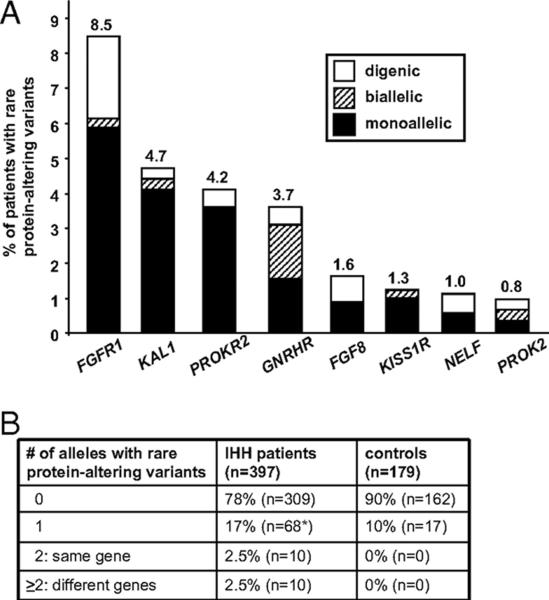
(A) Frequency of monoallelic, biallelic, and digenic rare protein-altering variants in 8 genes known to cause isolated GnRH deficiency (B) Number of alleles with rare protein-altering variants in isolated GnRH deficient patients (IHH subjects) and healthy controls.
References
-
- Altmann F. Uber Eunuchoidismus. Virchows Arch [Pathol Anat] 1930;276:455.
-
- Andersson AM, Toppari J, et al. Longitudinal reproductive hormone profiles in infants: peak of inhibin B levels in infant boys exceeds levels in adult men. J Clin Endocrinol Metab. 1998;83(2):675–681. - PubMed
-
- Badano JL, Kim JC, et al. Heterozygous mutations in BBS1, BBS2 and BBS6 have a potential epistatic effect on Bardet-Biedl patients with two mutations at a second BBS locus. Hum Mol Genet. 2003;12(14):1651–1659. - PubMed
-
- Beranova M, Oliveira LM, et al. Prevalence, phenotypic spectrum, and modes of inheritance of gonadotropin-releasing hormone receptor mutations in idiopathic hypogonadotropic hypogonadism. J Clin Endocrinol Metab. 2001;86(4):1580–1588. - PubMed
-
- Bhagavath B, Xu N, et al. KAL1 mutations are not a common cause of idiopathic hypogonadotrophic hypogonadism in humans. Mol Hum Reprod. 2007;13(3):165–170. - PubMed
Publication types
MeSH terms
Substances
Grants and funding
LinkOut - more resources
Full Text Sources
