


Behavior therapy for pediatric trichotillomania: a randomized controlled trial
- PMID: 21784296
- PMCID: PMC3143367
- DOI: 10.1016/j.jaac.2011.05.009
Behavior therapy for pediatric trichotillomania: a randomized controlled trial
Abstract
Objective: To examine the efficacy and durability of a behavioral therapy (BT) protocol for pediatric TTM compared with a minimal attention control (MAC) condition. It was hypothesized that the BT condition would be superior to MAC at the end of acute treatment, and would also demonstrate durability of gains through the maintenance treatment phase.
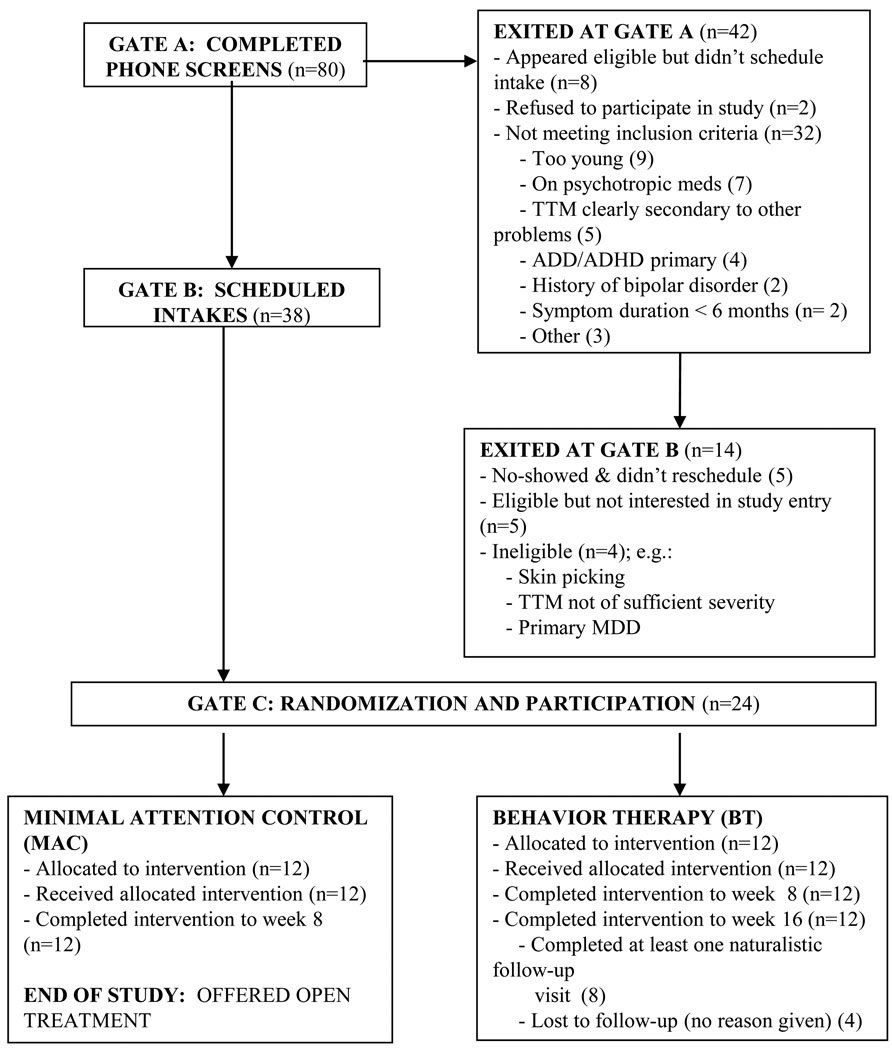
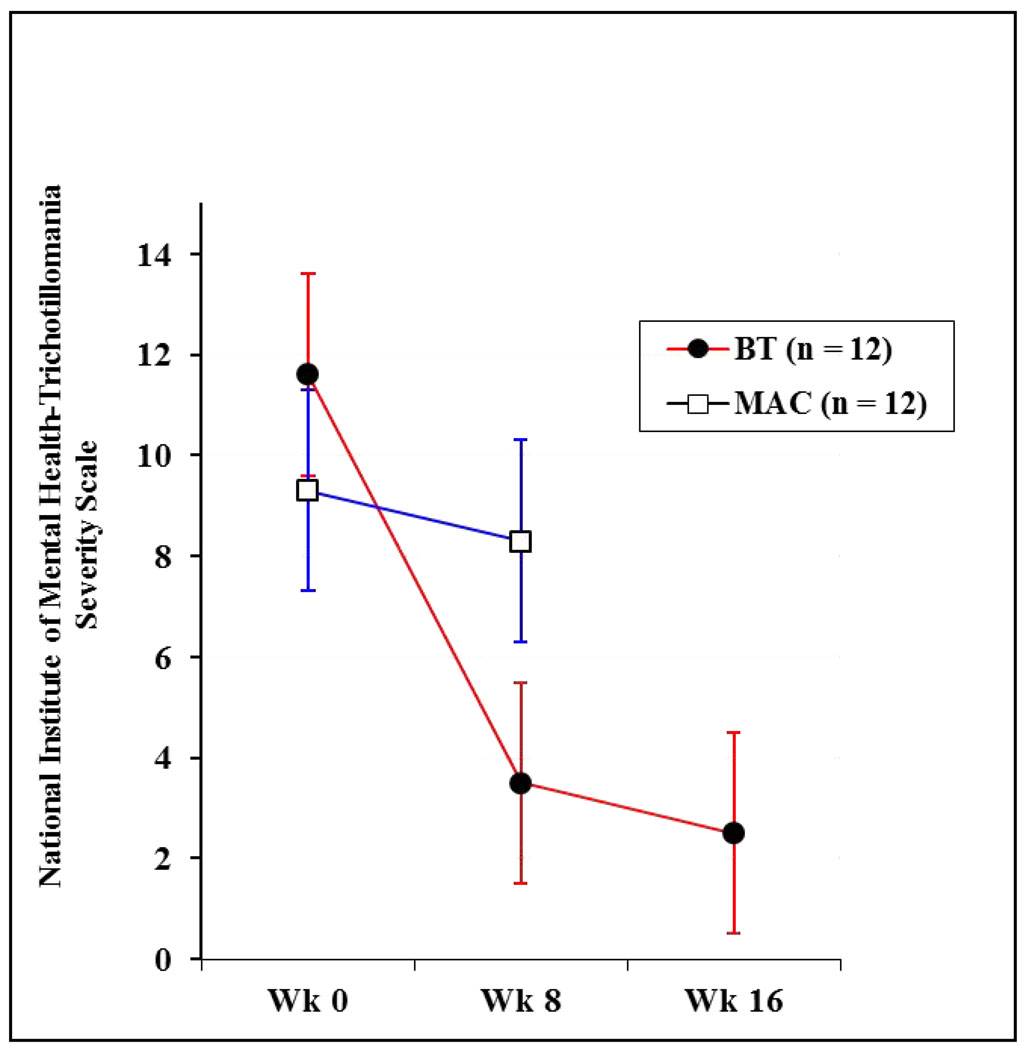
Method: A randomized controlled trial in which 24 youths were assigned to either a pilot-tested BT protocol, consisting of eight weekly sessions, or to MAC, consisting of three sessions and five telephone calls over 8 weeks. Independent evaluators assessed outcome at pretreatment (week 0) and post-treatment (week 8) for BT and MAC, and again at week 16 for BT patients only. The primary outcome measure was the National Institute of Mental Health Trichotillomania Severity Scale (NIMH-TSS).
Results: For the BT condition, the week 8 mean NIMH-TSS score was significantly lower than that of the MAC condition. The BT condition's mean week 8 score was also significantly lower than their own mean week 0 score, whereas no such reductions were observed for the MAC condition. Upon completion of acute treatment at week 8, the BT group's gains were maintained through an 8-week maintenance treatment phase.
Conclusions: BT produced a superior outcome compared with a condition that controlled for participation in a pediatric TTM research study, nonspecific therapist contact effects, repeated assessments, and the passage of time. Maintenance of gains after acute BT provides preliminary support for the durability of treatment gains.
Clinical trial registration information: Cognitive Behavioral Treatment of Pediatric Trichotillomania; http://www.clinicaltrials.gov; R21 MH 61457.
Trial registration: ClinicalTrials.gov NCT00043563.
Copyright © 2011 American Academy of Child and Adolescent Psychiatry. Published by Elsevier Inc. All rights reserved.
Conflict of interest statement
Disclosure: Drs. Franklin, Ledley, and Cahill, and Ms. Edson report no biomedical financial interests or potential conflicts of interest.
Figures
Comment in
-
Trichotillomania: awareness and advances.J Am Acad Child Adolesc Psychiatry. 2011 Aug;50(8):747-8. doi: 10.1016/j.jaac.2011.05.008. J Am Acad Child Adolesc Psychiatry. 2011. PMID: 21784294 No abstract available.
References
-
- American Psychiatric Association. Diagnostic and statistical manual of mental disorders, Fourth edition Text Revision. Washington, DC: American Psychiatric Association; 2000.
-
- Christenson GA, Pyle RL, Mitchell JE. Estimated lifetime prevalence of trichotillomania in college students. J Clin Psychol. 1991;52:415–417. - PubMed
-
- Woods DW, Flessner CA, Franklin ME, et al. The trichotillomania impact project (TIP): Exploring phenomenology, functional impairment, and treatment utilization. J Clin Psychiat. 2006;67(12):1877–1888. - PubMed
-
- Stein DJ, Christenson GA, Hollander E. Trichotillomania. Washington, DC: American Psychiatric Press; 1991.
-
- Mansueto CS, Townsley-Stemberger RM, McCombs-Thomas A, Goldfinger-Golomb R. Trichotillomania: A comprehensive behavioral model. Clin Psych Rev. 1991;17:567–577. - PubMed
Publication types
MeSH terms
Associated data
Grants and funding
LinkOut - more resources
Full Text Sources
Medical
