


Volumetric and visual rating of magnetic resonance imaging scans in the diagnosis of amnestic mild cognitive impairment and Alzheimer's disease
- PMID: 21784342
- PMCID: PMC3145968
- DOI: 10.1016/j.jalz.2010.07.002
Volumetric and visual rating of magnetic resonance imaging scans in the diagnosis of amnestic mild cognitive impairment and Alzheimer's disease
Abstract
Background: In the diagnosis of Alzheimer's disease (AD), structural magnetic resonance imaging (MRI) scans have been used primarily to exclude non-Alzheimer's causes of dementia. However, the pattern and the extent of medial temporal atrophy on structural MRI scans, which correlate strongly with the pathological severity of AD, can be used to support the diagnosis of a degenerative dementia, especially AD, even in its early predementia stage.
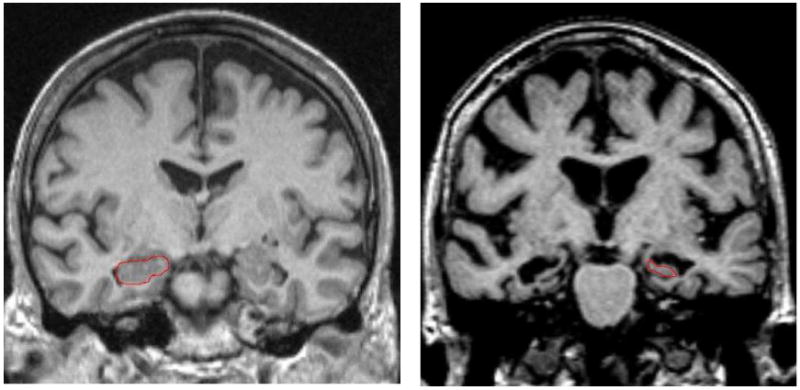
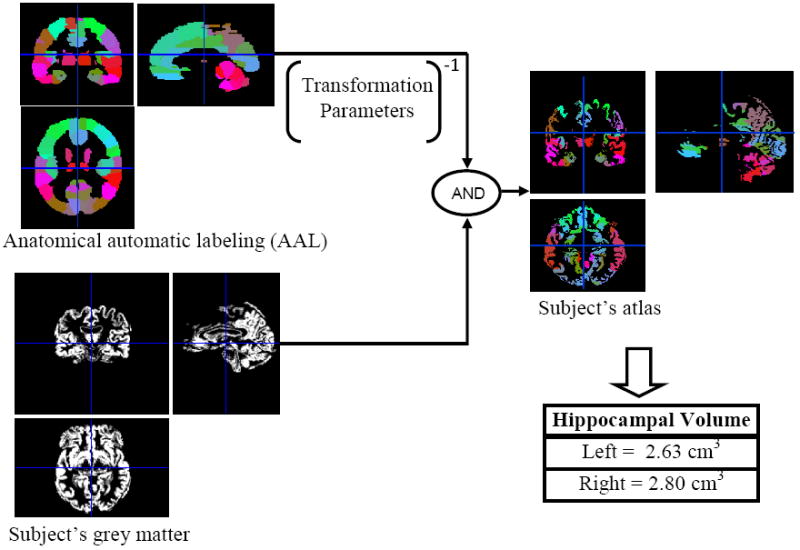
Methods: Elderly subjects (n = 224) were diagnosed with either no cognitive impairment (NCI), amnestic mild cognitive impairment (aMCI), or AD. Hippocampal and hemispheric gray matter volumes were measured on structural MRI scans, and a new visual rating system was used to score the severity of medial temporal atrophy (VRS-MTA) of the hippocampus (HPC), entorhinal cortex, and perirhinal cortex on a coronal image intersecting the mammillary bodies.
Results: Although both VRS-MTA scores and HPC volumes distinguished between subjects with NCI, aMCI, and AD, subjects with aMCI and NCI could be better distinguished using right VRS-MTA scores, in comparison with right HPC volumes. VRS-MTA scores were more highly correlated with episodic memory and Clinical Dementia Rating scores. A combination of left sided VRS-MTA scores and left sided hippocampal volume was the most predictive measure of diagnostic classification.
Conclusion: VRS-MTA is a clinically convenient method or distinguishing aMCI or AD from NCI. As compared with volumetric measures, it provides better discriminatory power and correlates more strongly with memory and functional scores.
Copyright © 2011 The Alzheimer's Association. Published by Elsevier Inc. All rights reserved.
Conflict of interest statement
Disclosure: The authors report no conflicts of interest.
Figures
References
-
- Bowen J, Teri L, Kukull W, McCormick W, McCurry SM, Larson EB. Progression to dementia in patients with isolated memory loss. Lancet. 1997;349:763–5. - PubMed
-
- Tabert MH, Albert SM, Borukhova-Milov L, Camacho Y, Pelton G, Liu X, et al. Functional Deficits in Patients with Mild Cognitive Impairment: Prediction of Alzheimer's Disease. Neurology. 2002;58:758–64. - PubMed
-
- Snowdon DA, Greiner LH, Mortimer JA, Riley KP, Greiner PA, Markesbery WR. Brain infarction and the clinical expression of Alzheimer disease. The Nun Study. JAMA. 1997;277:813–7. - PubMed
Publication types
MeSH terms
Grants and funding
LinkOut - more resources
Full Text Sources
Medical
